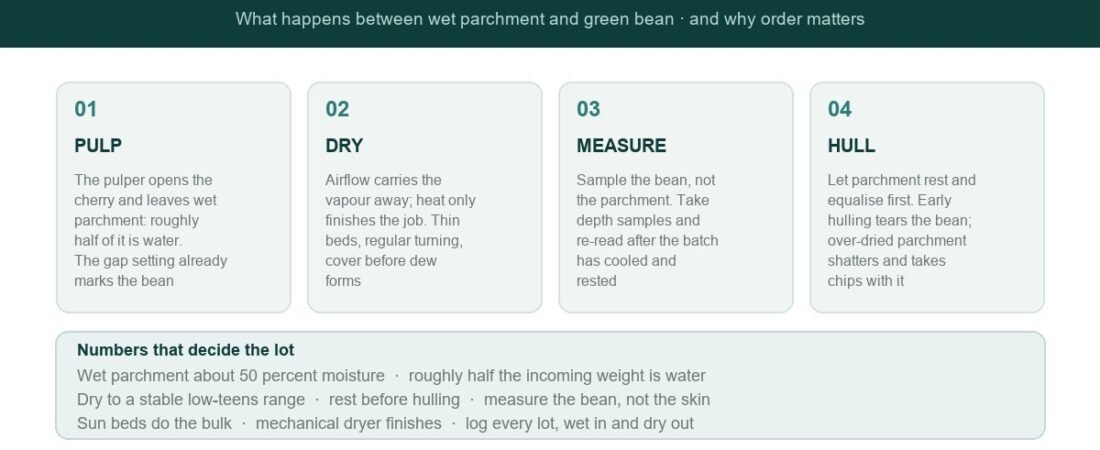
Pulping gets the coffee cherry open, but the bean that leaves the pulper is still wet parchment — heavy, fragile and not yet stable enough to store. Everything that determines its final cup character and its sale weight happens in the two stages that follow: drying and hulling.
This page covers those two stages the way we cover drying for nuts: what the water is doing, how the two drying routes compare, how to work out how much water has to leave, how to tell when a batch is ready to hull, and the mistakes that quietly downgrade a lot.
Last updated: October 2026
The short answer
- Drying comes before hulling, always. Hulling wet parchment tears the bean; parchment should be dried to a stable moisture range before the huller is opened.
- Two routes dominate: sun drying on raised beds or patios, and mechanical drying. Most wet mills use sun drying and finish with a mechanical dryer in the wet season.
- Airflow does more of the work than heat. The same principle governs coffee and macadamia: moving saturated air away from the crop is what lets water leave; heat only shortens the tail of the curve.
- Mass balance is simple arithmetic. Roughly half the weight of freshly pulped parchment is water, and most of that has to come out before the batch is stable.
- The bean, not the parchment, is what you measure. A reading taken from the outside surface of the batch will tell you the surface is dry, not the batch.
- Hulling too early and hulling too dry are both expensive. Early hulling tears and bruises; over-drying makes parchment brittle and raises broken-bean losses in the huller.
Where drying and hulling sit in the chain
Coffee has more process steps between the tree and the green bean than most nuts, and each one hands a specific condition to the next. Drying and hulling are stages four and five.
| Stage | What it does | What it hands to the next stage |
|---|---|---|
| 1. Harvest | Selective picking of ripe cherries | Ripe cherries, sorted free of green and damaged fruit |
| 2. Pulping | Removes skin and pulp in the pulper | Wet parchment with mucilage still attached |
| 3. Fermentation or mechanical demucilage | Breaks down the mucilage | Clean, wet parchment |
| 4. Drying | Removes water to a stable moisture level | Dry parchment that can be stored and hulled |
| 5. Hulling (dry milling) | Removes the dried parchment layer | Green bean ready for grading and export |
If you are still choosing the front of the chain, the pulping stage is covered in our guide to coffee fruit peeling and wet processing, and the settings that decide whether the pulper damages the bean are in coffee pulping: settings and damage control.
Two drying routes, compared
| Sun drying (beds or patios) | Mechanical drying | |
|---|---|---|
| Capital cost | Low | Higher; needs a heat source and a fan |
| Labour | High — turning and covering the batch | Low, once loaded |
| Speed | Depends entirely on weather | Predictable, independent of weather |
| Risk | Rain, condensation at night, uneven drying on the outer layer | Over-heating if the air temperature is pushed too hard |
| Best use | Dry-season lots, small and medium volumes | Finishing lots, wet-season harvests, high-volume mills |
| Typical practice | Thin layers, turned regularly, covered at night | Warm air below the temperature that would cook the bean |
In practice, the two are not competitors. Most wet mills dry the bulk of the lot on beds while the weather holds and finish the last of the water in a mechanical dryer — because the last few moisture points take the longest time to remove and are the ones the weather is least likely to deliver on schedule.
That finishing logic is identical to the one in our nut drying method: a slow primary stage does the bulk of the work, and a controlled secondary stage brings the batch to target.
How much water actually has to leave
Drying is easy to plan once it is treated as a mass balance rather than a guessing game. Water leaves; dry matter stays. The dry matter in the batch is the anchor, and it does not change while the batch sits on a bed or in a dryer.
| Wet parchment at the mill | Dry matter in the batch | Weight at a stable target | Water removed |
|---|---|---|---|
| 1,000 kg at ~50% moisture | ~500 kg | ~560 kg | ~440 kg |
| 2,000 kg at ~52% moisture | ~960 kg | ~1,080 kg | ~920 kg |
| 5,000 kg at ~52% moisture | ~2,400 kg | ~2,700 kg | ~2,300 kg |
Two things follow from the table, and both matter commercially:
- You are drying off roughly half the weight you brought in. Freight, bagging and floor space should be planned against the dry figure, not the wet one.
- The last points are the expensive ones. Removing water from 12% down to 11% takes more time and more energy per kilo than removing it from 20% down to 18%, because the remaining water is held more tightly inside the bean.
The exact starting moisture depends on the pulper setting, the variety and how long the parchment sat after pulping — which is one reason the pulper stage and the dryer stage cannot be planned independently.
What decides how fast a batch dries
Four variables, in order of influence:
- Airflow across the batch. Water has to leave the surface as vapour, and vapour has to be carried away. A bed in still air will stall no matter how warm the day is.
- Bed depth. Thin layers dry fast and evenly; thick layers dry on top and stay wet underneath. If you can only turn the batch once a day, the layer has to be thin enough to survive that.
- Turning. Turning exchanges the dry surface layer with the wet interior, which is the only way a static bed dries evenly.
- Air temperature (mechanical drying). Useful for the finishing stage, but it is a finishing tool, not a shortcut. Pushing temperature to force speed risks uneven drying and quality loss that only shows up in the cup.
The practical rule is the same one that governs every crop in this range: keep the air moving, keep the layer even, and let the batch tell you when it is done.
Measuring a batch properly
A moisture meter is the only way to make drying repeatable, and it has to be used on the bean, not on the surface of the heap.
- Take depth samples. A reading from the top of the bed describes the top of the bed. Sample from the middle and bottom of the pile as well.
- Sample the bean, not the parchment. The parchment layer dries before the bean inside it, so a skin reading flatters the batch.
- Re-check after the batch has cooled and rested. Coffee continues to redistribute moisture for a period after drying stops. A reading taken while the batch is still warm will not match the reading taken the next morning.
- Record every lot. Wet weight in, dry weight out, and the final reading. After one season you will know your own mill’s behaviour instead of guessing at it.
This is the same discipline we describe for measuring moisture in nut in shell: the instrument matters less than where the sample comes from.
Hulling: timing and condition
Hulling removes the dried parchment layer to expose the green bean. It is a mechanical operation with a short window of ideal conditions.
Too early. Parchment that still holds moisture is flexible and tough. The huller has to work harder, and the bean inside is soft enough to be scored, split or bruised. Those defects do not disappear later in the chain.
Too dry. Parchment dried well past the stable range becomes brittle. Instead of peeling away, it fractures, and broken parchment takes fragments of bean with it — broken beans and chips that reduce the graded-out percentage.
Correct condition. Parchment that has been dried to a stable range, then allowed to rest and equalise before hulling, separates cleanly and leaves the bean intact. The rest period matters as much as the reading itself.
Machine condition matters on the same scale: worn huller surfaces produce the same damage as badly conditioned parchment, so the huller belongs on the same maintenance schedule as the pulper. Our machine maintenance checklist covers the wear-part logic that applies across the range.
Mistakes that downgrade a lot
| Mistake | What it costs |
|---|---|
| Judging dryness by feel or by colour | Inconsistent lots; some bags stable, some not |
| Sampling only the surface of the bed | A batch that measures dry and goes mouldy in storage |
| Turning only once a day on a thick bed | Uneven drying; the bottom of the bed stays wet |
| Covering the bed late, after dew has formed | The batch re-wets overnight and the drying clock resets |
| Pushing dryer temperature to finish faster | Uneven drying and quality loss that shows in the cup |
| Hulling straight from the dryer | Brittle parchment and higher broken-bean losses |
| Storing green bean without stabilising first | Condensation inside the bag; mould and faded colour |
Every one of these is a measurement or timing error rather than an equipment failure — which is why the cheapest improvement in a wet mill is usually a moisture meter and a written drying log, not a bigger dryer.
What this means for equipment choice
Drying and hulling are the stages where a wet mill’s throughput is set, but they are not the stages where the machine choice is hardest. That decision sits at the front of the chain.
If you are specifying a mill, the order that avoids expensive mistakes is:
- size the pulper against your peak harvest day, because cherries will not wait;
- size drying capacity against the wet weight the pulper produces, not against the weight of the finished green bean;
- and only then size the huller against the number of lots you expect to finish per week.
For the pulping stage itself, the machine we build is covered on the coffee fruit peeling machine page, and the whole chain from cherry to green bean is mapped in our coffee processing guide. If your volume is modest, the same sizing logic we use for farm-scale processing equipment applies to coffee as well.
Frequently asked questions
What moisture should coffee be dried to before hulling?
Parchment is normally dried to a stable moisture range in the low teens before hulling, and green bean is then held in a slightly narrower band for storage and export. The exact target depends on your buyer and your climate, so the practical approach is to fix one target for the mill, write it into the drying log and hold every lot to it rather than judging each batch by eye.
How long does coffee take to dry?
There is no single answer, because drying time is set by airflow, bed depth and weather rather than by a schedule. A thin, frequently turned bed in dry, breezy weather can finish the bulk of the water quickly; the same batch under cloud, in deep layers, will take considerably longer and will usually need a mechanical dryer to finish. Plan the schedule around your wet-season worst case, not your dry-season best case.
Can I hull coffee straight out of the dryer?
It is better to let the batch rest and equalise first. Parchment coming straight out of a dryer is warm and still redistributing moisture internally, and it is more brittle than parchment that has settled overnight. Hulling after a rest period gives cleaner separation and fewer broken beans, and it makes the moisture reading you took at the end of drying mean something.
Is sun drying better than mechanical drying?
Neither is better in every case. Sun drying costs less to run but depends on weather and labour; mechanical drying is predictable but needs capital and careful temperature control. Most mills use both, drying the bulk of the lot on beds and finishing the last points mechanically, which is the combination that keeps quality consistent through a wet harvest.
Does pulping affect how the batch dries?
Yes. The pulper setting decides how much mucilage is left on the parchment and how much the bean is stressed, and both change how the batch behaves on the bed. Parchment left sticky dries more slowly and unevenly, and beans scored or bruised at pulping cannot be recovered later in the chain. That is why the pulping settings and the drying log belong in the same record.
How much weight do I lose during drying?
You are removing water, not dry matter, so the loss is roughly half the incoming weight when you start from wet parchment and finish at a stable target. The dry matter in the batch stays constant throughout. Plan bags, freight and floor space against the dried weight, and use the wet weight only to size the dryer and the beds.
Talk through your coffee line
If you are planning a wet mill — or trying to work out why last season’s lots dried unevenly — send us the crop, the volume you handle on your busiest harvest day, the drying method you use now and the stage that limits you. We will tell you which part of the chain is undersized and what to measure first.
Reach us through the enquiry form, or email nanshengtechnology@gmail.com. If you are putting a quote together, the checklist in what a nut processing machine quotation should contain applies to coffee equipment just as well.
Related reading and machines
- Coffee processing: complete guide from cherry to green bean
- Coffee fruit peeling machine: how pulping sets up everything that follows
- Coffee pulping: settings and damage control
- Coffee fruit peeling machine NS series
- Coffee fruit peeling machines category
- How to dry macadamia nuts before cracking
- Nut in shell moisture content: the target before cracking
- Small-scale processing equipment: sizing a farm-scale line
- Knowledge forum: processing guides
- how a coffee line is costed from cherry to green bean
- coffee pulper vs coffee huller: what each machine does