Macadamia drying is usually treated as a storage chore, and that is exactly backwards. Nut in shell moisture content is the setting that decides how much kernel comes out whole when you finally crack — and unlike a machine adjustment, it cannot be corrected after the fact. Most of the loss you see at the cracker was created days earlier, in the drying shed. This guide gives you the target numbers, the two-stage schedule, and the measurement method that makes the target real rather than theoretical.
Last updated: 23 September 2026
The short answer
Dry nut in shell to 1.5% moisture before cracking. Get there in two stages: fan-forced air down to below 10% within the first days after harvest, then silos or dehumidifiers for the slow secondary dry down to below 3%, with 1.5% as the target. Dehusk within 24 hours of harvest and never beyond 48, because the green husk puts moisture back into the kernel. Measure with a calibrated moisture meter or the oven method, and sample the kernel rather than judging by feel. Everything else in the drying shed is detail; those four numbers are the ones that decide your whole-kernel rate.
Why the moisture number decides your margin
Whole-kernel rate is the share of kernel, by weight, that survives cracking completely intact, and moisture is the single largest lever you control over it. At the right moisture the kernel shrinks away from the shell wall and releases cleanly when the shell opens; get it wrong in either direction and the same machine that produced whole kernels yesterday starts producing pieces today. The arithmetic is blunt. Take five tonnes of nut in shell per day at 28% kernel recovery: that is roughly 1,400 kg of kernel per day. Lose five percentage points of whole-kernel rate and you lose about 70 kg per day, or 4.2 tonnes across a 60-day season. That loss is decided before the nuts reach the cracker, and no downstream sorter can undo it.
The two-stage drying schedule
| Stage | Method | Target | Why this stage exists |
|---|---|---|---|
| Harvest to dehusking | None | Dehusk within 24 h of harvest, never beyond 48 h | The wet green husk is biologically active and pushes moisture back through the shell into the kernel |
| Stage 1 — primary drying | Fan-forced ambient or gently warmed air | Bring nut in shell below 10% | Removes the bulk of the water quickly, before mould and rancidity can start |
| Stage 2 — secondary drying | Silos, bins or dehumidified rooms | Below 3%, targeting 1.5% | Slows the process down so the kernel shrinks evenly instead of case-hardening on the surface |
| Pre-cracking check | Calibrated meter or oven test | Confirm 1.5% before the batch runs | A batch that reads dry on the outside can still be wet at the kernel |
How to measure nut in shell moisture properly
Nut in shell moisture content is the percentage of water by weight remaining in the whole nut — shell and kernel together — after harvest and drying. Measuring it correctly is the difference between drying to a target and drying to a feeling. There are two acceptable methods, and most processors should use both. A calibrated handheld moisture meter gives you an instant reading you can take dozens of times a day across different bins, which is what you need to catch a wet pocket before it spreads. The oven method — weighing a sample, drying it fully, and weighing again — is slower and far more accurate, and it is the way to check that your handheld meter is telling the truth. Recalibrate the meter against an oven test at least once a season. Sample from inside the bin, not from the surface, and take several samples per batch because moisture stratifies.
What happens if you get it wrong
The failures run in opposite directions, and both cost you kernel. Under-dried nuts are the more common error because the outside of a nut dries long before the kernel does, so a batch can feel and look ready while the kernel is still holding water. Over-dried nuts are the second error, usually caused by pushing drying too hard to catch up on a backlog.
- Too wet (above about 3%) — the kernel adheres to the shell wall and tears instead of releasing. You get torn kernel and shell fragments stuck to the kernel surface.
- Too dry (well below 1.5%) — the kernel turns brittle and shatters under the same force that would have opened it cleanly, so whole kernels split into halves.
- Case-hardened (dried too fast) — the outer kernel layer seals while the centre stays wet. The nut reads dry on a surface test and behaves wet at the cracker.
- Mould and rancidity — nut in shell held above 10% for days in warm conditions develops mould, and free fatty acid levels rise. This is a food safety problem, not just a quality problem.
What actually moves the drying curve
Four variables do the work, and they are all cheap to control. Airflow matters more than heat: drying is the removal of water from the kernel to the air passing over it, so a big volume of ambient air beats a small volume of hot air. Temperature should stay gentle — drying air for in shell macadamia is commonly kept below roughly 40 °C to protect kernel oil quality, and pushing hotter will damage the oil before it speeds anything up you care about. Bed depth is the variable people most often get wrong, because a deep pile means the air finds channels and leaves wet pockets behind, so turn or mix the batch and keep the bed shallow enough for air to pass evenly. Relative humidity sets the floor: in a humid climate ambient air can only pull moisture down so far, which is exactly why the secondary stage needs dehumidified air or a sealed silo rather than more fan.
Storage after drying: why 1.5% buys you time
Nuts held in shell at 1.5% moisture keep far better than cracked kernel, which is why many processors dry in bulk and crack to order rather than cracking everything at harvest. In shell at that moisture, in a cool dry store and off the floor, nuts hold their quality for months; cracked kernel, with its oil exposed to air, deteriorates far faster however well it was dried. Two practical rules do most of the work. Keep the store dry and ventilated, because a sealed shed in a humid climate will let the nuts pull moisture back out of the air. And keep cracked and uncracked product apart, because kernel absorbs odours and moisture quickly and a single wet batch in the same room can undo a season of careful drying. If you are holding nuts for more than a few weeks, re-check moisture before cracking rather than assuming the reading from harvest still applies.
Check the machine only after the moisture is right
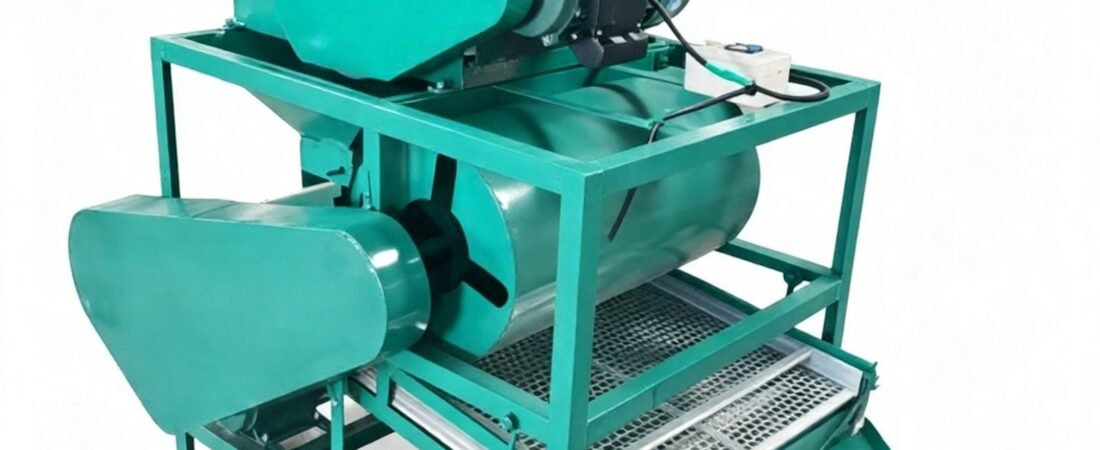
If your crack-out is poor, the drying shed is the first place to look and the machine is the second. Once a batch is genuinely at 1.5%, the two adjustments that matter on the machine are the opening angle, which controls how the nut is held while force is applied, and the opening diameter, which must match the size grade you are running. The NS-X322 industrial cracking machine adjusts both, which matters here because a change in moisture changes how the shell behaves and how the tool should meet it. For volume work where the kernel goes on to further processing rather than retail display, the NS-X221 sheller cracks hard shells and extracts kernel in a single pass. If your breakage starts before drying even begins, read how to improve macadamia kernel recovery for the harvest and dehusking side of the same problem.
Five drying mistakes that cost whole kernels
- Judging moisture by feel or by the sound of the nut rather than by a calibrated reading.
- Sampling only the surface of the bin, where nuts are always drier than the middle.
- Pushing the temperature up to catch up on a backlog, which damages oil quality without fixing the moisture gradient.
- Treating the secondary stage as optional because the nuts already read below 10%.
- Cracking straight out of storage without re-testing, after weeks in humid air.
Drying in a wet climate versus a dry one
The target is the same everywhere — 1.5% nut in shell before cracking — but how you get there depends on the air you have. In a dry harvest climate, stage one does most of the work on its own and the secondary stage is mainly about slowing the last few percent down so the kernel does not case-harden. In a humid climate, ambient air reaches equilibrium with the nuts long before they are dry enough, so no amount of extra fan time will finish the job. That is the point where the secondary stage stops being a silo and becomes dehumidified air or a sealed store.
| What you are seeing | What to do about it | Why it works |
|---|---|---|
| Relative humidity stays high through the day and the batch stalls above 10% | Move the secondary stage to dehumidified air or a sealed silo instead of running fans longer | Air that is already close to saturation cannot take up more water, so more airflow only moves the same wet air around |
| Cool, damp nights after warm days | Stop the fans overnight and restart in the warmest part of the day | Running ambient air at night when humidity is at its highest can put moisture back into the batch |
| Wet weather blocks the first stage for days | Prioritise dehusking discipline and mould control, then return to the schedule as soon as airflow is worth running | The immediate risk in a wet spell is mould and rising free fatty acid, not the drying rate you lost |
| Nuts have been in store for weeks before cracking | Re-test moisture before the cracking run rather than trusting the harvest reading | In shell nuts in a humid store pull moisture back out of the air, and the reading from harvest no longer applies |
Whichever climate you are in, the sequence does not change: dehusk fast, dry in two stages, measure at the kernel, and only then adjust the machine.
Frequently asked questions
What moisture content should macadamia be before cracking?
Target 1.5% nut in shell moisture. Below about 3% is workable, but the closer you run to 1.5%, the better both the crack-out and the storage life become. Sample the kernel, not the shell, and re-test before cracking a batch that has been in storage.
How long does macadamia take to dry?
It depends on airflow, bed depth, humidity and how much water the batch is carrying, so treat any single figure with suspicion. What is predictable is the shape: the bulk of the water comes off fast in the first stage with fan-forced air, and the last few percent take disproportionately longer because drying rate slows as moisture falls. That is why the secondary stage uses sealed silos or dehumidified air rather than simply running the fan longer.
Can I dry macadamia at high temperature to save time?
No. Drying air for in shell macadamia is commonly kept below roughly 40 °C because higher temperatures damage kernel oil quality, and they do not fix the thing that is actually slowing you down, which is an uneven moisture gradient through the bed. More airflow at a gentle temperature beats less airflow at a high one.
How do I know if my moisture meter is accurate?
Check it against the oven method — weigh a sample, dry it completely, weigh again — at least once a season, and ideally more often. A handheld meter that has drifted by two percentage points will have you cracking at 3.5% while believing you are at 1.5%, which is precisely the condition that produces torn kernel.
Should I store macadamia in shell or crack it straight away?
Store in shell at 1.5% and crack to order where your operation allows it. In shell at that moisture, in a cool dry store, nuts hold quality for months, while cracked kernel with its oil exposed deteriorates far faster. Re-check moisture before any cracking run that follows a long storage period.
Tell us your harvest volume, moisture readings and size grade, and we will help you work out where the loss is coming from and which cracker settings suit your batch — or get a quote for a macadamia cracking line sized to your throughput.
Related reading and machines
- How to improve macadamia kernel recovery
- How to choose a macadamia cracking machine
- Macadamia opening machines (cracking)
- Macadamia shelling machines
- Shelling vs Opening Machines: Which One Do You Need?
- Storing dried macadamia: humidity, temperature and shelf life
- 5 cracking mistakes that break kernels
Related reading: Green husk peeling: timing, loss rates and settings. Also see Whole kernel rate: how to measure it and what actually improves it. For how these stages fit into a working line, see Macadamia processing line layout: harvest to packed kernel.