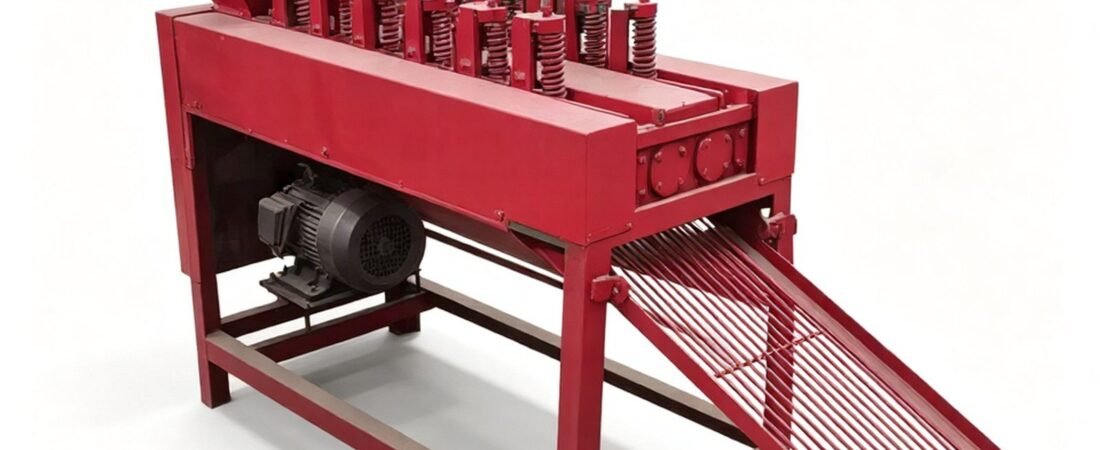
Green husk peeling is the cheapest place in the whole macadamia line to lose money, because almost nothing that goes wrong here is visible at the point it happens. A dehusker set too tight bruises shell that only shows up as torn kernel three weeks later at the cracker, and a batch that sits in husk overnight loses kernel quality that no dryer setting can bring back. This guide is built around the three numbers that actually decide whether your dehusker is earning money: hours from harvest to husking, the percentage of kernel that leaves the machine inside the husk stream, and the percentage of shell you dent getting the husk off.
Last updated: 14 September 2026
The short answer
- Husk within 24 hours of harvest, and never past 48 hours. In a heap above roughly 25 °C the nut in husk is still respiring, and the husk layer moves moisture back into the kernel the whole time it is attached.
- Green husk is roughly 40–50% of the weight of the nut in husk as it comes off the tree, so a dehusker is handling the larger half of your intake, not a trim-off.
- Set the machine to split the husk, not to crush the shell. The working method is a wide first pass that opens the husk along its seam, then a second pass that strips it — not one tight pass.
- Keep husk-stream loss under 1% and dented shell under 5% of the batch. Both are measurable in about thirty minutes on your own floor, and both are the reason a dehusker pays or bleeds.
- Feed evenly at 70–80% of the machine’s rated capacity. Rated figures assume a steady, single-layer feed; feeding in surges is the most common cause of shell damage.
What green husk peeling actually is
Green husk peeling — also written dehusking or husking — is the mechanical removal of the leathery outer husk from macadamia nuts immediately after harvest, before drying and before cracking. The husk is the green-to-brown outer layer that splits open along its seam while the nut is still on the tree; the hard brown shell underneath is what a cracker opens weeks later. In most commercial operations the dehusker sits at the head of the line, directly after the collection point, and everything downstream inherits the condition of what it discharges.
That position is what makes it so consequential. A dehusker cannot improve a nut, but it can damage one in ways that are expensive and permanent:
- Bruised or dented shell. The shell grips the kernel as the nut dries. A dent in the shell becomes a stress point that concentrates force at the cracker, so shell damage at the dehusker converts almost directly into broken kernel weeks later.
- Husk left attached. Any husk fragment still stuck to the shell carries water into the drying bin, which delays the batch and creates the uneven moisture gradient that ruins whole-kernel rate.
- Kernel sent to the husk heap. Every whole nut that leaves with the husk stream is lost product, and in most plants nobody weighs it.
Why the 24-hour window decides kernel quality
| Time from harvest to husking | What is happening in the heap | Practical effect |
|---|---|---|
| Under 8 hours | Husk still turgid, seam still open | Cleanest split, lowest shell damage, best kernel colour |
| 8–24 hours | Respiration continues, heap warms from the inside | Still acceptable; becoming the practical cut-off in warm climates |
| 24–48 hours | Heat builds, husk starts to ferment against the shell | Kernel discolouration and off-flavour begin; mould risk rises sharply |
| Beyond 48 hours | Active mould growth, oil degrading in the kernel | Reject-grade batches, free fatty acid levels climb, whole-kernel rate falls |
The mechanism is simple and worth stating plainly, because it explains why this is a timing problem rather than a machine problem. A freshly harvested nut in husk is alive: the husk respires, generates heat, and holds water against the shell. Because the shell is porous, that water keeps moving inward toward the kernel, so a nut left in husk is effectively being re-wetted even while it looks fine from the outside. Once the heap is warm, the same conditions that favour the nut also favour mould, and macadamia kernel oil starts to break down into free fatty acids — the measurement buyers use to judge how the crop was handled.
The practical instruction that comes out of this is uncomfortable for any operation that husks in batches: the dehusker capacity you need is set by your peak collection day, not by your season average. If your biggest harvest day delivers 6 tonnes, a machine sized on the season average will either run late into the second day or run overfed, and both of those outcomes cost more than the larger machine would have.
> “We treat the husker as a quality machine, not a capacity machine. The questions we ask a new customer are how many hours pass between collection and husking on their busiest day, and whether they can weigh their husk discharge — because those two answers predict their whole-kernel rate more reliably than any spec sheet.” — Nansheng Technology engineering team
The loss-rate arithmetic that justifies the whole machine
Husk-stream loss is the share of saleable nut that exits the dehusker with the husk instead of going into the drying bins. Run the numbers on a modest line and the case for taking it seriously becomes obvious.
Take 5,000 kg of nut in husk per day. At roughly 45% husk, that is about 2,750 kg of nut in shell entering the dryer and about 2,250 kg of husk leaving the machine. At a 30% kernel recovery from nut in shell, the day’s crop is around 825 kg of kernel.
Now suppose the dehusker is losing 2% instead of 1% into the husk stream: 50 kg of nut in husk per day, which is about 27.5 kg of nut in shell, which is about 8 kg of kernel per day. Over a 60-day season that is roughly 495 kg of kernel — nearly half a tonne — recovered by a setting change that costs nothing to make. In most plants that number never appears in any report, because the husk stream is treated as waste and never weighed.
There is a second, quieter cost. Husk returned to the field partly because it still contains whole nuts means those nuts are re-collected later, by which time they have spent days in the open. The loss is not just the weight; it is the quality of whatever comes back.
Settings that decide your loss rate
| Setting | What it changes | Where to start | Warning sign |
|---|---|---|---|
| Drum-to-concave clearance | How aggressively the nut is gripped and pulled past the husk | Wide enough that whole nuts fall through unharmed | Shell dents, or whole nuts with the husk peeled back but still attached |
| Drum speed | Dwell time in the husking zone | Manufacturer’s rated speed; do not raise it to chase throughput | Increasing kernel in the husk stream as speed rises |
| Feed rate | Whether the drum sees a single layer or a crowd | 70–80% of rated capacity | Rate falls when you feed at nameplate; noise and shell damage |
| Feed evenness | Peak load on the drum | Continuous, thin, steady — never in surges | Bumps of two or three nuts thickness moving through at once |
| Husk condition | How cleanly the husk separates | Husking while the husk is still fresh and turgid | Husking off the tree too early (husk not yet split) or too late (husk tough and stuck) |
| Second pass | Recovers under-peeled nuts | Standard practice, not an exception | Treating the second pass as a rework step rather than part of the process |
The single most useful rule of thumb is the one that decides clearance: an opening wide enough to split the husk without squeezing the shell is always better than one tight enough to guarantee the husk comes off. A slightly under-peeled nut costs you one second pass. A dented shell costs you kernel three weeks later, at a stage where you can no longer do anything about it. When you are adjusting between two clearances, take the wider one and check the husk stream.
Run the two-pass method, not one tight pass
The reason a single tight pass fails is mechanical. The husk has to be torn along its seam before it will release, and the seam is a weak line that opens under tension. A tight clearance does not open the seam; it compresses the whole nut, and the shell — which is thinner and more brittle than the husk — gives way first.
The two-pass method avoids that by doing the work in order:
- First pass, wide clearance. The nut is rolled and squeezed just enough that the husk splits along its seam and shells start to separate. Nothing is meant to be fully husked at this point.
- Second pass, working clearance. Now that the husk has an opening, a normal setting strips it off cleanly, because the husk no longer has to be torn — it only has to be pulled.
How to measure your husk loss in thirty minutes
You do not need a laboratory to make this a managed number. What you need is a scale, a sample and a habit.
- Sample the husk stream, not the bin. While the machine is running at normal feed, take a representative 10 kg from the husk discharge, spread across several minutes rather than a single grab.
- Hand-search the sample. Pick out every nut in shell and every loose kernel. Weigh them separately.
- Calculate the loss percentage. Recovered weight divided by sample weight, times 100. Anything above 1% is a clearance or feed problem, not a husk-quality problem.
- Recheck after every clearance change. One number before and one number after is how you prove an adjustment helped, rather than assuming it did.
- Do the same for shell damage. Take a 200-nut sample from the discharge, count nuts with visible dents or cracked shell, and record the percentage. Under 5% is a reasonable working target; if it is climbing, your clearance is too tight regardless of what the husk stream says.
Record both numbers once a week through the season. Two columns on one sheet will tell you more about your dehusker and your operators than any visual inspection, because they catch drift before it becomes a season-long loss.
Matching the dehusker to your tonnage
Sizing the machine is where the 24-hour rule and the throughput figure have to be solved together. Pick from season average and you will be overfeeding on peak days, which is exactly the condition that damages shell.
| Model | Rated capacity | Dimensions (L×W×H) | Power | Weight | Typical fit |
|---|---|---|---|---|---|
| NS-X121 Fruit & Nut Peeler | ~150 kg/h | 1050 × 400 × 750 mm | 2.2 kW / 220 / 380 V | ~126 kg | Smallholdings and trials; under ~1 t of nut in husk per day |
| NS-X122 Fruit & Nut Peeler | ~500 kg/h | 820 × 580 × 1000 mm | 4 kW / 380 V | ~130 kg | Small to medium plants husking 2–3 t per day in one shift |
| NS-X123 Fruit & Nut Peeler | 300 kg/h | 1050 × 400 × 1400 mm | 3 kW / 220 / 380 V | ~160 kg | Medium plants wanting a taller feed height and pit separation |
| NS-X124 Fruit & Nut Peeler | 1,000 kg/h | 2350 × 630 × 1130 mm | 3 kW / 380 V | ~280 kg | Industrial intake; 5–8 t per day across one or two shifts |
The rated figure is the ceiling, not the working point. A 1,000 kg/h machine run at 70–80% feed does roughly 700–800 kg/h of clean work, so an eight-hour shift handles about 5.6–6.4 tonnes of nut in husk with a margin for surges. That is the number to plan against, and it is the number that keeps you inside the 24-hour window on your busiest day of the season.
All four models share an integrated pit-separation design, so husked nuts and husk leave the machine on separate paths and the second pass feeds straight back in. If you are unsure which size fits your peak day, give us your daily intake in nut in husk and your shift pattern and we will work it out from there.
Five dehusking mistakes that cost kernel
- Husking before the husk has split. Immature nuts husk badly, the shell takes the force instead of the seam, and the kernel is not ready to dry evenly anyway.
- Leaving the crop in bags or in a heap in the sun. Bags hold heat exactly where you do not want it. Keep depth shallow, in shade, and get to the machine.
- Closing the clearance until the husk comes off in one pass. This is the classic trade: a clean-looking husk stream bought with dented shell that tears kernel at the cracker.
- Overfeeding to catch up after a late start. Rate rises and quality falls together. A second shift on a correctly fed machine beats a rushed single shift.
- Treating the second pass as rework. Nuts that come through under-peeled are a normal output of a correctly set machine, not a fault, and they should be fed straight back rather than set aside.
Where dehusking sits in the rest of the line
Dehusking is the first quality decision in the chain, not the only one, and the settings downstream assume you got it right. Two steps matter most once the husk is off.
The first is drying. A dented or partly husked batch carries more water per nut and dries unevenly, which is the mechanism behind most broken kernel at the cracker — the moisture target and two-stage drying schedule are covered here. The second is cracking, where shell condition becomes force: the seven specs that decide how a cracker handles your batch are covered here. If you are still deciding how much whole kernel you are actually losing, start with how to improve macadamia kernel recovery, which puts harvest, dehusking and cracking losses on the same sheet.
Frequently asked questions
How soon after harvest should macadamia be dehusked?
Within 24 hours, and never beyond 48 hours. The husk continues to respire after harvest and holds water against the porous shell, so a nut left in husk is being slowly re-wetted and the heap is warming from the inside at the same time. In warm conditions the practical window is tighter still. If your peak harvest day is larger than your dehusker can process in one shift, that is a capacity problem to solve before the season starts, not a reason to delay husking.
What percentage of a macadamia nut is green husk?
Roughly 40–50% of the weight of the nut as harvested. The exact share varies with variety, growing conditions and how mature the crop is, but the planning figure most operations use is about 45%. That matters for sizing: a dehusker handling 5 tonnes of nut in husk per day is discharging close to 2.25 tonnes of husk, so the husk handling and removal side of the line needs the same attention as the machine itself.
Can you dehusk macadamia without a machine?
For very small volumes, yes — husk that has already split can be removed by hand, and some growers do it for samples and trials. At any commercial volume it stops being practical for two reasons. Hand dehusking is far too slow to meet a 24-hour window on a real harvest, and it grips the nut unevenly, which dents shell in exactly the way a badly set machine does. A small machine such as the NS-X121 at ~150 kg/h covers trial volumes and smallholder intakes with no hand work at all.
What size dehusker do I need for 5 tonnes a day?
Plan on 70–80% of rated capacity rather than the nameplate figure, so 5 tonnes per day in an eight-hour shift needs a machine rated around 800–1,000 kg/h — the NS-X124 class. If your intake is concentrated into a few peak days rather than spread across the season, size against the peak day, not the average. The cost of the larger machine is almost always smaller than the value of the kernel lost to rushed, overfed husking.
Does green husk peeling affect whole kernel rate?
Yes, and mostly through the shell rather than the kernel. The dehusker rarely breaks a kernel directly; what it does is dent and bruise shell that later grips the drying kernel, so the damage lands at the cracker where a weakened shell tears kernel apart. That is why shell damage is the number to watch at the dehusker, and why taking the wider clearance and running a second pass is the cheaper choice in the long run.
Send us your daily intake in nut in husk, your shift pattern and your current husk-loss reading, and we will tell you whether the loss is a setting, a sizing problem or a harvest-timing problem — or request a quote for a macadamia green husk peeler sized to your peak day.
Related reading and machines
- How to improve macadamia kernel recovery
- How to choose a macadamia cracking machine
- Nut in shell moisture content: the 1.5% target
- Macadamia green husk peelers
- Macadamia green husk peeler — industrial model NS-X124
- Shelling vs Opening Machines: Which One Do You Need?
- Coffee fruit peeling: how pulping sets up everything after it
- Shells and husks as by-product revenue
- Small-scale nut processing: choosing a farm-scale line
Related reading: Whole kernel rate: how to measure it and what actually improves it. For how dehusking sits inside a full line, see Macadamia processing line layout: harvest to packed kernel.