Macadamia is the most expensive nut per kilo to grow — and one of the easiest to lose money on after harvest. The price gap between whole kernels and broken pieces is wide, so a couple of percentage points of extra breakage can take out most of a season’s margin.
Two numbers decide whether a processing line pays: kernel recovery — how much saleable kernel you get from each tonne of nut-in-shell — and the whole-kernel percentage — how much of that kernel arrives unbroken. Neither is decided by the cracking machine alone. Most of the loss happens in the 48 hours before the nuts ever reach it.
This guide covers the four steps that decide both numbers, with the targets and settings we use when sizing macadamia processing lines.
Last updated: 18 September 2026
The short version
- Dehusk within 24 hours of harvest, never beyond 48.
- Dry nut-in-shell to 1.5% moisture before cracking — this is where recovery is won.
- Set opening angle and diameter to the batch, and sample-test before running it.
- Separate shell from kernel quickly, or you lose the kernels you just saved.
If you only have time to fix one thing, fix the moisture. Everything downstream behaves better when the nuts are dried correctly.
The two numbers that decide your margin
Kernel recovery is measured as the share of harvested nut-in-shell (NIS) weight that ends up as saleable kernel. Industry benchmarks sit around 27–30%; everything else is husk and shell. Whole-kernel percentage is measured after cracking, and it is where the price premium lives — a 70–80% whole rate is a realistic target for well-dried nuts on correctly set equipment.
Worth knowing before you blame the machine: kernel recovery swings with variety, orchard, season and rainfall, often by more than any equipment setting. Establish your own baseline per orchard first.
Step 1 — Dehusk within 24 hours of harvest
The green husk is wet and biologically active. Left on the nut in a pile, it heats up and pushes moisture back through the shell into the kernel.
Standard practice is to dehusk within 24 hours, and never beyond 48. The cost of delay is not cosmetic. A kernel that has taken on moisture from the husk adheres to the shell wall, tears instead of releasing, and becomes pieces the moment it is cracked.
Size the peeler to your harvest peak rather than your average: an industrial green husk peeler rated at ~1,000 kg/h keeps up with a large orchard’s daily drop, while small, medium and large units suit growers who harvest in batches.
Step 2 — Dry to 1.5% moisture before cracking
This is where most of your recovery is won or lost.
Nuts leave the orchard at up to 30% moisture. The standard two-stage approach is to bring them below 10% with fan-forced air soon after harvest, then use silos or dehumidifiers for secondary drying down below 3% — with 1.5% nut-in-shell moisture as the target that delivers both long storage life and the best crack-out.
The mechanism is simple. As the kernel dries it shrinks away from the shell wall. At the right moisture it sits loose inside the shell and releases cleanly when the shell opens. Get it wrong in either direction and you pay for it:
- Too wet — the kernel adheres to the shell and tears. You get pieces, not kernels.
- Too dry — the kernel turns brittle and shatters under the same force that would have opened it cleanly.
One practical point: 1.5% is a measured number, not a schedule. Ambient humidity and variety both move drying time, and a batch that feels dry on the outside can still be wet at the kernel. Sample every batch.
Step 3 — Set the cracker to the batch, not to the last one
Macadamia shells are hard enough that uncontrolled force simply destroys what is inside. The two common failures are opposites: not opening enough nuts, so they recirculate, get hit again and break on the second pass; and over-compressing, so kernels split under force that was never needed.
There are two things to set, and they matter more than headline tonnage:
- Opening angle — controls how the nut is held while force is applied.
- Opening diameter — must match the size grade you are actually running.
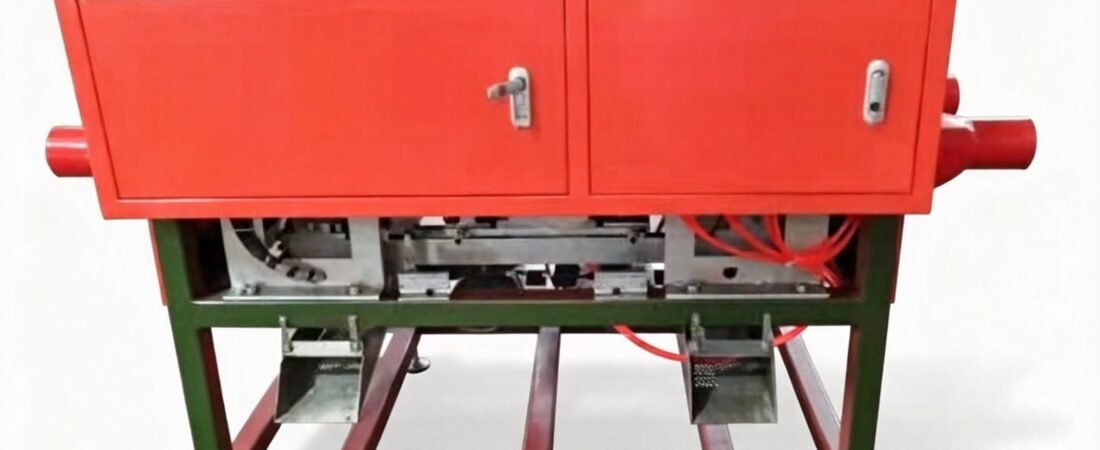
Our NS-X322 industrial opening machine is built around both adjustments, at roughly 150 kg/h — enough for a mid-size processor to crack a dried batch in a single shift without pushing the machine past its rating. For continuous lines handling macadamia or pecan at higher volume, the NS-X222 heavy-duty shelling line uses continuous automatic feeding and discharging at around 200 kg/h in a stainless-steel frame.
Whatever you run: crack a small sample, inspect the breakage, adjust, and only then run the batch. Log the setting per orchard and variety — next season’s starting point is this season’s log.
Step 4 — Separate shell from kernel quickly
Once cracked, kernel sitting in a pile of shell fragments keeps chipping every time it is moved. There are two standard separation routes, and the choice is a labour-versus-capital decision:
- Colour sorter — high capital cost, almost no labour, straightforward to automate.
- Trommel plus hand sorting on a belt — low capital cost, labour-intensive.
Neither is wrong. But the longer kernels stay in contact with shell, the more you lose to chipping, so size the separation step to keep pace with the cracker.
Diagnose your breakage: symptom, cause, adjustment
- Kernels splitting into clean halves — cracking force too high, or nuts over-dried. Reduce compression and re-check moisture against the 1.5% target.
- Kernels torn, or shell stuck to the kernel — under-dried nuts. Extend drying and sample the kernel, not the shell.
- Many uncracked nuts on the first pass — opening diameter too small for the grade. Adjust the diameter and re-grade the batch.
- Good crack-out early in the shift, worse later — mixed-moisture batches, or feed rate above rating. Re-bin by moisture and slow the feed.
- Whole-kernel rate below your orchard baseline — check the husking delay before touching the machine. Confirm dehusking happens inside 24 hours.
Matching equipment to throughput
| Process step | Model | Throughput | Notes |
|---|---|---|---|
| Dehusking | NS-X124 green husk peeler | ~1,000 kg/h | Integrated pit separation, 3 kW / 380 V |
| Dehusking | Small / medium / large peelers | Batch scale | For growers harvesting in batches |
| Cracking | NS-X322 opening machine | ~150 kg/h | Controllable opening angle, adjustable diameter, 6 kW / 380 V |
| Cracking | NS-X222 heavy-duty line | ~200 kg/h | Stainless steel, continuous feed and discharge |
For how these stages connect — including the drying buffer that sits between dehusking and cracking — see how a macadamia processing line is laid out, stage by stage.
Frequently asked questions
What moisture content should macadamia be for cracking?
Target 1.5% nut-in-shell moisture. Anything under 3% is workable, but the closer you run to 1.5%, the better both storage life and crack-out become.
How quickly must macadamia be dehusked after harvest?
Within 24 hours, and never beyond 48. After that the husk transfers moisture back into the shell, and kernel damage at cracking rises sharply.
What whole-kernel rate should I expect?
70–80% whole kernels is realistic for properly dried nuts on correctly set equipment. If you are below that, check moisture and cracking force before changing machines.
Can I store nuts in shell instead of cracking straight away?
Yes — that is the point of drying to 1.5%. Stored in shell at that moisture, nuts keep far better than cracked kernel, which is why many processors crack to order.
Not sure which of these is costing you kernels? Send us your batch data — moisture, variety, current breakage rate — and we will tell you where the loss is coming from. Or get a quote for a macadamia line sized to your throughput.
Related reading and machines
- How to choose a macadamia cracking machine — the seven specs that decide your whole-kernel rate
- Nut in shell moisture content: the 1.5% target that decides your crack-out
- Green husk peeling: timing, loss rates and settings
- Whole kernel rate: how to measure it and what actually improves it
- Macadamia processing line layout: harvest to packed kernel
- Shelling vs Opening Machines: Which One Do You Need?
- Storing dried macadamia: humidity, temperature and shelf life