A macadamia line produces two waste streams before it produces a single kernel: green husk from dehusking and shell from cracking. Both are saleable, both are easy to turn into a cost, and the difference between the two outcomes is decided by two things you control – how cleanly the machine separates them, and how quickly you deal with the husk. This page covers what each stream actually is, which uses are worth costing out, and what the machines either side of the process have to do for a by-product to be a product.
Last updated: 26 September 2026
The short answer
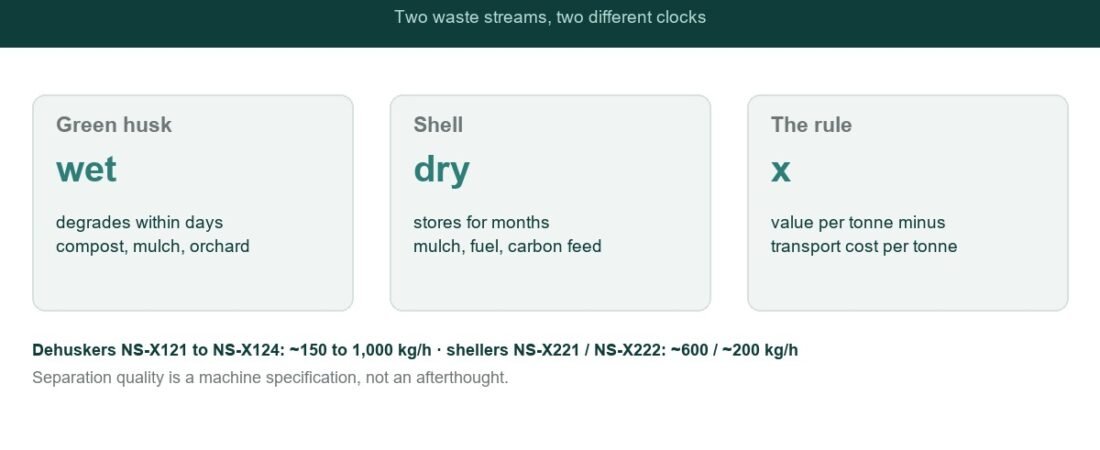
- Husk and shell are different materials with different clocks. Green husk is wet, biologically active and starts degrading within days. Shell is dry, stable and can be stored for months.
- Cleanliness decides whether you can sell it. Husk with nut in it is a loss of product; shell with kernel in it is a loss of revenue. Separation quality is a machine specification, not an afterthought.
- The highest-value uses need scale, not ambition. Biomass fuel, activated carbon feedstock and growing media all need consistent volumes and consistent moisture. If you cannot supply both, the practical options are compost and mulch.
- Compost and mulch are the default because they need nothing but space and time. They also give a farm a real input saving, which is revenue in the only currency that matters at that scale.
- Get local quotes before you build a business case. The value of a by-product is set by whoever is within trucking distance of you, not by a figure in an article.
- The machine choice is a separation choice. A dehusker that leaves husk on the nut and a sheller that grinds shell into kernel both destroy by-product value at the same time as they destroy product value.
What the two streams actually are
Green husk is the outer layer removed after harvest, and it is the wet stream. It comes off the dehusker in a condition that is still respiring, and a pile of it will heat up within days if it is left in a heap.
Shell is the hard layer removed at cracking, and it is the dry stream. Once it is separated from kernel and stored dry, it does not change much, which is why shell is the easier of the two to turn into a product.
The key operational point is that neither stream is a waste-disposal problem you solve at the end. Both are decided by settings made at the machine, and both reward being dealt with on the day they are produced.
Green husk: the material with the shortest shelf life
The reason husk has to be handled quickly is biological rather than commercial. Fresh husk is wet and full of readily available carbohydrate, which makes it an excellent feedstock for the microbes already on it. Left in a heap, that is a composting process you did not design and cannot control.
Three practical approaches:
- Spread and dry it. Thin layers and turning cost nothing but labour and reduce the moisture enough to slow the process down.
- Compost it deliberately. If you are going to end up with compost anyway, build it as a windrow from the start rather than letting a heap decide for you.
- Apply it back to the orchard. Returning husk to the trees is a real input saving, and it avoids transport cost entirely, which is usually the largest cost in any by-product decision.
What you should not do is leave it in a heap next to the processing shed and decide later. That is how a by-product becomes a smell.
Shell: the material with the most options
Dry macadamia shell is dense, hard and relatively consistent, which is what makes it flexible. The uses below are the ones that come up most often in small and medium processing operations, ordered roughly from least capital to most.
- Mulch and landscaping. Sold or given to nurseries and landscapers. Low value per tonne but near-zero processing.
- Compost bulking agent. Shell gives a compost windrow structure and airflow, which is exactly what wet husk lacks. The two streams solve each other’s problem, which is worth noticing.
- Biomass fuel. Dry shell burns well and can substitute for wood in a boiler. This is where value starts to appear, provided you have a boiler nearby that will take it.
- Feedstock for activated carbon. A real industrial use, but it needs a buyer with the plant, and they will specify a particle size range. That means screening.
- Growing media component. Needs a consistent particle size and a clean stream, so again, screening.
- Bulk density matters more than you think. Every one of these uses is priced per tonne and moved per cubic metre. Loose shell is bulky, airy and expensive to move, so compacting or bagging can change the economics more than the end use does.
The uses worth costing out, and the question that decides each
Before you build a business case, get an answer to one question per option:
| Option | The question that decides it |
|---|---|
| Mulch | Is there a nursery, landscaper or garden centre within economic trucking distance? |
| Compost | Do you already produce compost, or would this create a new process to manage? |
| Biomass fuel | Is there a boiler within reach that will accept macadamia shell as a feedstock? |
| Activated carbon feedstock | Is there a processor who will specify the particle size and buy consistently? |
| Growing media | Can you deliver a stable particle size and moisture, batch after batch? |
| Return to orchard | What does it save you on inputs, and what does spreading cost you? |
Notice that none of these questions is about the material. They are all about distance, volume and consistency. That is the honest shape of by-product economics: the material is rarely the constraint.
What the machines have to do for any of this to work
By-product value is created at the dehusker and destroyed at the cracker, or the reverse. It depends entirely on separation quality.
At dehusking, the requirement is husk off the nut, with nut not leaving in the husk stream. Every nut that exits with the husk is a lost sale, and it is invisible to you because it is going out with something you were going to discard anyway. Published capacities in the dehusker range run from around 150 kg/h on the small NS-X121 to 1,000 kg/h on the industrial NS-X124.
At cracking, the requirement is the opposite: kernel out of shell, with kernel not going out in the shell stream. Kernel in the shell pile is a revenue leak, and it is the same leak the whole-kernel discussion is about. The published capacities in the shelling range differ by design intent – the standard NS-X221 is quoted at around 600 kg/h and the stainless heavy-duty NS-X222 at around 200 kg/h with automatic continuous feeding and discharging.
The two machine ranges in their published numbers
| Model | Machine | Capacity | Power | Packing volume |
|---|---|---|---|---|
| NS-X121 | Green husk peeler, small | ~150 kg/h | 2.2 kW, 220 V or 380 V | 0.80 CBM |
| NS-X123 | Green husk peeler, medium | 300 kg/h | 3 kW, 220 V or 380 V | 1.00 CBM |
| NS-X122 | Green husk peeler, large | ~500 kg/h | 4 kW, 380 V | 0.80 CBM |
| NS-X124 | Green husk peeler, industrial | 1,000 kg/h | 3 kW, 380 V | 2.10 CBM |
| NS-X221 | Nut shelling machine, standard | ~600 kg/h | 3 kW + 1 kW, 220 V | 2.00 CBM |
| NS-X222 | Shelling machine, heavy duty | ~200 kg/h | stainless body, automatic continuous feed | 2.40 CBM |
Two things are worth saying plainly about that table. First, the dehusker series is the one that decides how much usable nut you carry forward, and the throughput range across it is wide – roughly a seven-fold spread from the small unit to the industrial one – so matching the machine to your harvest peak matters more than picking the largest. Second, the shelling figures are published capacities on a suitable feed, and the definition of a suitable feed is the graded, correctly dried nut described elsewhere in this knowledge base.
The green husk peelers range and the macadamia shelling machines range each carry the full per-machine tables.
The economics rule that keeps this honest
By-product revenue is real, but it is small per tonne and it is dominated by movement cost. The rule that follows from that is simple:
- Value per tonne minus transport cost per tonne is the only number that matters. If it is negative, the by-product is a disposal cost no matter how attractive the end use sounds.
- Volume beats price. A guaranteed 20 tonnes a year to one buyer is worth more than a speculative 5 tonnes to a better-paying one, because consistency is what lets the buyer plan.
- Returning material to your own orchard beats almost everything, because it removes transport from the equation entirely and replaces a purchased input.
- Consistency of quality is the entry ticket for every industrial use. A buyer who needs a particle size range will not negotiate on it; they will simply go elsewhere.
That is why we would encourage any producer to start with the two options that need no buyer: compost and return to orchard. Both are genuine savings, both need no contract, and both can be upgraded later if a buyer appears.
Frequently asked questions
Can macadamia husk be used as animal feed?
Green husk is not a feed, and we would not describe it as one. The practical uses for husk at farm scale are compost, mulch and return to the orchard, where the material breaks down under biological action rather than being eaten. If you have a specific feed application in mind, that is a question for a nutritionist who knows your material and your animals – not for a machine supplier.
How long can I store macadamia shell?
Dry shell is stable and stores far better than husk, which is one reason it is the easier stream to sell. What limits storage is moisture and contamination, not time. Keep it dry, keep it clean of kernel fragments, and keep it out of contact with the ground, and you have a material you can hold while you look for a buyer.
Do I need a separate machine to prepare shell for sale?
Not necessarily. Whether you need screening, compacting or bagging depends entirely on what your buyer specified. Many buyers of mulch and biomass will take shell straight from the cracker. Buyers of activated carbon feedstock will specify a particle size range, which does mean screening. Ask the buyer before you buy equipment.
Will a bigger dehusker give me more by-product?
It will give you more throughput, which is a different thing. What matters for by-product value is separation quality: husk that leaves clean and nut that stays in the product stream. That is set by matching the machine to your nut size and condition, not by its capacity figure.
What is the minimum order, and how quickly do you reply?
Minimum order is one unit. OEM branding and customisation are available on request, specifications are confirmed in writing before production, and we normally reply within one business day.
Getting the separation right is the whole job
If husk and shell are leaving your line mixed with product, no end use will rescue the economics – you are losing nut at the dehusker and kernel at the cracker every hour you run. Tell us your harvest peak in kilograms per hour, your nut size range, and what you currently do with the husk, and we will tell you which model fits and where the separation needs attention. Reach us through the contact page.
Related reading and machines
- Green husk peeling: timing and loss rates
- Whole kernel rate: how to measure it and the order to improve it in
- Macadamia kernel recovery: moisture, dehusking and the numbers that decide it
- Sorting kernels: manual vs machine grading
- Green husk peelers
- Industrial macadamia dehusking machine, NS-X124, 1,000 kg/h
- All nut processing machines
- Nut processing knowledge base