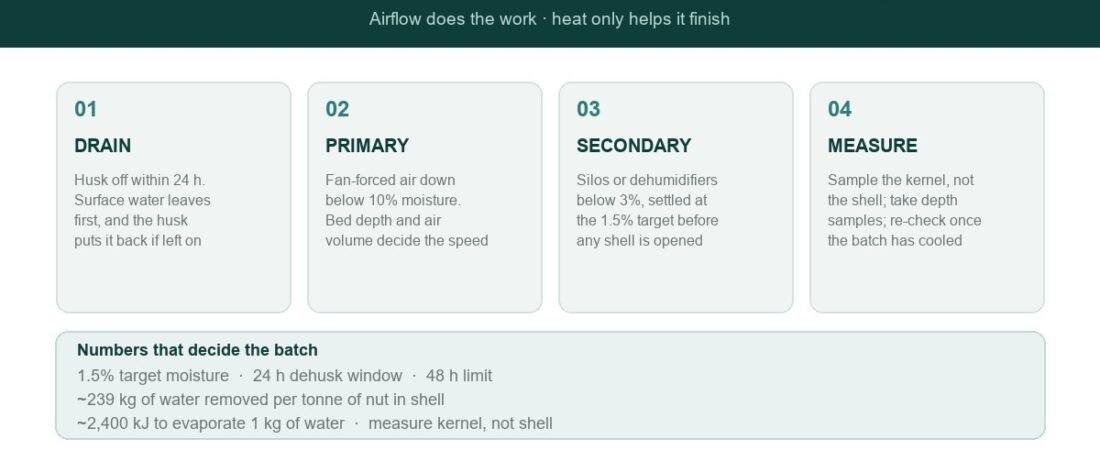
Drying is the stage where the whole-kernel rate for the season is decided, and it happens before the nuts reach any machine we sell. A macadamia shell is dense and holds water stubbornly, so drying nut in shell is a matter of days to weeks rather than hours – unless you use heated or dehumidified air to finish the job.
This page covers how to dry macadamia nuts before cracking: the two stages the process actually has, how the common drying methods compare, why airflow does more of the work than heat does, how much water you are really removing, and how to tell a batch is dry using a meter rather than a guess. The target moisture figure itself is published on its own page, and everything here is written to be consistent with it.
Last updated: 4 October 2026
The short answer
- Dry in two stages. Fan-forced or ambient air down below 10% moisture first, then a slow secondary dry – silos or dehumidifiers – down below 3%, with 1.5% as the target before cracking.
- Airflow moves the water; heat only raises how much water the air can carry. Adding heat to a badly fed bed dries the top layer and leaves the middle wet.
- Dehusk within 24 hours of harvest, never past 48. Every hour the green husk stays on, it puts water back into the kernel and adds drying time later.
- The batch is not dry when the outside of the shell feels dry. Measure the kernel, not the shell, and sample from depth rather than from the top of the pile.
- Watch the exhaust air, not the thermometer. If you cannot hold a hand comfortably in the air leaving the bed, you are pushing the batch harder than it needs.
- Re-measure after the batch cools. Moisture reads high on a warm sample, and a batch that passed hot can fail once it settles.
- Drying is not a one-way door. A correctly dried batch re-absorbs moisture in a humid store, so storage decisions finish what the dryer started.
Why drying decides the whole-kernel rate
A macadamia kernel shrinks as it loses water. Dry it to the right point and the kernel pulls away from the shell wall, so it releases cleanly when the shell opens. Dry it too little and the kernel is still pressed against the shell, so it tears. Dry it too far and the kernel becomes brittle, so a machine that produced whole kernels yesterday produces halves and chips today.
That is why drying is described as a process control problem rather than a heating problem. The cracker itself is a fixed variable: once you have chosen a model, the only levers left are the condition of the crop going in and the way the machine is set. Moisture is the larger of the two.
The arithmetic is worth doing once. Take five tonnes of nut in shell per day at around 28% kernel recovery – roughly 1,400 kg of kernel per day. Lose five percentage points of whole-kernel rate and you lose about 70 kg of whole kernel per day, which across a 60-day season is over four tonnes. None of that loss can be recovered downstream by a sorter, and none of it is visible until the shells are already open.
The process has three parts, not two
Most drying problems come from treating drying as a single operation. It has a drain phase and two drying stages, and each one has a different job.
| Phase | What happens | What it is for | What decides the time |
|---|---|---|---|
| Drain | Free surface water leaves the husk and shell | Stops the batch going into the dryer wet enough to mould | Hours, and how soon after harvest the batch is started |
| Primary dry | Fast air movement removes the bulk of the water | Gets the batch below 10%, where mould risk and handling weight both fall sharply | Airflow and bed depth, not temperature |
| Secondary dry | Slow, low-volume drying to the target | Settles the batch to 1.5% evenly, without case-hardening the shell | Time and humidity control, plus how evenly the batch was loaded |
The sequence exists because the first stage can be done fast and cheaply, while the last part of the drying is slow and cannot be rushed without damaging the kernel. Trying to reach 1.5% in one pass means running the primary stage long past the point where it is efficient, which is how batches end up with dry shells and wet centres.
The drying methods, compared
There is no single correct method. The right one depends on the climate you are drying in, the volume, and whether you are drying in the wet season or the dry one.
| Method | How it moves water | Best suited to | Main risk |
|---|---|---|---|
| Shade or shed drying | Ambient air across a thin bed | Small volumes, dry climates, the first days after harvest | Very slow in humid weather, and mould if the bed is deep |
| Fan-forced ambient air | Air is pushed through the bed at ambient temperature | The primary stage at any scale, in most climates | Bed depth: air channels through the loose spots and bypasses the rest |
| Heated air | Air is warmed so it can carry more water | Finishing a batch, or drying in wet or cool conditions | Over-drying the top of the bed and cooking the oil if the setpoint is wrong |
| Dehumidified air | Moisture is removed from the air instead of adding heat | The secondary stage, humid climates, and rooms with no headroom to heat | Running cost per kilo if the room is not sealed |
| Two-stage hybrid | Ambient fan-forced first, dehumidified or gentle heat to finish | Most commercial macadamia lines | None, provided the changeover point is measured rather than guessed |
In practice, most processors end up with a hybrid: a shed or silo with fans for the primary dry, and either a dehumidifier or a small amount of heat for the last part. The changeover is not a fixed number of days; it is the point at which a measured sample reads below 10%.
Airflow does the work
Air has to take the water away. If the air around the nut is already close to saturated, the nut cannot give up moisture no matter how long it sits there, which is why drying stalls in humid weather even though the fans are running.
Four things decide whether the air is doing its job:
- Bed depth. Air takes the path of least resistance. A deep bed develops channels: some nuts dry fast, the rest stay wet, and the average reading looks acceptable while the batch is uneven. Thinner beds dry more evenly and faster.
- Air speed through the bed. A large volume of air at low speed through a thin bed beats a small volume at high speed through a thick one. This is the single most common design mistake in small drying setups.
- Inlet humidity. If the ambient air is close to saturated, the only ways to make it useful are to warm it slightly or to dehumidify it. Fans alone cannot dry a batch in saturated air.
- Turning and re-stacking. Turning the batch evens out the difference between the top and bottom of the bed, and it is far cheaper than drying the batch twice as long to fix the same unevenness.
A practical check that costs nothing: feel the air leaving the bed. It should be noticeably more humid than the air going in, and it should not be hot. If the exhaust air is comfortable to the hand, the batch is being dried by moving air rather than by heat, which is exactly the condition the kernel tolerates best.
How much water you are removing
The volume of water in a batch surprises most people who have not calculated it, and it explains why drying is the slowest stage on the line.
Moisture content is measured on the wet weight of the whole nut, so the calculation starts by stripping out the dry matter:
- One tonne of nut in shell at 25% moisture contains 750 kg of dry matter and 250 kg of water.
- To finish at 1.5% moisture, that 750 kg of dry matter must end up as a batch of about 761 kg, because 750 divided by 0.985 is 761.
- The water removed is therefore about 239 kg from every tonne of nut in shell.
Two consequences follow. First, a line handling five tonnes a day is removing around 1.2 tonnes of water a day, which is a large airflow requirement. Second, drying is where most of the energy in a nut processing line goes, before any machine has been switched on.
For scale: evaporating a kilo of water takes about 2,400 kJ at the kind of temperature drying air actually works at. So the theoretical minimum for removing 239 kg of water is roughly 575 MJ, or around 160 kWh, per tonne of nut in shell. Real dryers need several times that figure because air has to be moved, wasted heat is lost, and not all of the air that passes through the bed is at the right humidity. Treat the number as a floor for planning, not a budget.
How to tell a batch is dry
The field tool is a moisture meter, and the referee is the oven method used in oilseed testing. Both matter, and both are easy to use wrongly.
Measure the kernel, not the shell. A dry shell over a wet kernel is the failure mode this whole page is about. On a sample of nuts, open the shells and measure the kernel.
Sample from depth, and take more than one sample. Take nuts from the top, the middle and the bottom of the bed. If the readings spread by more than a fraction of a percent, the batch is unevenly dried and the average is not a useful number.
Calibrate the meter, and check it against a reference. Manufacturer settings differ, and a meter that reads two tenths high will let you crack a wet batch all season. The oven method, on a ground sample, is the reference used to check the meter.
Re-measure after the batch cools. Warm samples read high. A reading taken straight out of a warm bed is not the same as the moisture the kernel will hold tomorrow.
Do a small crack test before committing the whole batch. Open a handful by hand. If the kernel releases cleanly and the shell splits without crushing the kernel, the batch is ready. If the kernel tears or sticks, it is either too wet or too dry, and the way it fails tells you which.
What goes wrong, and what it looks like
| What you see at the cracker or in the store | Likely cause | What to change |
|---|---|---|
| Kernels shatter and chip, with a lot of fines | Batch dried past the target | Shorten the secondary stage; re-condition the batch before cracking |
| Kernels tear, or stay stuck to the shell wall | Batch still wet, usually at the centre of the pile | Finish the secondary dry; check bed depth and airflow first |
| Meter reads fine but the kernels still break | Sample taken from the shell, or from the top of the pile only | Sample the kernel, from depth, from at least three positions |
| Part of the batch dry, part wet | Bed too deep; air channelled through the loose areas | Thinner bed, more air volume, turn the batch during drying |
| Off smell or mould in store, weeks later | Went into store too warm, too wet, or sealed while still damp | Cull before storing, dry to target first, store airtight and cool |
| Shell sticks to the kernel at the dehusker | Green husk left on longer than 24 hours | Dehusk within 24 hours of harvest, and never past 48 |
| Drying energy cost higher than planned | Heating wet air, or drying in a single pass | Two-stage drying: fans first, heat or dehumidification to finish |
Drying and the machines that follow it
Drying sits between the field and the first machine in the line, and it interacts with both of them.
Dehusking comes before drying, and the clock starts at harvest. The green husk carries water, so nut in shell left in the husk gets wetter rather than drier. Our macadamia green husk peelers cover the farm-scale band and above, from the small NS-X121 at a published capacity of about 150 kg/h to the industrial NS-X124 at about 1,000 kg/h.
Cracking comes after drying, and only after it. A macadamia shelling machine or an opening machine can only work with the crop it is given. If the batch has not settled, the machine will be blamed for a result the dryer caused.
Sizing is a drying question as well as a capacity question. A dryer that finishes a tonne in two days is a different specification from one that finishes five tonnes in two days, even when the fans look similar. When you enquire, the useful information is the batch size, the starting moisture and the target, not the floor area of the shed.
If you want to see where drying sits in the whole route, the macadamia processing line layout page maps every stage from harvest to packed kernel, and what drives the price of a macadamia processing line explains why the drying stage is usually the largest single cost in it.
Frequently asked questions
How long does it take to dry macadamia nuts before cracking?
It is set by airflow, bed depth, ambient humidity and how wet the batch started – not by a fixed schedule. Primary drying with fans takes days and, in humid weather, can take a couple of weeks; the slow secondary dry that takes the batch from below 3% to the 1.5% target is the longest part. Reducing bed depth and increasing air volume usually shortens the process more than raising the temperature does.
What moisture should macadamia nut in shell be before cracking?
1.5% is the target. The working path is to get below 10% with fan-forced air in the days after harvest, then use silos or dehumidifiers for the slow secondary dry down below 3%, and settle at 1.5% before cracking.
Can I dry macadamia nuts in the sun?
Shed or shade drying works for the first phase in a dry climate, provided the bed is thin and turned regularly. It is unreliable in humid weather, and it is not a way to reach 1.5% evenly because the last part of the dry is slow and needs controlled humidity.
Is it better to dry with heat or with air movement?
Air movement, for almost all of the process. Heat only increases how much water the air can carry, and it is applied most usefully at the end, when the batch is nearly dry and the ambient air is no longer able to do the job. Heating a deep, badly fed bed dries the outside of the batch and leaves the middle wet.
How do I know if my batch is too dry?
The crack test tells you: if the kernel shatters and produces fines when the shell opens, the batch has gone past the target. Brittle kernels are the visible cost of over-drying, and the fix is to shorten the secondary stage rather than to add water back.
Does the husk have to come off before drying?
Yes. The green husk holds water and will move it back into the shell and kernel while it is still attached. Dehusk within 24 hours of harvest and never past 48, then start the primary dry.
Tell us about your batch
If you are planning the drying and cracking stages together, send us the crop, the batch size you handle in a day, the starting moisture and the target you are drying to, the power supply at the installation position and the stage that limits you today. We will tell you which machine fits the line and what has to be true of the crop before it reaches it. Reach us through the contact page.
Related reading and machines
- Nut in shell moisture content: the target before cracking
- Storing dried macadamia: humidity, temperature and shelf life
- How to improve macadamia kernel recovery
- Macadamia processing line layout: harvest to packed kernel
- Macadamia green husk peelers range
- Macadamia nut shelling machine, standard NS-X221
- Green husk peeling: timing, loss rates and settings
- How to write a nut processing machine enquiry