A nut processing machine quotation is built out of whatever the buyer supplied. When an enquiry says only “I need a macadamia shelling machine”, the reply has to assume a crop condition, a throughput and a power supply, and every assumption has to be either written into the quotation as a caveat or priced in as margin. When the enquiry describes the material, the working pattern and the installation, the reply can be a specification instead of a guess.
Most of the time between a first message and a usable quotation is not production planning. It is the round of questions that would have been answered in the first message. This page lists the nine specification groups that change a quotation, the details buyers most often leave out, what a complete quotation should contain, and how to compare two quotations line by line.
Every machine figure used as an example below is a figure we publish in our own catalogue. We do not publish a price list, because the configuration decides the figure. What we publish is the specification card.
Last updated: 1 October 2026
The short answer
- A quotation is a specification first and a price second. A supplier who quotes without asking about feed moisture and power supply is quoting a machine you may not be able to run.
- Nine groups of information decide a quotation: what you process, which stage you are buying, throughput, feed condition, power supply, output quality, equipment you already have, destination and terms, and after-sales requirements.
- A throughput figure only means something with a working pattern. 200 kg/h for two hours a day and 200 kg/h across two shifts are not the same requirement.
- Feed moisture and size spread are the two most common omissions, and they move the required machine more than almost anything else on the list.
- The power supply at the installation position is a hard constraint. Voltage, phase and frequency are settled before production, not by an adapter after delivery.
- A complete quotation lists exclusions as clearly as inclusions, and every performance figure in it should be traceable to a published specification.
- Minimum order is one unit. OEM branding and custom configurations are available, specifications are confirmed in writing before production, and we normally reply within one business day.
Why a vague enquiry produces a vague quotation
A quotation is only as precise as its weakest input. If the material condition is unknown, the supplier has to cover the range, and covering a range costs more than meeting a specification. That extra cost does not appear as a line item – it appears as a heavier machine, a wider adjustment band, or a caveat that shifts responsibility for the result back to the buyer.
The practical consequence is that a short enquiry rarely produces a shorter process. It produces a longer one: a quotation that is either provisional or padded, followed by questions that have to be answered anyway before an order can be placed. Writing the material condition, the working pattern and the installation into the first message usually removes a full round of correspondence.
There is also a comparison problem. Two quotations for the same crop cannot be compared unless both were built on the same inputs. If one supplier assumed 12% moisture and the other assumed 20%, the two figures describe different jobs, and the cheaper one is not necessarily cheaper.
The nine specification groups
These are the inputs that actually change what gets built. Everything else is detail that can be settled after the shape of the quotation is agreed.
| Group | What to write | Why it changes the quotation |
|---|---|---|
| Crop and condition | The nut or fruit, the variety if you know it, and whether it arrives in husk, in shell, dried or fresh | Shell strength, seed size and how the material fails under load decide the working principle, not just the size of the machine |
| Processing stage | Peeling, shelling, opening, threshing, pulping, or a complete line | Each stage is a different machine family, and “processing machine” on its own could mean any of them |
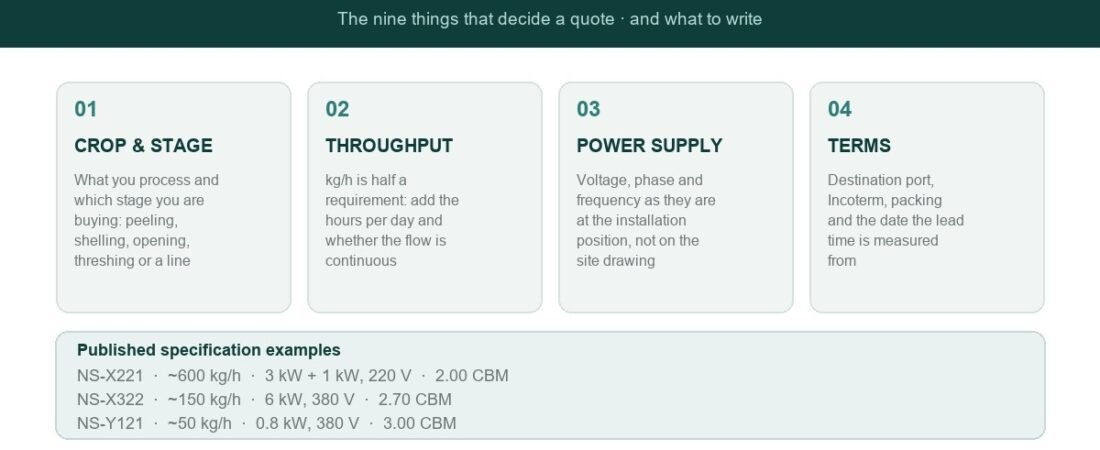
| Throughput | kg/h or tonnes per day, plus hours per day and whether the flow is continuous | Capacity and drive rating follow from the peak inflow the machine must absorb, not from the seasonal average |
| Feed condition | Moisture at the time of processing, size spread within the batch, and how the material was stored | Moisture and size spread change settings and, past a point, change the machine |
| Power supply | Voltage, single or three phase, frequency, and what is actually available at the installation position | The electrical configuration is built in, and the drive rating follows the supply you really have |
| Output quality | Whether the kernel must stay whole, and what breakage or damage level you can accept | Output targets decide settings and downstream stages, and at the margin they decide the model |
| Equipment you already have | The stages before and after the machine you are buying | A machine is sized against the line it joins, not in isolation |
| Destination and terms | Country, nearest port, the Incoterm you want, and any import documentation you need | Packing, packing volume and documents follow the route |
| After-sales requirements | Spare parts you want held, warranty expectations, and who installs the machine | Determines what is quoted alongside the machine rather than after it |
Feed material: moisture, size spread and condition
The material is the variable the machine cannot control, and it is usually described in the least detail. Three properties do most of the work, and all three are decided before the machine is switched on.
| Detail | Why it is usually left out | What it changes |
|---|---|---|
| Moisture at the time of processing | It changes through the season, and nobody measures it at the machine | Settings directly, and at the extremes the machine family that is appropriate |
| Size spread within the batch | Sorting is often planned as a later upgrade | Whether one setting can serve the batch, or pre-sorting has to be added |
| Storage history | It is not visible in the material | How the material behaves even when a moisture reading looks comparable |
A useful habit is to write the range rather than a single number: “arrives at 12-18% depending on the week” tells a supplier more than “dry”. A range tells them which end of it the machine has to be set for, and it makes the difference between a quotation that covers your season and one that covers your best day.
Throughput: a rate needs a time base
Capacity in kg/h is a rate, and a rate without a working pattern is half a requirement. The table below shows how the same sentence can be read in three different ways.
| What a buyer often writes | What the supplier has to assume | What to write instead |
|---|---|---|
| “I need 500 kg/h” | Continuous duty, all day, every working day | 500 kg/h for 8 hours a day, 250 days a year |
| “Small farm, not much volume” | Anywhere from a few kilos an hour to a ton an hour | Around 150 kg/h, two hours a day, three days a week |
| “As much as possible” | The largest machine in the range | The peak inflow during harvest, and the hours available to run it |
Working pattern matters because it decides drive duty and, in some families, the model itself. Our pine nut threshing range is a clear example: the standard model is published at around 100 kg/h on a 3 kW, 220 V supply, while the high-capacity model is published at around 200 kg/h with a three-phase drive for continuous duty. Choosing between them is a question about hours per day at least as much as about kilos per hour.
Power supply and the installation position
Electrical configuration is the item most often treated as a detail and most likely to stop an installation. It is settled at the factory, so it has to be settled in the enquiry.
It helps to see how much the published figures vary across one catalogue. The small macadamia green husk peeler is listed at 2.2 kW and can be built for 220 V or 380 V. The industrial macadamia nut opening machine is listed at 6 kW on 380 V. The standard macadamia nut shelling machine is listed at 3 kW plus 1 kW on 220 V. Three machines, three different answers, and none of them interchangeable after the machine has been built.
Write the supply as it exists at the wall, not as it exists on the site drawing: voltage, phase, frequency, and whether the machine will share a circuit with anything else. If the supply is not yet decided, say so, because a supplier can often build for either option but cannot rebuild for free afterwards. More on this is in our guide to voltage and power requirements for export machines.
What a complete quotation should contain
A quotation is a working document. If it can be read as a complete description of what will arrive, the buyer can check it, compare it and plan around it.
| Item | What it should say | Why it matters |
|---|---|---|
| Model and configuration | The model number plus every option selected, such as voltage, body material and feeding arrangement | Two machines with the same family name can differ in configuration |
| Published performance figures | Capacity, power, dimensions, weight and packing volume | Lets you check the quotation against the published specification card |
| Inclusions and exclusions | Exactly which parts, guards, spares and documents are inside the figure | Most disputes are about items that were never discussed |
| Electrical specification | Voltage, phase, frequency and drive rating, stated explicitly | Confirms the machine matches the supply at your installation position |
| Packing details | Packing type, packing volume and packed weight | Needed to compare freight and to plan clearance |
| Terms | The Incoterm, the named port, and what the figure does and does not include | Makes two suppliers comparable on the same basis |
| Lead time | Measured from the date the specification is confirmed | Removes the most common source of schedule confusion |
| Payment terms | Stages and percentages, in writing | So nothing is ambiguous after the order |
| Warranty and spare parts | What is covered, for how long, and which parts are stocked | Determines the real running cost, not just the purchase figure |
| Documents | Manual, packing list, and any certificate your import process needs | A missing document stops a shipment at the port |
A published specification card, as an example
This is what traceable figures look like. Every line below is a figure we publish on our own product pages, and it is the same set of figures a quotation should carry.
| Model | Machine | Capacity | Power supply | Packing volume |
|---|---|---|---|---|
| NS-X121 | Macadamia green husk peeler, small | ~150 kg/h | 2.2 kW, 220 V or 380 V | 0.80 CBM |
| NS-X123 | Macadamia green husk peeler, medium | 300 kg/h | 3 kW, 220 V or 380 V | 1.00 CBM |
| NS-X221 | Macadamia nut shelling machine, standard | ~600 kg/h | 3 kW + 1 kW, 220 V | 2.00 CBM |
| NS-X322 | Macadamia nut opening machine, industrial | ~150 kg/h | 6 kW, 380 V | 2.70 CBM |
| NS-S122 | Pine nut threshing machine, high capacity | ~200 kg/h | 2 kW, 220 V, three-phase drive | 2.10 CBM |
| NS-Y121 | Cashew shelling machine | ~50 kg/h | 0.8 kW, 380 V | 3.00 CBM |
Notice what is not in the table: a price. The configuration decides the figure, which is why the useful part of a quotation to compare is the specification, and why a supplier who answers with a number and nothing else is telling you very little.
How to compare two quotations line by line
Compare the specification columns before the price column. Most differences between two quotations come from a difference in scope, not from a difference in margin, and the following four checks catch the majority of them.
| Check | What to look for | Why a difference appears |
|---|---|---|
| Configuration | Same voltage, same body material, same feeding and discharging arrangement | Stainless steel, a different drive or an added stage all carry cost |
| Scope | Same inclusions, same exclusions, same number of spares | A lower figure often simply contains fewer items |
| Basis | Same Incoterm, same named port, same packing | FOB and CIF figures are not comparable without the terms attached |
| Timing | Lead times measured from the same starting point | A shorter lead time may be measuring from a different date |
It is worth writing the four lines into a simple table and filling it in for each supplier. The exercise takes minutes and routinely changes which quotation is the better one.
Warning signs in a quotation
- Performance figures with no unit basis. “High capacity” is not a specification; kg/h with a working pattern is.
- A price with no exclusions. If nothing is listed as excluded, the scope has not been defined.
- Electrical specification left open. If the voltage is settled after the order, the machine is being built to an assumption.
- Lead time quoted from the enquiry date. Production can only be planned from a confirmed specification.
- Warranty described informally. What is covered, for how long and by what means should be written down.
- Guaranteed output figures. Plant performance has to be confirmed as a specification for published figures.
How we handle an enquiry
Send the nine groups above in whatever form is easiest, and where something is unknown, say that it is unknown. The gaps are easier to close than to assume.
We confirm the specification in writing before production, including the configuration, the electrical build and the published performance figures for the model quoted. Minimum order is one unit, so a single machine is quoted exactly the same way as a stage on a larger line. OEM branding and custom configuration are available on request, and we normally reply within one business day. If you already know which stage is causing the bottleneck, say so, and the answer can start there instead of at the beginning.
Frequently asked questions
How do I get a nut processing machine quotation from you?
Send the crop and its condition, the stage you need, the throughput in kg/h with your working hours, the feed moisture and size spread, the power supply at the installation position, and the destination port. If some of those are not yet decided, write that down rather than guessing. The enquiry form is on the contact page, and the more of the nine groups you cover, the closer the first reply gets to a final specification.
Do you publish prices?
No. A price depends on the configuration: voltage, body material, feeding and discharging arrangement, spares and packing are all part of the figure, so a list price would describe a machine that may not be the one you need. What we publish instead is the specification card for each model, so the figures in a quotation can be checked against the figures on the product page.
What information do you need before you can quote accurately?
Nine groups: crop and condition, processing stage, throughput with its working pattern, feed moisture and size spread, power supply, output quality target, the equipment already in place before and after, destination and terms, and your after-sales expectations. Moisture and power supply are the two that most often change the answer, and they are the two most often left out of a first message.
Can I buy a single machine instead of a complete line?
Yes. Minimum order is one unit, and a single machine is specified and quoted in the same way as a stage on a larger line. Buyers commonly start with the stage that limits their output, add the next stage when volume justifies it, and size the later machines against the flow the first one established.
Do you offer OEM branding and custom configurations?
OEM branding is available on request, as are custom configurations such as voltage, body material and feeding or discharging arrangements. Because those choices are built in rather than added later, they belong in the enquiry. Whatever is agreed is confirmed in writing before production, so the confirmation and the quotation describe the same machine.
What are your terms, and how quickly do you reply?
Minimum order is one unit, specifications are confirmed in writing before production, and we normally reply within one business day. There is no published price list, because the configuration decides the figure, and any figure we send is tied to a written specification so that two quotations can be compared on the same basis.
Tell us what you are processing
Send us the crop, the condition it arrives in, the throughput you need with your working hours, the power supply at the installation position and your destination port, and we will come back with the model that fits and the specification it will be built to. Where something is not yet decided, say so and we will tell you what it changes. Reach us through the contact page.
Related reading and machines
- Macadamia nut shelling machine, standard NS-X221
- Macadamia green husk peeler, medium NS-X123
- Cashew shelling machine NS-Y121
- Macadamia shelling machines range
- Voltage and power requirements for export machines
- How to inspect and commission a nut processing line
- What drives the price of a macadamia processing line
- All nut processing machines
- Coffee processing: complete guide from cherry to green bean
- Small-scale nut processing: choosing a farm-scale line