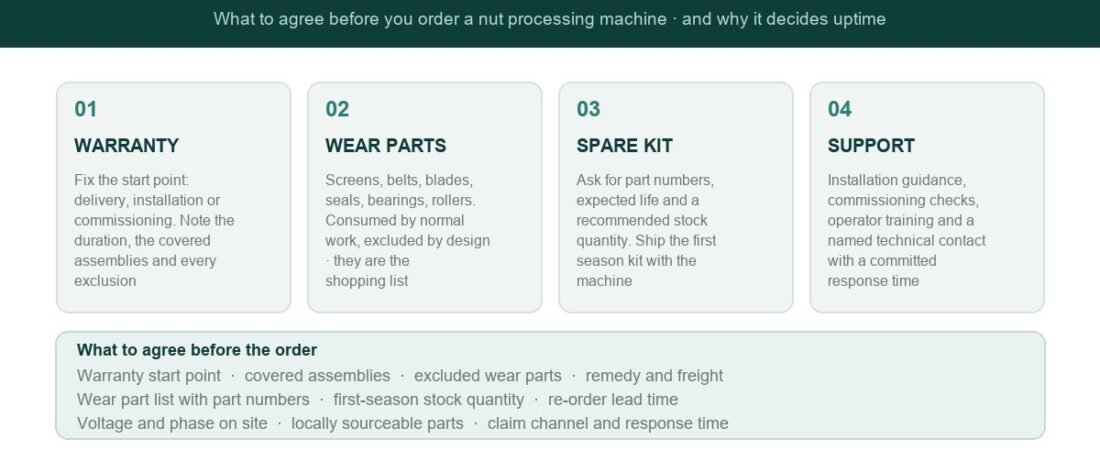
A nut processing machine is a long-term asset, and the part of the deal that decides whether it stays productive is not in the machine itself — it is in the warranty and the spare parts arrangement agreed at the same time as the machine. A line that is perfectly sized but has no wear parts within reach will spend more hours stopped than a line that was specified a little more conservatively.
This page is written for buyers putting a quotation together: what a usable warranty should actually state, which parts wear and should be stocked before the first season, how export voltage and standards affect sourcing, and the disputes that are easy to avoid if they are settled on paper before the deposit is paid.
Last updated: October 2026
The short answer
- The warranty and the spare parts list belong in the same document as the price. Asking about them after the order is placed is the most common and most expensive mistake.
- Read what is excluded, not only what is covered. Wear parts — screens, belts, blades, seals, bearings, rubber rollers — are normally excluded from a machine warranty, and that is exactly the list you need to buy.
- Ask for the wear-part list with the quotation. A supplier who builds the machine can name every part that is expected to be replaced during normal operation, with a part number.
- Plan spare parts for the first season, not for the first failure. Freight and customs add weeks; a part that is cheap at the factory can be expensive in lost throughput.
- Voltage and standards decide whether local sourcing is possible. A machine built for 380 V three-phase in one market may use components that cannot be bought locally in another.
- Support is part of the product. Installation guidance, commissioning checks and a named technical contact are usually worth more than a longer warranty on paper.
Why warranty and spare parts belong in the enquiry, not after it
Most buyers spend their preparation time on capacity, power and price — the visible numbers. Warranty and spares are treated as after-sales questions, something to sort out once the machine is on the water.
That sequence is backwards, for one practical reason: the terms you can negotiate are highest before the order is confirmed. Once the machine is built and paid for, a discussion about which parts are covered stops being a negotiation and becomes a complaint. Every point in this guide is cheaper to raise in the enquiry than in an email after a breakdown.
The same logic already applies to the commercial side of the order. The structure of a clear quotation — line items, exclusions, delivery terms and the assumptions behind each number — is covered in what a nut processing machine quotation should contain. Warranty and spares are simply two more line items that should be visible from the start.
What a usable machine warranty should state
A warranty line that says “one year warranty” is not a term you can plan around. A usable warranty answers six questions.
| What it should state | Why it matters |
|---|---|
| Start point | From delivery, from installation, or from commissioning? On a line that ships by sea and waits for site power, the difference can be weeks |
| Duration | The length matters less than whether it covers the first full production season, when most early faults appear |
| Scope | Which assemblies are covered: motor, gearbox, drive, control panel, structural parts |
| Exclusions | Wear parts, consumables, damage from misuse, unauthorised modification, and shipping damage |
| Remedy | Repair, replacement part, or a credit — and who pays the freight in each case |
| Claim process | Who to contact, what evidence is needed, and the response time the supplier commits to |
If a supplier can answer those six points in writing before the order, the warranty is real. If the answer is a sentence, it is a marketing line.
Wear parts and failure parts: the distinction that decides your downtime
Not every replacement part behaves the same way, and the difference decides what you stock.
| Category | Behaviour | What to do |
|---|---|---|
| Wear parts | Consumed gradually by normal operation; replacement is expected and predictable | Stock before the season. These are excluded from warranty by design |
| Consumables | Used up quickly and cheaply — lubricants, filters | Keep a small working stock |
| Failure parts | Should last the machine’s life; when they fail early it is a warranty question | Do not pre-buy; make sure the claim process is clear |
| Sourcing-limited parts | Correctly built but hard to buy locally — special motors, custom screens, control components | Ask for the part number and, where possible, a locally equivalent |
The mistake is to treat everything as a spare part and buy nothing. The other mistake is to buy a full set of everything and tie up cash in parts the machine may never need. The wear-part list from the supplier is what separates one from the other.
Wear surfaces are not unique to nuts. The pulping side of a coffee mill has the same logic — the settings that decide how much the machine stresses the crop are covered in coffee pulping: settings and damage control — and the maintenance schedule that keeps those surfaces in condition is set out in our machine maintenance checklist.
The spare parts list to ask for with the quotation
Rather than asking for “spare parts”, ask for a structured list. A supplier who builds the machine can fill this in from the bill of materials.
| Column | What it gives you |
|---|---|
| Part name and function | So the part can be identified by anyone on site, not only by the person who unpacked the machine |
| Part number | The only reliable way to re-order the identical part years later |
| Material and size | Lets you judge whether a local equivalent is realistic |
| Expected life | Turns “buy spares” into a number you can compare against your season |
| Recommended stock quantity | A suggestion from the builder, based on throughput and crop |
| Unit weight | Determines freight cost and how you ship the first order |
For a farm-scale or first machine, the practical starting point is a small kit: the parts the supplier lists as most likely to be replaced in the first season, plus anything that cannot be sourced locally. The sizing logic for a smaller line is covered in small-scale nut processing equipment, and the same kit logic applies.
Voltage, standards and parts that are hard to source locally
The reason some parts cannot be bought locally has nothing to do with quality. It is a standards question.
- Voltage and phase. A machine built for one market’s supply may use a motor and control components that do not match the local grid. The checks that should be agreed before shipping are set out in voltage and power requirements for export.
- Component brands and certification. Control components and motors may need certification before a local electrician will work on them, and switching to a local equivalent later can invalidate the warranty on the assembly.
- Custom tooling. Screens, perforated plates and shaped cutters are made for the machine and the crop; the local equivalent usually has to be ordered anyway.
- Thread and fitting standards. Small, and disproportionately annoying when a replacement arrives and does not fit.
The practical answer is to record the exact specification of every sourcing-limited part at commissioning. That record is covered in our guide to inspecting and commissioning a nut processing line, and it is the difference between a quick re-order and a month of emails.
How shipping and lead time for spares should be arranged
Spare parts are not an afterthought of logistics; they should be planned with the machine shipment.
- Ship the first-season kit with the machine. Freight and customs are already arranged, and the parts arrive before they are needed.
- Agree the re-order route. Which courier or forwarder, from which port, and with what documentation. A part number alone does not clear customs.
- Know the lead time by category. A common wear part may ship in days; a custom-machined component can take weeks to make and weeks to move.
- Keep the documentation together. Invoice, packing list and part numbers, stored with the machine manual, so a re-order needs one email rather than an archive search.
For a line being assembled for the first time, the parts kit is naturally part of the line layout and delivery plan, because it has to be crated and shipped with everything else.
What a support and service arrangement should cover
Support is the part of the purchase that cannot be inspected, so it has to be specified.
| Element | What to agree |
|---|---|
| Installation | Who guides the install, by phone, video or on site, and how the process is scheduled |
| Commissioning | Which checks confirm the machine is running correctly, and who signs them off |
| Training | Who is trained on settings and maintenance, and whether the training is recorded |
| Technical contact | A named channel for technical questions, not only a sales address |
| Response time | A realistic commitment for answering a fault report |
| Documentation | Manual, wiring diagram, wear-part list and part numbers, in a language the operators read |
When a machine is commissioned, the settings that were fixed on site — and why — belong in the same record as the parts list. For the coffee side of the range, the conditions that decide quality are covered in coffee processing: the complete guide, and the same principle applies to every crop: the settings, the parts and the schedule are one document, not three.
Common warranty disputes and how to avoid them
| Dispute | Root cause | Prevention |
|---|---|---|
| “The wear part should be covered” | The wear-part list was never attached to the order | Ask for the list with the quotation and attach it to the contract |
| “The claim took too long” | No agreed response time or process | Agree the claim channel and the response commitment before the order |
| “The damage was in transit” | Shipping risk was not assigned | Confirm who carries risk, and when, in the delivery terms |
| “Damage from local power” | Voltage or phase mismatch at installation | Confirm the supply specification before shipping and record it at commissioning |
| “The warranty ended before we started” | The start point ran from delivery, not commissioning | Agree the start point in writing |
| “The local repair voided the cover” | Components were substituted without agreement | Confirm the rules on local sourcing and substitutes |
Every one of these is a documentation problem rather than a technical one, and all of them are fixed on the same page — before the order, not after it.
The checklist to paste into your next supplier email
1. What is the warranty duration, and does it start from delivery, installation or commissioning?
2. Which assemblies are covered, and which parts are excluded as wear parts?
3. Can you send the wear-part list, with part numbers, alongside the quotation?
4. What is the recommended first-season spare parts kit for my throughput?
5. Which parts are likely to be difficult to source locally in my market?
6. What are the lead times for a common wear part and for a custom component?
7. Who is the technical contact after delivery, and what response time is committed?
8. What documentation is supplied, and in which language?
Send these with the enquiry. A supplier who answers them clearly is describing a machine that will keep running; a supplier who avoids them is describing a price.
Frequently asked questions
How long should a nut processing machine warranty be?
There is no universal figure, and the length matters less than the start point and the exclusions. What you want is cover that spans the first full production season, so that faults which only appear under real load are caught while the machine is still new. Ask what the warranty says about the start point — delivery, installation or commissioning — and read the excluded-parts list as carefully as the duration.
Are spare parts covered by the warranty?
Normally not. Wear parts are designed to be consumed by normal operation, so they are excluded from the machine warranty — that is standard practice rather than a supplier avoiding liability. The practical consequence is that the wear-part list is the shopping list you need for the first season, which is why it should be requested at the quotation stage.
What spare parts should I stock for the first season?
Start from the supplier’s wear-part list and stock the parts they identify as most likely to be replaced at your throughput, plus anything that cannot be sourced locally. A small, targeted kit is more useful than a large, generic one, because freight and storage cost real money. If the machine is a first purchase, the kit can be shipped with the machine, which avoids a separate shipment later.
Should I buy spare parts with the machine or later?
For the first season, buy them with the machine if the budget allows. The parts travel in the same shipment, clear the same customs entry and arrive before they are needed. Ordering later means a second freight cost, a second customs process and a lead time that runs at exactly the moment the line has stopped.
Do I need a warranty to get spare parts?
No. Part availability and warranty are separate commitments. A machine that is out of warranty should still be repairable, which is why the part numbers and the wear-part list matter beyond the warranty period. Ask for them as part of the machine documentation, not as part of the warranty.
Can I use locally made spare parts?
Sometimes, and for some parts it is the sensible choice — but check the rules first. Substituting components on a covered assembly can affect the warranty, and a locally made part that is not dimensionally identical can put load on the surrounding parts. The safest route is to confirm with the supplier which parts may be substituted and which must match the original specification.
Talk through your line
If you are putting a quotation together and want the warranty and spares side specified properly, send us the crop, the throughput you are planning, the destination country and the power supply available on site. We will tell you which parts are wear parts on that machine, what a sensible first-season kit looks like and which spares are worth buying up front.
Reach us through the enquiry form, or email nanshengtechnology@gmail.com. If you are still comparing machines, the specification questions in how to size a small-scale line and the checklist in what a quotation should contain make the warranty and spares items easy to compare across suppliers.
Related reading and machines
- Nut processing machine maintenance checklist
- How to inspect and commission a nut processing line
- Voltage and power requirements for export
- Nut processing machine quotation: what to include in your enquiry
- Small-scale nut processing: choosing equipment for a farm-scale line
- Coffee processing: complete guide from cherry to green bean
- Nut processing machines: the full product range
- Coffee fruit peeling machine NS series
- Knowledge forum: processing guides
- importing a nut processing machine from China: terms, documents and packing