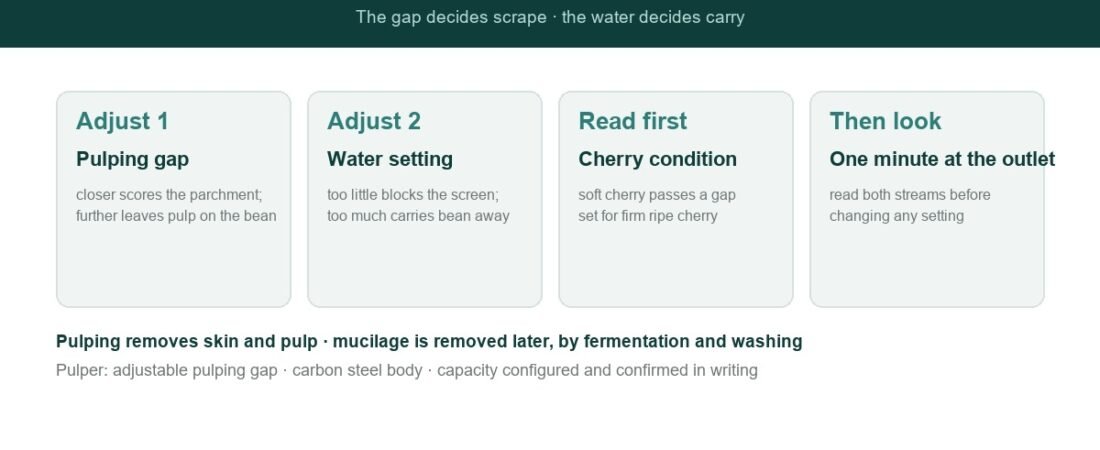
Pulping is the first operation that touches the bean itself. Everything before it handled fruit – picking, floating, grading, de-stemming – and everything after it handles a bean that is now exposed. That is why the pulping gap and the water setting are the two adjustments on a wet mill that decide how much of your crop reaches the fermenting tank intact.
This page covers what pulping is actually asked to separate, the two adjustments that control it, how to read the defects you find in a pulped batch, and how to record a setting so that it can be repeated tomorrow.
Last updated: 28 September 2026
The short answer
- Pulping removes skin and pulp. It does not remove mucilage. Expecting the pulper to finish the job is how under-fermented and over-scraped batches happen.
- The gap decides scrape; the water decides carry. A gap that is too tight scores the parchment, water that is too low leaves pulp on the bean and blocks the screen.
- Cherry ripeness is a pulping variable. Soft over-ripe cherry passes a gap that is correct for firm ripe cherry, so grade before you pulp.
- Every defect points at one of four causes: gap, water, cherry condition or feed rate. Read which one before adjusting anything.
- Pulped weight against cherry weight is your first yield figure, and it costs five minutes to take.
- The pulper is a coffee cherry pulper with an adjustable pulping gap and a carbon steel body, described on the product page; capacity and power supply are confirmed in writing for the configuration you need.
What pulping actually removes
A coffee cherry has four layers: skin, pulp, mucilage and parchment. Pulping takes off the first two. It is a mechanical separation, and like every mechanical separation it has a pass-through and a reject: pulp leaves one way, parchment-covered bean leaves the other, and the job is done when both streams are clean.
Two consequences follow, and between them they explain most wet-mill quality problems:
1. The pulper cannot judge ripeness. It separates by size and resistance, so a batch containing unripe and over-ripe cherry at one gap setting gives a mixed result – some beans scraped, some still carrying pulp.
2. Everything the pulper does not finish becomes a fermentation variable. Mucilage left on the bean ferments on the bean, not in the tank, and the difference is not visible until the bean is washed.
The two adjustments that decide the result
Gap and water are the only two controls an operator normally has, and they are often confused with each other because both change how much pulp leaves with the bean.
| Adjustment | What it controls | Too tight / too little | Too loose / too much |
|---|---|---|---|
| Pulping gap | How close the drum and the plate come to the bean | Parchment scored and beans nicked; that damage cannot be removed later | Pulp left on the bean, screen loading, mixed output |
| Water setting | How freed pulp is carried away and how the bean is flushed off the drum | Screen blocks, mush builds up, bean stays in contact with pulp | Water cost, diluted pulp stream, cherry carried into the wrong stream |
The order of adjustment matters. Set the gap from the cherry you actually picked this week, then set water until the pulp stream runs clear and the bean stream holds no free pulp. Using water to compensate for a wrong gap only hides the gap problem until fermentation.
How cherry condition changes your setting
Three batches of the same variety at the same gap will behave differently depending on ripeness and on how long they have stood in the hopper:
- Firm ripe cherry separates cleanly and tolerates a moderate gap.
- Over-ripe or soft cherry collapses against the drum, so it passes a gap that is correct for firm cherry and reaches the tank partly pulped.
- Unripe and green cherry is hard and resists, so it rides over the drum and comes out whole, then ferments alongside pulped bean – a flavour risk rather than a mechanical one.
Floating and grading before pulping is not a courtesy to the pulper. It is the control that makes a single gap setting possible. Without it you will be adjusting the gap mid-shift, and a mid-shift adjustment is a setting you can no longer repeat tomorrow.
Reading a pulped batch: what the defects tell you
Stand at the pulper outlet for one minute and look at both streams.
| What you see | What it usually means | First thing to change |
|---|---|---|
| Whole cherry in the bean stream | Gap too wide, or cherry too firm for this gap | Grade harder, or close the gap slightly |
| Pulp still on the bean | Gap too wide, or water too low to flush | Close the gap a little, then check water |
| Beans scored or nicked | Gap too tight, or feed rate too high for the gap | Open the gap; reduce feed |
| Screen blocking with pulp | Water too low, or pulp arriving faster than the screen can pass | Increase water before touching the gap |
| Bean carrying into the pulp stream | Water too high, or screen worn | Reduce water; inspect the screen |
| Mixed result within one batch | Ungraded cherry, not a machine fault | Grade before pulping |
Two rows in that table are the same adjustment in opposite directions. That is why a one-minute look at the outlet is worth more than a mid-shift gap change: it tells you which direction you are already wrong in.
Wet processing order: pulping is step one
Pulping sits at the start of a chain, and each stage depends on the one before it:
1. Floating and grading – separates ripe from unripe and removes foreign matter.
2. Pulping – removes skin and pulp, and sets the mucilage load going forward.
3. Fermentation – the stage the pulper most directly affects, because pulp left on the bean ferments on the bean.
4. Washing – removes remaining mucilage and, with it, the evidence of how well step two went.
5. Drying – the last chance to influence quality before the bean is stable.
The practical point is that a pulping problem is usually diagnosed after fermentation, when the bean is washed – and by then it is too late to correct. That is the argument for recording the setting rather than remembering it.
A five-minute check on every batch
1. Weigh a known quantity of cherry in. Any container of known volume is enough if you weigh it once and mark it.
2. Weigh the pulped bean out. Pulped weight against cherry weight is your first yield figure, and a drop usually means the gap has moved or the cherry has changed.
3. Watch both streams for one minute and note which of the defects above you can see.
4. Squeeze a bean. Parchment that is intact and free of pulp means the setting suits this cherry; scored parchment means the gap is too tight.
5. Record gap, water and cherry condition on the same line as the weights, so tomorrow starts from a number instead of a memory.
A batch record for pulping
| Column | Why it is there |
|---|---|
| Date, lot and variety | Cherry behaviour differs by variety and by week |
| Cherry condition: ripe, over-ripe or mixed | Determines whether one gap setting is even valid |
| Gap setting and water setting | The two numbers you will want to repeat |
| Feed rate | Separates machine behaviour from batch behaviour |
| Cherry weight in, pulped weight out | Your first and cheapest yield figure |
| Defects seen in the bean stream | Names the direction you are wrong in |
| Defects seen in the pulp stream | Names the opposite direction |
| Float and grading result | Explains a good day and a bad day on the same setting |
The same record logic applies on the dry side of a processing line and is set out in whole kernel rate: how to measure it and improve it.
Common mistakes
| Mistake | What it costs | The fix |
|---|---|---|
| Pulping ungraded cherry | Mixed output you cannot diagnose | Grade first, then one gap setting works |
| Adjusting the gap without looking at the outlet | You tune in the wrong direction | One minute at the outlet before any change |
| Using water to compensate for a wrong gap | The gap problem returns as a pulp-stream problem | Set the gap from cherry condition, then set water |
| Treating pulping as complete when the bean exits | Mucilage ferments on the bean | Accept pulping as step one of the wet process |
| Not weighing pulped output | A yield loss you notice only at the mill gate | Weigh every batch; it takes five minutes |
Frequently asked questions
What is the difference between pulping and de-pulping?
They name the same mechanical operation: removing skin and pulp from fresh coffee cherry. “Pulping” describes what the machine produces, a pulped bean; “de-pulping” describes what it takes off. Either way the machine is a coffee cherry pulper with an adjustable gap, and the variable that decides the result is still the gap against the cherry you are feeding.
Does pulping remove the mucilage?
No. Pulping removes skin and pulp; mucilage is a separate, thinner layer that stays bound to the parchment and is removed later by fermentation and washing, or by mechanical demucilaging. Treating pulping as a complete cleaning step is the usual way to leave pulp on the bean, where it ferments unevenly and shows up in the cup.
How do I know if my pulping gap is too tight?
The clearest sign is scored or nicked parchment and a bean stream with visible surface damage, especially when feed rate is high. A tight gap does not improve pulp removal – it turns a separation into a scraping action. Open the gap slightly, reduce feed if cherry is arriving faster than the drum can handle, and squeeze a bean again after a few minutes.
Why is whole cherry coming out in the bean stream?
Usually because the cherry was firmer or more uneven than the gap was set for. Unripe cherry is hard and rides over the drum, and an ungraded batch can contain enough of it to look like a machine fault. Check the float and grading step before opening the gap, because opening the gap to pass unripe cherry will leave pulp on the ripe cherry behind it.
Can I set the gap once and leave it for the season?
No, and this is the setting most mills get wrong. Cherry firmness changes through the season, between varieties and between deliveries from different blocks, so a gap that was correct in the first week can be too tight or too wide a month later. Squeeze-test a bean at the start of each shift and record the setting beside the cherry condition.
What is the minimum order, and how quickly do you reply?
Minimum order is one unit. OEM branding and customisation are available on request, specifications are confirmed in writing before production, and we normally reply within one business day.
Send us your pulping setup
Tell us your cherry condition, your current gap and water settings, and what you are seeing in the two streams, and we will tell you which adjustment to move and in which direction. Reach us through the contact page.
Related reading and machines
- Coffee fruit peeling in wet processing
- Whole kernel rate: how to measure it and improve it
- Nut sorting: manual versus machine
- Pine nut processing: the complete guide
- Coffee fruit peeling machine, adjustable pulping gap
- Coffee fruit peeling machines
- All nut processing machines
- Nut processing knowledge base
- Coffee processing: complete guide from cherry to green bean