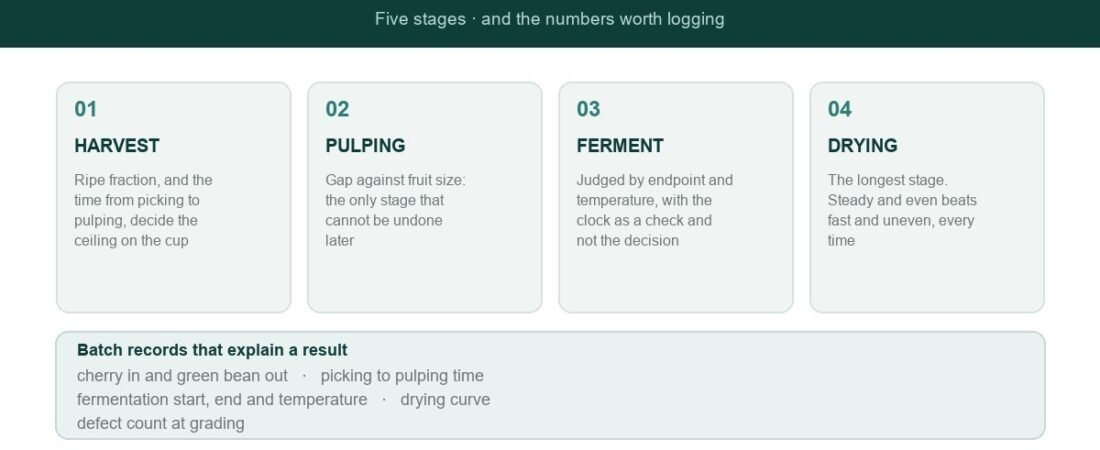
Coffee processing is the set of decisions made between picking and export: how the fruit is opened, how long it is left to ferment, and how it is dried. Those decisions are made on a wet line, they take days rather than minutes, and they decide the cup far more than most equipment choices do. This page sets out the whole route from cherry to green bean, where each machine fits, and which numbers are worth recording at each stage.
It is written for buyers who are putting a line together or replacing one stage of it. The machine data quoted here is data we publish in our own catalogue; fermentation times and drying targets are given as methods and working ranges, because the right figure depends on your cherry, your altitude and your market – those are settled with a sample and a log, not with a brochure.
Last updated: 3 October 2026
The short answer
- Processing begins at harvest, not at the machine. Cherry picked unripe or left in a sack overnight behaves differently before it ever reaches the pulper.
- There are two main routes: washed and natural. Washed removes the fruit before drying; natural dries the whole cherry first. The equipment list and the drying area change accordingly.
- The pulper is the only stage that cannot be undone. Damage at pulping shows up later as defects, so it is the stage to set up carefully and check by sample.
- Fermentation is a time-and-temperature problem, not a fixed clock. Measure it, do not assume it.
- Drying is the longest stage and the one most often under-built. It sets the shelf life of everything that came before it.
- Hulling and grading belong to the dry mill, and they decide the lot that is actually offered for sale.
- Record four numbers per lot: cherry in, green bean out, drying time, and the defect count at grading. Without them, a change to the process cannot be judged.
The two routes, and what each one needs
The first decision is whether the fruit is removed before drying or after it. Everything downstream follows from that choice.
| Route | What happens | Drying load | Where the risk sits |
|---|---|---|---|
| Washed | Cherry is pulped, fermented and washed, then dried as parchment | Parchment only, in a thin layer | Fermentation control – too short gives a flat cup, too long gives a fermented defect |
| Natural | Whole cherry is dried first, then hulled | The whole fruit, in a thicker layer and for longer | Mould and uneven drying, because fruit dries far more slowly than parchment |
| Honey / semi-washed | Pulped but part of the mucilage is left on the parchment | Parchment with mucilage attached | Sticky parchment that clumps and dries unevenly |
A line built for washed coffee will not simply convert to natural by skipping the pulper – the drying area, the turning routine and the hulling stage all change. Deciding the route first is what keeps the equipment list short.
Step 1: Harvest and sorting
Cherry arrives with a mix of ripe, unripe and damaged fruit, plus leaves and sticks. What happens next is decided here.
- Ripe fraction. The proportion of ripe cherry in the delivery sets the ceiling on the cup quality. Floating and density separation remove the light fraction before it reaches the pulper.
- Time on the ground. Cherry held warm and wet before pulping starts to ferment in the sack. The interval between picking and pulping is a process parameter, not a logistics detail.
- Debris. Sticks, leaves and stones damage pulpers and blocking screens. Removing them is cheap; replacing a damaged pulping cylinder is not.
A delivery log with time, weight and visual ripeness costs nothing to keep and is the only way to know whether a later defect came from the field or from the machine.
Step 2: Pulping
The pulper squeezes the cherry so that the skin and pulp come away from the parchment, and it does that with a clearance between the rotating surface and the screen. Our coffee fruit peeling machine is built for exactly this job – removing the outer skin and pulp from fresh cherry – and its pulping gap is adjustable, with a carbon steel body.
Because the machine data we publish for this model is limited to machine type, application, pulping gap and body material, everything else about the configuration is confirmed in writing for your cherry and your throughput. That is deliberate: the correct pulping setup depends on the fruit in front of you.
Three points decide most of the result:
- Gap setting against fruit size. Too wide and pulp stays attached, putting load onto the fermentation and washing stages; too narrow and the parchment is scored or the bean is nicked.
- Steady feed. A surge after a gap produces a mix of under-pulped and over-pulped fruit in the same lot, which no later stage can separate.
- Water use. Pulping consumes water, and how much is a design decision about your water supply and your wastewater arrangements, not an afterthought.
The practical check is a sample taken every 20-30 minutes: parchment free of pulp, and no beans with a scrape mark on the surface.
Step 3: Fermentation and washing
Fermentation breaks down the mucilage that stays attached to the parchment after pulping. In the washed route it is the stage that defines the cup, and it is the stage most often run on habit instead of measurement.
What actually controls it:
- Time. A working window rather than a fixed number – it shortens as temperature rises and lengthens when tanks are cold.
- Temperature. An ambient-tank fermentation in a cool climate and one in a hot climate at the same number of hours are not the same process.
- Method. Dry fermentation in a tank, wet fermentation under water, and the newer sealed or inoculated styles each behave differently, and they need different amounts of attention from the operator.
- The endpoint. The reliable signal is tactile and visual: the parchment loses its slipperiness and the mucilage breaks down under the hand. A clock is a backup to that check, not a replacement.
Washing then removes what fermentation has loosened, and grading channels separate floaters from sound parchment. Water used here carries a high organic load – worth planning for before the line is installed, not after.
Step 4: Drying
Drying is the longest stage in the process and the one that most often limits the size of a line. Whether the coffee is being dried as parchment or as whole cherry, the objective is the same: bring the moisture down steadily to a level that keeps the green bean stable in storage and transport.
- Slow and even beats fast and uneven. Rapid surface drying on one side of a bed while the other stays wet is what produces mould, not the final moisture figure.
- Turning routine. How often the material is turned, and how the load is spread, does more work than raising the heat.
- Target and stop point. The target moisture is chosen for your storage and shipping conditions, and it is verified by meter on a cooled sample – reading a hot sample overstates dryness.
- Where the figure comes from. We do not publish a universal target, because it depends on the destination climate and the time to export. It is agreed as part of the specification.
The common mistake is to under-build the drying stage relative to the pulper. A pulper that handles a day of cherry takes an hour; drying the same day’s output takes days.
Step 5: Hulling and grading
Once dry, parchment or dried cherry goes to the dry mill, where the outer layers are removed and the green bean is sorted by size and density. This is where the lot that is actually offered for sale is decided.
- Hulling. Removes the dried parchment or the dried fruit, and it is a different machine from the pulper, running on a completely different feed.
- Size grading. Screens separate beans by width, which is what buyers specify against.
- Density and colour sorting. Removes defects that size screens cannot, and it is the last chance to pull a defect out before the bag is closed.
- Defect count at grading. The number that tells you whether the changes made upstream actually worked.
Where our machines fit
We build the wet-processing stage: the coffee fruit peeling machine that removes the outer skin and pulp from fresh cherry, with an adjustable pulping gap and a carbon steel body. That is the single machine we publish for coffee, and it is the stage where most small and medium lines start, because it is the bottleneck that manual labour cannot absorb when volumes rise.
Beyond that stage we do not claim to be a coffee line integrator. Drying beds, fermentation tanks, hullers and colour sorters are outside what we publish, and if you need them we will say so rather than quote around the question. What we can do is specify the pulping stage against the cherry volume and power supply you actually have, confirm the configuration in writing, and tell you what the rest of the line has to keep up with.
Sizing the pulping stage from your cherry volume
The pulping stage is sized against peak daily delivery, not against the seasonal average. Three numbers do the work, and all three come from your own records.
| Input | Why it decides the machine | Where to get it |
|---|---|---|
| Peak cherry per day (kg) | The pulper only has the hours you give it to clear a day of delivery | Delivery records from the last harvest, or the picking plan |
| Hours available per day | A pulper run for four hours needs a different capacity from one run for eight | Your labour shift and the time cherry can wait after picking |
| Peak days per season | Decides how much buffer the rest of the line needs, and how much downtime you can absorb | Harvest calendar, with the top ten days marked |
Working practice: state the peak day and the hours, not the season’s average. A pulper sized on the average is a pulper that is behind on exactly the days that matter. If the peak-to-average ratio is three to one, it is usually better to state that openly and discuss it than to buy a machine for the average and add labour at the peak.
What to record every batch
A processing log turns a series of opinions into a process. If a lot turns out better than the last one, the log is the only way to know why.
| Record | Why it matters | How often |
|---|---|---|
| Cherry weight in, green bean weight out | The starting point for any yield discussion | Every lot |
| Time from picking to pulping | The most common cause of an unexplained defect | Every delivery |
| Pulping sample result | Confirms the gap setting before the whole lot goes through | Every 20-30 minutes |
| Fermentation start, end and temperature | The single most useful pair of numbers in washed processing | Every lot |
| Drying curve, not just the final figure | Shows whether the lot dried evenly or only dried last | Daily |
| Defect count at grading | The measure of whether anything upstream improved | Every lot |
Two of these – time from picking to pulping, and the drying curve – cost nothing but attention, and they explain more defects than any machine setting.
Frequently asked questions
What does a coffee fruit peeling machine actually do?
It removes the outer skin and pulp from fresh coffee cherry, leaving parchment with mucilage attached for the fermentation and washing stages. Our machine is built for that job with an adjustable pulping gap and a carbon steel body. It is a wet-processing machine, so it does not dry, hull or grade coffee – those are separate stages with separate equipment.
Should I choose washed or natural processing?
Washed processing gives the operator more control over the cup and needs less drying area, because only parchment has to dry. Natural processing needs a much larger and more carefully managed drying area, since the whole fruit dries slowly, and it carries a higher risk of mould if turning and airflow are not managed. The choice is usually made by the market you sell into and the drying space you have, not by the machine.
How long should fermentation take?
There is no single figure worth publishing, because the time depends on temperature, method and the fruit itself. What matters operationally is that fermentation is judged by its endpoint – the mucilage breaking down and the parchment losing its slipperiness – with the clock used as a check rather than the decision. Run the same method, measure temperature, and log the time, and the right window for your site becomes visible within a few lots.
What moisture should coffee be dried to?
The target depends on your storage conditions, the time before export and the destination climate, so we do not publish a universal figure. Drying should be steady and even, verified on a cooled sample rather than a hot one, and recorded as a curve rather than a single final number. If you tell us the destination and the storage period, the target can be discussed as part of the specification.
Can you supply the whole coffee processing line?
We publish one machine for coffee: the fruit peeling machine that removes skin and pulp from fresh cherry. Drying beds, fermentation tanks, hullers and colour sorters are outside our published range, and we would rather say that plainly than quote around it. For the stages we do build, the specification is confirmed in writing before production.
What is the minimum order, and how quickly do you reply?
Minimum order is one unit, so a single pulper is specified and quoted exactly the same way as a stage on a larger line. OEM branding and custom configurations are available on request, specifications are confirmed in writing before production, and we normally reply within one business day.
Tell us about your cherry and your peak day
Send us the cherry volume you handle on a peak day, the hours you have available to pulp it, the power supply at the installation position and how you plan to dry the output, and we will tell you how the pulping stage should be sized and what the rest of the line has to keep up with. Reach us through the contact page.