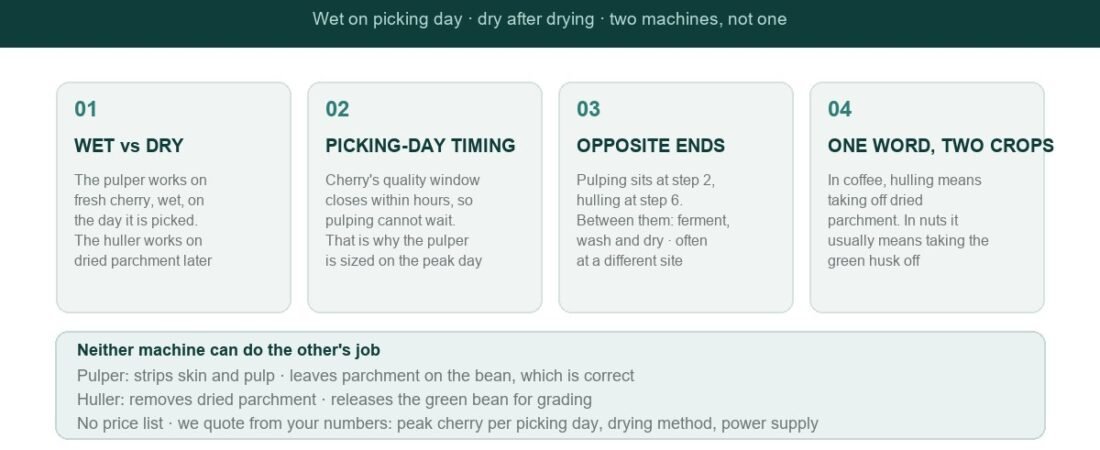
A coffee pulper and a coffee huller both remove a layer from the coffee fruit, and that is almost everything they have in common. The pulper works on fresh cherry on picking day and takes off the skin and pulp. The huller works on dried parchment, weeks later, and takes off the parchment shell that is still wrapped around the green bean. Buyers who treat them as interchangeable usually discover the difference in the middle of a harvest, when the machine they bought cannot do the job the other one was supposed to do.
This page separates the two machines by job, timing and place in the line, explains why the word “hulling” means something different in coffee than it does in nut processing, and sets out what to put in an enquiry so a supplier quotes the machine you actually need.
Last updated: October 2026
The short answer
- A pulper is a wet machine. It takes fresh cherry and strips the skin and pulp away from the parchment, on the day the cherry is picked.
- A huller is a dry machine. It takes parchment that has already been dried and fermented, and removes the parchment layer to release the green bean.
- They sit at opposite ends of the line. Pulping happens within hours of picking; hulling happens after drying, often weeks later and sometimes at a different site.
- Neither one replaces the other. A pulper that leaves parchment on the bean is working correctly; a huller fed fresh cherry will not separate anything cleanly.
- “Hulling” means two different things depending on the crop. For coffee it is the parchment layer; for a nut it is usually the outer husk, which in coffee is closer to what a pulper removes.
- We publish no price list. Which machine, and which size, depends on your numbers; we quote from those instead.
What a coffee pulper actually does
A pulper — also sold as a coffee fruit peeling machine — takes freshly picked cherry and presses it through a gap between a rotating drum and a fixed surface. The skin, the outer pulp and the mushy layer underneath are torn away and flushed out with water, and the beans come out still wrapped in their parchment. Floaters, unripe fruit and stones are separated at the same stage, because they behave differently in the water channel and can be diverted before they reach the fermentation tank.
The important detail is not the mechanism but the timing. Cherry is a living fruit: once it is picked, the sugars begin to change and the flavour window starts closing. Pulping has to happen the same day, which means a pulper has to be sized on the busiest picking day of the harvest, not on the annual crop. A mill that is correctly sized on annual tonnage will still be the wrong machine in the two weeks that decide the quality of the whole lot. That sizing logic is worked through in the coffee processing guide and, from the cost side, in what drives a coffee processing line cost.
The one setting that matters most on a pulper is the gap between drum and plate. It has to be adjustable, because cherry size changes with variety and with the stage of the season, and a gap that is right in the first week can bruise the bean or leave pulp attached in the last. How to set and re-set it is covered in coffee pulping settings and damage control.
What a coffee huller actually does
A huller works on the opposite end of the process. By the time parchment reaches it, the coffee has been fermented, washed and dried down to a stable moisture, and the bean inside has shrunk slightly away from the parchment layer that surrounds it. The huller presses or rubs the dried parchment until that layer splits and comes away, releasing the green bean.
Two consequences follow. First, a huller is a dry mill machine: it is designed around parchment at a controlled moisture, and feeding it wet or partly dried coffee produces broken beans and a hulling job that has to be repeated. Second, because the bean is now bare and fragile, everything downstream — grading, density separation, hand sorting, bagging — is about not re-damaging what the huller just released. The drying step that has to come before hulling is set out in coffee drying and hulling, from wet parchment to green bean.
The same word means different things in coffee and in nuts
Most of the confusion between the two machines comes from vocabulary rather than engineering, and it gets worse when a buyer also handles nuts.
| Term | What it means in coffee | What it means in nut processing |
|---|---|---|
| Pulping / peeling | Removing skin and pulp from fresh cherry, on picking day | Rarely used; the closest nut equivalent is green husk removal on macadamia |
| Hulling | Removing the dried parchment layer to release the green bean | Usually the same job as dehusking — taking the outer husk off the nut |
| Shelling | Not used for coffee; the parchment is not called a shell | Splitting the hard nut shell to release the kernel |
| Cracking | Not used for coffee | A gentler opening of the shell, usually to keep the kernel whole |
So when a coffee buyer says “huller”, they mean the machine at the dry end. When a macadamia or cashew buyer says “huller”, they very often mean the machine at the wet end that takes the green husk off within days of harvest. The two machines are not related, and a specification written for one crop will not describe the other. Where each crop puts its bottleneck is compared in which nut should you process, and the wet end of the coffee line specifically is covered in coffee fruit peeling and wet processing.
Where each machine sits in the line
The sequence below is the ordinary shape of a wet mill followed by a dry mill. The two machines this page is about are marked, and everything between them is the part of the process that cannot be skipped.
| Step | What happens | Which machine |
|---|---|---|
| 1. Intake and float separation | Cherry is weighed, washed and sorted; floaters and unripe fruit are diverted | Pulper or a separate siphon |
| 2. Pulping | Skin and pulp are removed from fresh cherry; beans leave still in parchment | Coffee pulper |
| 3. Fermentation | Parchment rests in tanks under controlled time to break down remaining mucilage | Tanks, not a machine |
| 4. Washing and grading | Mucilage is washed off and parchment is separated by density | Washers and channels |
| 5. Drying | Parchment is brought down to a stable moisture for storage | Beds, or a mechanical dryer |
| 6. Hulling | The dried parchment layer is removed to release the green bean | Coffee huller |
| 7. Grading and sorting | Green bean is sized and defects are removed | Graders and sorters |
The gap between steps 2 and 6 is usually several weeks, and on a smallholding it is often also a change of site: pulping happens at or near the farm, hulling happens at a mill that aggregates parchment from many farms. That is the single most practical reason the two machines are bought separately and rarely bought together.
The mistake that costs money
The expensive error is not choosing the wrong model; it is buying the two machines in the wrong order, or buying only one of them and assuming it covers the other job.
- Buying a huller first. A huller cannot process fresh cherry. A buyer who starts with a huller has equipment that sits idle until the first crop has been dried — a full harvest cycle of waiting, with nothing to hull.
- Buying a pulper and stopping there. This is a reasonable place to stop, but it has to be a deliberate decision: parchment has to be dried and stored, and then either hulled at a shared mill or sold as parchment. The route is described in coffee fruit peeling and wet processing.
- Sizing the pulper on annual tonnage. Covered above, and the most common single cause of a line that cannot keep up in the peak week.
- Expecting one machine to do both jobs. No pulper hulls, and no huller pulps. A machine that claims both is either two machines in one frame or a machine that does one job badly.
- Comparing prices without comparing the stage. A quotation for “coffee processing equipment” that does not say which stage it covers cannot be compared with another. Our own position on this is set out in how to compare a nut and coffee machine quotation.
What to put in an enquiry
Whether you are asking about a pulper or a huller, a supplier can only quote accurately against numbers. The list below is the one we work from, and it is the same list we would send back as questions if it is missing.
- Fresh cherry per peak picking day, in kilograms, and the number of hours you can realistically run the machine on that day.
- What you want to leave with. Parchment for sale, parchment for your own drying, or green bean ready for grading — each one implies a different set of machines.
- Your moisture and drying situation. Whether you already dry to a stable moisture, and by what method, decides whether hulling is even the next step for you.
- Power supply available on site, and whether it is single-phase or three-phase. Voltage and phase conventions differ by country, and a machine quoted for the wrong supply cannot be commissioned. The general rules are in machine voltage and power requirements for export.
- Throughput you expect in two years, not today. These machines are usually bought once and kept, so the sensible question is what the line has to clear once the acreage has grown.
- Whether you will hull at the same site. If not, the hulling decision can wait, and the money can go into pulping and drying first.
The full set of small-machine figures, including which combinations are realistic at each scale, is in the nut processing machine capacity and power chart. Our own coffee pulper is described on the coffee fruit peeling machine page, and the family it belongs to is listed under coffee fruit peeling machines.
Frequently asked questions about coffee pulpers and hullers
What is the difference between a coffee pulper and a coffee huller?
A pulper removes the skin and pulp from fresh cherry on picking day, and leaves the beans wrapped in parchment. A huller removes the dried parchment layer later, after fermentation and drying, to release the green bean. One works wet at the start of the line, the other works dry at the end, and neither can do the other’s job.
Does a coffee pulper remove the parchment?
No. After pulping, the bean is still covered by parchment, and that is the intended result. Removing parchment at the pulping stage would damage the bean, because the layer is still firmly attached to fresh coffee. The parchment has to be fermented, washed and dried first, and only then removed by a huller.
Can one machine do both pulping and hulling?
Not as a single working unit. The two jobs differ in what is being removed, in whether the coffee is wet or dry, and in how much force can be applied before the bean is damaged. A supplier offering “one machine for the whole process” is normally quoting a line of several machines rather than a single unit, and the stages should be listed separately.
What does “hulling” mean in nut processing compared with coffee?
In coffee, hulling means removing the dried parchment layer at the dry mill. In nut processing, hulling usually means dehusking — taking the outer green husk off within days of harvest, which is a wet job closer to coffee pulping. The same word describes two different operations on two different materials, which is why a specification has to name the crop and the layer being removed.
What should I include when asking for a coffee pulper quotation?
Send the fresh cherry weight per peak picking day and the hours available to run it, what you want to end up with, your drying method, your site’s power supply and phase, and the throughput you expect in two years. Without the peak-day figure in particular, any quotation you receive is sized on a guess, and a guess is usually the annual average.
Is a coffee pulper the same as a coffee fruit peeling machine?
Yes — in this market the two names describe the same machine. “Pulper” is the term used in the wet-processing trade and in most English-language equipment listings, while “coffee fruit peeling machine” is the term used in export catalogues and in some buyer markets. When comparing quotations, confirm which stage each one covers rather than comparing the names.
Request a quotation
Tell us the peak cherry weight per picking day, what you want to end up with, and the power supply at your site. We will confirm which machines your line actually needs, in which order, and send a quotation that names the stage each item covers. Prices depend on configuration, so we do not publish a price list — we quote from your numbers instead. You can reach us through the contact page or see the full range under our products.