Power supply is the specification that decides whether a machine works where it is going to be installed, and it is the one most often left to the last email. A nut processing machine bought for a 220 V single-phase workshop will not run from a 380 V three-phase supply without a decision being made about how to connect it – and the same machine ordered for a 60 Hz country is not the same machine in operation as the one on a 50 Hz bench.
This page explains what actually changes between supplies, how to measure your site before you order, and what to put in an enquiry so that the machine you receive matches the power you have.
Last updated: 29 September 2026
The short answer
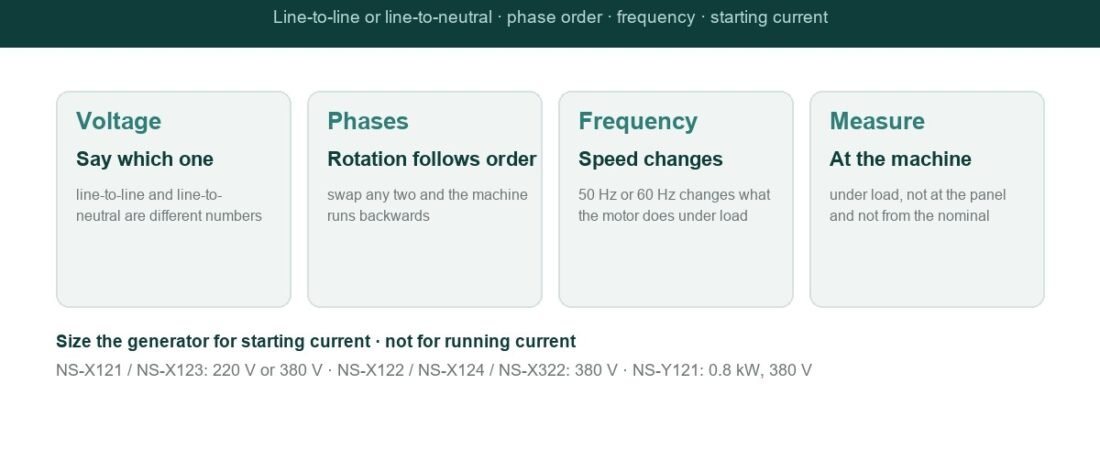
- Voltage is stated as line-to-line or line-to-neutral, so “220 V” means different things in different countries; say which one you mean.
- Three-phase rotation depends on phase order. Any two phases reversed and the motor runs backwards, which on a machine with a blower or a screw conveyor reverses the process.
- Frequency changes motor speed. A 60 Hz supply turns a 50 Hz motor faster, which changes output and load together.
- Some of our machines are offered with a voltage choice and some with a stated supply. Where the catalogue lists a choice, the choice is confirmed at order; where it does not, the supply is confirmed in writing for your configuration.
- Measure at the machine, under load, before you order – not at the incoming panel and not from the utility’s nominal figure.
- Motors starting on a generator need the generator sized for starting current, not running current.
Why the destination decides the machine
A machine is a mechanical design plus an electrical drive, and only the drive usually changes with destination. What changes is more than a plug:
- The motor winding must suit the supply voltage.
- The phase arrangement decides whether the machine can be connected at all.
- The frequency decides the motor’s speed, and therefore the working behaviour of everything driven by it.
- The control circuit may run on a separate voltage from the motor, whether from a transformer or a switch-mode supply inside the panel.
- The protection – breaker, isolator, cable and earthing – has to be sized for the machine’s actual current, not for the socket that happens to be nearby.
This is why the power question belongs in the first enquiry rather than the shipping email. Changing a winding, a control transformer or a heating element after the machine is on the water is expensive; deciding it before production is a line in the specification.
Single-phase and three-phase: what actually changes
| Single-phase | Three-phase | |
|---|---|---|
| Typical use in our range | Small threshing and shelling drives | Peelers, opening machines, cashew shelling, larger lines |
| Motor construction | Capacitor or split-phase arrangement, more current per kW | Simpler, more efficient motor |
| Starting | Higher starting current, more strain on the supply | Better starting torque, gentler for a given load |
| Rotation direction | Fixed by the wiring | Set by phase order and easily reversed |
| Cable size | Larger for the same power | Smaller for the same power |
| Site requirement | Common in small workshops | Needs a three-phase supply and a suitable panel |
The practical consequence is simple: a three-phase machine needs a three-phase supply, and a single-phase machine cannot be upgraded to three-phase by changing a plug. If your site only has one of the two, that decides the configuration you order.
50 Hz and 60 Hz: why the same machine behaves differently
Frequency changes the speed at which an induction motor runs, and speed is not a cosmetic difference on a nut machine: it changes throughput, it changes the working action at the gap or the crusher, and it changes how hard the motor is working while doing it.
Three practical points:
- A 50 Hz motor on a 60 Hz supply runs faster and, unless the machine is adjusted, it will be asked to do more work per hour than it was set for. Capacity and setting both need reviewing, with the supplier, against the actual supply.
- A 60 Hz motor on a 50 Hz supply runs slower. Output drops, and a machine bought on a rated capacity may not reach it.
- Control and heating elements may also be frequency- or voltage-sensitive, which is why the whole panel is specified for the destination rather than only the motor.
Voltage and power supply as specified for our machines
The table below is what our own product catalogue states. Where a machine is listed with a choice, the choice is confirmed with the order. Where a machine is listed without a published supply figure, the supply for your configuration is confirmed in writing before production rather than assumed here.
| Machine | Model | Power supply as specified |
|---|---|---|
| Pine nut threshing machine, standard | NS-S121 | 3 kW, 220 V |
| Pine nut threshing machine, high capacity | NS-S122 | 2 kW, 220 V, with three-phase drive for continuous duty |
| Macadamia nut shelling machine, standard | NS-X221 | 3 kW + 1 kW, 220 V |
| Macadamia nut shelling machine, heavy duty | NS-X222 | Confirmed per configuration |
| Macadamia green husk peeler, small | NS-X121 | 2.2 kW, 220 V or 380 V |
| Macadamia green husk peeler, medium | NS-X123 | 3 kW, 220 V or 380 V |
| Macadamia green husk peeler, large | NS-X122 | 4 kW, 380 V |
| Macadamia green husk peeler, industrial | NS-X124 | 3 kW, 380 V |
| Macadamia nut opening machine, compact | NS-X321 | Confirmed per configuration |
| Macadamia nut opening machine, industrial | NS-X322 | 6 kW, 380 V |
| Cashew shelling machine | NS-Y121 | 0.8 kW, 380 V |
| Coffee fruit peeling machine | – | Confirmed per configuration |
OEM branding and customisation are available on request, and the configuration you need – including the supply it will run on – is confirmed in writing before production.
What to measure at your site before you order
Measurements taken from a utility’s nominal figure and measurements taken at the machine are two different numbers. Take the second one.
1. Voltage at the point of connection, with the load running. A supply that reads at nominal at rest can sag under load, and that sag is what the motor actually sees.
2. Number of phases and the line-to-line and line-to-neutral voltages. Both, because panels and control circuits sometimes use the neutral.
3. Frequency, confirmed rather than assumed. Some countries operate more than one.
4. The panel’s rating and spare capacity, including whether the breaker can take the machine’s starting current alongside everything already on that circuit.
5. Cable route and length from panel to machine position, because length and cable size decide the voltage drop at the machine.
6. Earthing arrangement and RCD/earth-leakage protection, as required locally.
7. Whether the supply is mains, generator, or both – many plants start on a generator and switch later, and the machine has to suit both.
A photograph of the panel label and the machine’s intended position is often more useful than a description, and it costs nothing to send.
Generators, voltage drop and long cable runs
Three issues account for most of the power complaints we hear about machines that are working perfectly:
- Generator sizing against starting current. A motor draws considerably more current while starting than while running, so a generator sized on running kW may still not start the machine. The starting method matters as much as the generator: a drive or a soft-start reduces the starting current and, with it, the generator you need.
- Voltage drop over a long run. Undersized cable for the distance delivers a lower voltage at the machine than at the panel, and low voltage shows up as a motor that runs hot, starts slowly or trips under load.
- Phase order after a switchover. Moving between mains and a generator, or re-terminating a plug, can reverse two phases and reverse the machine.
| What the customer reports | What it usually is | What to check first |
|---|---|---|
| Motor runs hot and trips under load | Voltage below nominal at the machine, not at the panel | Measure at the machine while it is running under load |
| Machine turns the wrong way after a change of supply | Two phases swapped at the panel, or at the plug | Jog with no material and confirm rotation on the driven part |
| Generator cuts out when the machine starts | Generator sized on running current instead of starting current | Review the starting method as well as the generator rating |
| Output lower than the capacity figure quoted | Supply frequency below the design figure, or a setting calibrated on a different supply | Confirm frequency and re-check the setting against the actual supply |
In every one of those cases the machine is behaving correctly for the electricity it is receiving. That is why supply information belongs in the enquiry rather than in the fault report.
What to put in the enquiry
- Country and city of installation.
- Voltage, phases and frequency, measured at the machine position.
- Mains or generator, and whether the changeover is automatic.
- Ambient conditions, if the site is very hot, very cold, humid or dusty.
- The material you will process and the capacity you need per shift.
- Whether you want OEM branding or a specific configuration.
- A photograph of the panel and the intended installation position.
With those, the supply question is settled in the quotation instead of in the first week of production.
Frequently asked questions
Can I run a 380 V machine on a 220 V single-phase supply?
Not as delivered, and not by changing a plug. A three-phase machine needs a three-phase supply, and the motor winding, the control circuit and the protection all belong to that arrangement. The practical routes are to bring three-phase power to the machine position, or to order the configuration that suits the supply you actually have – which is why the measured supply belongs in the first enquiry.
What happens if I run a 50 Hz machine on a 60 Hz supply?
The motor runs faster, so the working parts run faster and the machine is asked to do more work per hour than it was set for. Output may rise and load definitely does, and the working setting – gap, angle, crusher clearance – usually needs reviewing with the supplier against the actual supply. It is a manageable difference when it is planned for, and an unpleasant surprise when it is discovered after installation.
How do I check rotation direction safely?
Jog the machine with no material in it, watch the driven part – not only the motor – and compare it with the direction marked in the documentation. On a three-phase machine, reversing any two of the three supply conductors reverses rotation. Check again after any electrical work or generator switchover: with a blower or screw conveyor stage, the wrong direction produces a wrong result rather than an obvious fault.
Is equipment supplied with a plug and cable for my country?
Plug, cable and panel arrangements differ by country and by site, and the safest approach is to confirm in the enquiry what is supplied with the machine and what is provided locally. What matters for the machine is the supply it is configured for; what matters for the installation is that the cable, breaker and earth protection are sized for its actual current and starting method.
Can the machine be customised for a different voltage?
OEM branding and customisation are available on request, and voltage, phase and frequency requirements are part of what is confirmed in writing before production. Tell us the measured supply at your installation position, whether it is mains or generator, and the capacity you need; the configuration is then confirmed against those figures rather than against an assumed standard.
What is the minimum order, and how quickly do you reply?
Minimum order is one unit. OEM branding and customisation are available on request, specifications are confirmed in writing before production, and we normally reply within one business day.
Tell us what your supply looks like
Send us your measured voltage, phases and frequency, whether you run on mains or generator, and the machines you are considering, and we will tell you which configuration fits and what to check at your panel before delivery. Reach us through the contact page.
Related reading and machines
- Nut processing line installation: how to inspect and commission
- Nut processing machine maintenance checklist
- How to size a pine nut processing line
- Which macadamia machine capacity do you actually need?
- Macadamia green husk peeler, small model NS-X121
- Cashew shelling machine, model NS-Y121
- All nut processing machines
- Nut processing knowledge base
- Nut processing machine quotation: what to include in your enquiry
- Coffee processing: complete guide from cherry to green bean