Sizing a pine nut line is not a question about machines. It is a question about one number: how many kilograms have to pass through the line on your busiest day, and how many hours you actually have to move them. Answer that, and the machine choice falls out of the arithmetic. Skip it, and you either buy capacity you will never use or discover the shortfall in the middle of a harvest, when there is nothing you can do about it.
This page sets out the five steps we use when a buyer sends us a requirement, the two published models that cover most small and mid-size lines, and the place where most pine nut lines quietly go wrong.
Last updated: 27 September 2026
The short answer
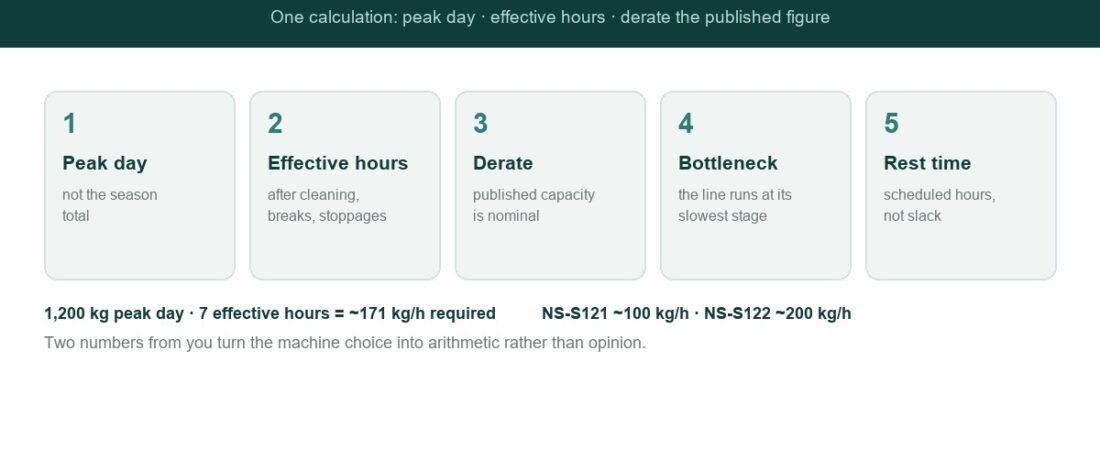
- Size against your peak day, never your season total. A season total is a comfortable number that hides a two-week bottleneck.
- Convert the peak day into an hourly requirement, using hours you can really run. Subtract breaks, cleaning, breakdowns and the shift change you will actually take.
- Then derate the published capacity. A published figure is a nominal throughput; your material, moisture and duty cycle decide what you get.
- The line runs at the speed of its slowest stage. Find that stage before you buy anything, because it is usually upstream of the machine everyone wants to talk about.
- Standing time is part of the schedule, not slack. Seed has to settle after drying before it can be shelled well – see pine nut drying and shelling settings.
- Two published models cover most cases: the NS-S121 at around 100 kg/h on 3 kW, 220 V, and the NS-S122 at around 200 kg/h on 2 kW, 220 V with a three-phase drive for continuous duty.
What sizing actually decides
Before the arithmetic, it is worth being clear about what the answer is used for. A sizing calculation decides:
- How many machines of each kind the line needs, and which published model covers the duty.
- Whether one shelling machine is enough or whether the peak needs two.
- How much drying capacity has to exist upstream of the sheller.
- How much buffer space you need for seed that is drying, standing or waiting.
- How many people the line needs per shift, because manual stages are throughput limits too.
- What you should not buy yet.
The last point matters most. Most small lines overspend on the stage they find most interesting and underspend on the stage that actually sets the pace.
Step 1 – Fix the number you are sizing against
Use your peak day, not your average day and not your season total. If you do not have records, estimate from the busiest delivery week you can remember and round up rather than down.
Write down three figures:
- Peak daily intake in kilograms. What arrives on the worst day, not what you hope will arrive.
- Hours available per day. The hours the line can run, not the hours the building is open.
- Effective hours. Hours available minus cleaning, breaks, start-up and the downtime that always happens.
If the peak day is 1,200 kg and you have eight hours that realistically produce seven effective hours, the requirement is 1,200 / 7 = around 171 kg/h.
Step 2 – Convert the peak day into an hourly requirement per stage
Do this per stage, because the line is not one machine. A simple table makes the shortfall obvious:
| Stage | Peak daily load | Effective hours | Required rate |
|---|---|---|---|
| Intake and grading | 1,200 kg | 7 | ~171 kg/h |
| Threshing or cone breaking | 1,200 kg | 7 | ~171 kg/h |
| Drying and standing | 1,200 kg | 7 drying + standing | set by dryer capacity |
| Shelling | 1,200 kg | 7 | ~171 kg/h |
| Kernel grading | 1,200 kg in, kernel out | 7 | scales with kernel share |
| Packing | kernel output | 7 | the last stage, often forgotten |
The moment you write it down, the arithmetic stops being a debate. Either a published model covers the required rate or it does not.
Step 3 – Derate the published figure before you compare it
A published capacity is a nominal throughput: clean, uniform, correctly prepared material fed at a steady rate by an attentive operator. Real shifts are not like that. When we plan a line with a buyer, we compare the requirement against a derated version of the published figure, and we say plainly that the derating is a planning convention rather than a machine specification.
What moves the number down:
- Material variability within the batch – mixed species, mixed seed size, mixed shell thickness.
- Moisture outside the working window, which forces slower feeding or better drying.
- Interrupted feeding, because intake arrives in lorries rather than at a constant rate.
- Duty cycle, if the machine is expected to run continuously rather than in bursts.
- Operator attention, which is a real variable on any manual stage.
What moves it up: a single consistent supply, seed that has already been graded and dried correctly, and a line designed so that no stage has to wait for another.
Step 4 – Find the bottleneck before you buy anything
Every line has one stage that decides the day”s output. Work down the list and ask, for each stage, what would stop it:
| Stage | What usually limits it | How to check it in one shift |
|---|---|---|
| Intake and grading | Manual sorting speed | Time a 50 kg lot by hand |
| Cone breaking or threshing | Published throughput and feed continuity | Weigh the output of a 30-minute run |
| Drying | Airflow, batch depth, ambient humidity | Weigh the batch before and after each pass |
| Standing | Nothing – it is a buffer, but it takes hours | Count the hours, do not assume them |
| Shelling | Moisture window and settings | Weigh the three streams |
| Kernel grading | Manual or mechanical separation | Time a 10 kg kernel lot |
| Packing | Labour and container handling | Count cartons per hour |
Two outcomes are common. On small lines, the bottleneck is usually manual sorting or packing, not the machine. On growing lines, it is drying: the sheller is fast enough, but the dryer cannot deliver dried, settled seed at the rate the sheller can empty the floor.
Step 5 – Match the stages, then check the schedule
Matching means the required hourly rate is met or exceeded at every stage, and no stage is more than roughly double the previous one. A stage that is five times faster than the one before it is capital you have tied up in idle capacity.
Two worked examples, using the published figures:
| Requirement | Peak day | Effective hours | Required rate | What the arithmetic says |
|---|---|---|---|---|
| Small holding or cooperative | ~600 kg | 7 | ~86 kg/h | One NS-S121, published at around 100 kg/h, covers the peak with modest margin |
| Larger operation, or a shorter harvest with heavier daily intake | ~1,600 kg | 7 | ~229 kg/h | One NS-S122, published at around 200 kg/h, is close to the line; two units, or longer effective hours, give a real margin |
Both rows assume the upstream stages can keep up. If the dryer cannot deliver 600 kg of settled seed inside the available hours, then the honest answer is not a bigger sheller – it is more drying capacity, or a longer schedule, or a smaller daily intake.
The two published models, side by side
These are the figures we publish for the two threshing models that cover most small and mid-size pine nut lines. Use the footprint and weight columns for space and floor planning, and the capacity column for the calculation above.
| Specification | NS-S121 (standard) | NS-S122 (high capacity) |
|---|---|---|
| Published capacity | ~100 kg/h | ~200 kg/h |
| Power supply | 3 kW, 220 V | 2 kW, 220 V |
| Drive | – | Three-phase drive for continuous duty |
| Dimensions (L x W x H) | 1,200 x 700 x 1,000 mm | 1,350 x 1,100 x 1,400 mm |
| Machine weight | ~120 kg | ~120 kg |
| Separation principle | Toothed crusher plus blower separation | Toothed crusher plus blower separation |
| Packing volume | 1.00 CBM | 2.10 CBM |
| Packed weight | ~200 kg | ~200 kg |
The counter-intuitive detail is the power figure: the higher-capacity model is published at the lower motor rating. That is not an error. The two machines reach their capacity in different ways, and the NS-S122 is quoted with a three-phase drive precisely because it is intended for continuous duty. Plan around throughput and duty cycle rather than motor size on its own – and check the supply you actually have, because single-phase and three-phase availability decides which model is even an option on your site.
What a line looks like at three scales
- One machine, one job. A threshing or cone-breaking machine feeding a drying floor and a hired shelling service. Sizing here is simple: buy the model that clears your peak day in the hours you have.
- Two machines, one flow. Threshing plus shelling on site, with drying in between. This is where the standing time starts to matter, because the sheller will be idle while seed settles unless the schedule is planned.
- Staged line with grading. The same flow with mechanical sorting and packing, which is what turns a seasonal operation into one that can supply buyers with a consistent grade.
Each step up adds capital and adds control. The mistake to avoid is adding the interesting stage – a second sheller – while the constraint is still drying or packing.
Where the losses actually hide
- Undersized drying. The sheller is blamed for damage that was created by shelling seed outside its moisture window.
- No buffer. Without standing capacity, seed is shelled hot from the dryer, and whole kernel recovery drops.
- Oversized intake. A machine bought for a peak that lasts two days sits idle for the season while its cost stays on the balance sheet.
- Manual bottlenecks. Grading and packing by hand can cap a line below the throughput of every machine on it.
What to send for a straight answer
Send these six things and any supplier can answer with a model and a number instead of a range:
1. Peak daily intake in kilograms, and how you measured or estimated it.
2. Effective hours per day, after cleaning and breaks.
3. Species or species mix, and the seed size range you see.
4. What you currently do at each stage, and which stage you are trying to fix.
5. The supply available on site: voltage, phases, and whether the supply is stable through the shift.
6. The space you can give the line, including ceiling height and access for delivery.
If you send only two, send numbers one and two.
Frequently asked questions
How do I calculate the capacity I need?
Divide your peak daily intake by your effective hours. If 1,200 kg has to move in seven effective hours, you need around 171 kg/h. Compare that requirement against a derated version of the published figure rather than the nominal one, then check that every upstream and downstream stage can match it.
Can one high-capacity machine replace two standard ones?
On paper, yes: the NS-S122 is published at around double the throughput of the NS-S121. In practice the two are not interchangeable, because capacity and duty cycle are different questions. The NS-S122 is quoted with a three-phase drive for continuous duty, and the NS-S121 at 3 kW on 220 V. What decides it is whether your site has the supply, and whether your bottleneck is throughput or continuous running hours.
What if my peak season is only a few weeks a year?
Size for the peak, but consider whether the peak can be stretched rather than met. Running the line for more hours, or accepting two passes over a longer schedule, is usually cheaper than buying a machine that stands idle for eleven months. The published figures are hourly rates: hours and throughput can be traded against each other.
How much floor space does a line need?
Start from the machine footprint and add the working space around it. The NS-S121 is 1,200 x 700 x 1,000 mm and the NS-S122 is 1,350 x 1,100 x 1,400 mm, and those are machine dimensions, not a room size. Then add the space for drying, for seed standing before shelling, and for kernel and shell storage – on most lines that is the larger part of the floor.
Do you supply dryers, graders and packing equipment?
We build the peeling, threshing and cracking machines in this range. When a requirement sits outside what we make, we will say so rather than sell you something adjacent, and we will tell you which stage to source elsewhere.
What is the minimum order, and how quickly do you reply?
Minimum order is one unit. OEM branding and customisation are available on request, specifications are confirmed in writing before production, and we normally reply within one business day.
Send us your two numbers
Give us your peak daily intake and your effective hours, and we will tell you which model covers the duty, where the bottleneck is likely to sit, and whether the honest answer is that you need more drying capacity rather than a bigger machine. Reach us through the contact page.
Related reading and machines
- Pine nut processing: the complete guide
- Pine nut drying and shelling settings
- Pine nut threshing: cones to seeds
- Macadamia processing line layout: harvest to packed kernels
- Standard pine nut threshing machine, NS-S121, around 100 kg/h
- High-capacity pine nut threshing machine, NS-S122, around 200 kg/h
- Pine nut threshing machines
- All nut processing machines
- How to inspect and commission a nut processing line