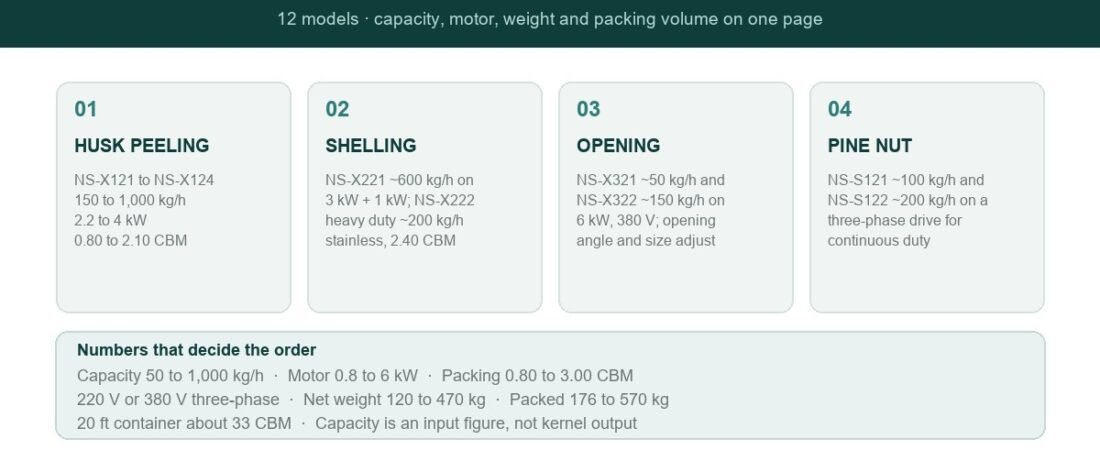
Buying a nut processing machine usually starts with one question — how many kilos per hour — and then runs straight into a second question that many supplier pages never answer: what does the machine draw, what does it weigh, and how much space does it take up in a container?
This page is a reference chart rather than a sales page. Every figure below is taken from the published specification sheet of the machine it belongs to, so you can compare families side by side, size equipment to a season instead of to a brochure, and read a quotation without having to ask for the same numbers twice.
Last updated: October 2026
The short answer
- Published capacities across our range run from ~50 kg/h to 1,000 kg/h, in six machine families: green husk peeling, shelling, opening, pine nut threshing, cashew shelling and coffee pulping.
- Power supply is not uniform. Most models are available on 220 V, but several run on 380 V three-phase — check the voltage column before you compare two models on price.
- Capacity is an input figure, measured on properly graded, correctly conditioned nuts. It is not a promise about finished kernel output.
- Packing volume ranges from 0.80 CBM to 3.00 CBM per unit, which is what decides whether a small order ships loose, on a pallet, or in a shared container.
- Three models — the coffee fruit peeling machine, the heavy-duty macadamia sheller and the compact opening machine — do not carry published motor or capacity figures, because their build is confirmed per order.
- The numbers on this page are not prices. If you need an FOB quotation, the fastest route is to send throughput, nut type and destination port through the enquiry form.
How to read a capacity figure without being misled
A capacity figure is only meaningful with three things attached to it: what is being fed, how well it is graded, and what the machine is doing with it.
Take the NS-Y121 cashew shelling machine. Its published capacity is ~50 kg/h and its shelling rate is 90-95%, with roughly 3% of nuts left unshelled. Both numbers are true at the same time, and a quote that mentions only the first one is incomplete. The 50 kg/h is raw cashew in shell going in; the 90-95% describes how much of that stream comes out shelled. An eight-hour shift at that rate handles about 400 kg of raw cashew — not 400 kg of kernels.
The same distinction applies to macadamia. A shelling machine rated at ~600 kg/h is rated on nut in shell. What share of that becomes whole kernel depends on moisture, variety and the gap settings upstream, which is why we publish the whole-kernel rate as a separate topic rather than folding it into the capacity number.
Two more habits make capacity figures comparable:
- Ask whether the figure is measured on one pass or on re-circulated product. Some suppliers quote a second-pass rate; a single-pass rate is the honest one to compare.
- Ask what nut size the figure assumes. A machine fed ungraded nuts runs slower and breaks more, whatever the rating says.
The 12 machines at a glance
| Model | Machine | Capacity | Power supply | Dimensions (L x W x H) | Net / packed weight | Packing volume |
|---|---|---|---|---|---|---|
| NS-X121 | Macadamia green husk peeler, small | ~150 kg/h | 2.2 kW, 220 V or 380 V | 1,050 x 400 x 750 mm | ~126 kg / ~176 kg | 0.80 CBM |
| NS-X123 | Macadamia green husk peeler, medium | 300 kg/h | 3 kW, 220 V or 380 V | 1,050 x 400 x 1,400 mm | ~160 kg / ~220 kg | 1.00 CBM |
| NS-X122 | Macadamia green husk peeler, large | ~500 kg/h | 4 kW, 380 V | 820 x 580 x 1,000 mm | ~130 kg / ~180 kg | 0.80 CBM |
| NS-X124 | Macadamia green husk peeler, industrial | 1,000 kg/h | 3 kW, 380 V | 2,350 x 630 x 1,130 mm | ~280 kg / ~360 kg | 2.10 CBM |
| NS-X221 | Macadamia nut shelling machine, standard | ~600 kg/h | 3 kW + 1 kW, 220 V | 1,350 x 1,000 x 1,300 mm | ~250 kg / ~330 kg | 2.00 CBM |
| NS-X222 | Macadamia nut shelling machine, heavy duty | ~200 kg/h | confirmed per configuration | 1,150 x 990 x 1,370 mm | ~390 kg / ~475 kg | 2.40 CBM |
| NS-X321 | Macadamia nut opening machine, compact | ~50 kg/h | confirmed per configuration | 1,200 x 700 x 1,100 mm | ~250 kg / ~330 kg | 1.00 CBM |
| NS-X322 | Macadamia nut opening machine, industrial | ~150 kg/h | 6 kW, 380 V | 1,850 x 1,200 x 1,180 mm | ~470 kg / ~570 kg | 2.70 CBM |
| NS-S121 | Pine nut threshing machine, standard | ~100 kg/h | 3 kW, 220 V | 1,200 x 700 x 1,000 mm | ~120 kg / ~200 kg | 1.00 CBM |
| NS-S122 | Pine nut threshing machine, high capacity | ~200 kg/h | 2 kW, 220 V | 1,350 x 1,100 x 1,400 mm | ~120 kg / ~200 kg | 2.10 CBM |
| NS-Y121 | Cashew shelling machine | ~50 kg/h | 0.8 kW, 380 V | 1,450 x 700 x 1,200 mm | ~200 kg / ~280 kg | 3.00 CBM |
| — | Coffee fruit peeling machine | confirmed per configuration | confirmed per configuration | confirmed per configuration | confirmed per configuration | confirmed per configuration |
Two rows deserve a note rather than a blank. The heavy-duty macadamia sheller (NS-X222) and the compact opening machine (NS-X321) have complete dimensional, weight and packing data but no published motor figure, because the drive is matched to the application when the order is confirmed. The coffee fruit peeling machine is a different machine family altogether: what is fixed in its specification is the machine type, the application, an adjustable pulping gap and the carbon steel body — capacity and motor are agreed in writing per order. If you are comparing suppliers, treat “confirmed per configuration” as an instruction to ask, not as a hidden weakness.
Reading the families, one by one
Macadamia green husk peelers
The widest capacity spread in the range sits here: ~150 kg/h, 300 kg/h, ~500 kg/h and 1,000 kg/h. The two largest-capacity units are not the heaviest ones — the 1,000 kg/h NS-X124 is longer and heavier, but the ~500 kg/h NS-X122 is the most compact machine we build at 820 x 580 x 1,000 mm. Husk peeling is a first-24-hours job, so a peeler is usually sized against the daily intake of a harvest day, not against the whole season.
Macadamia nut shellers
The standard model is the high-throughput one at ~600 kg/h on 3 kW + 1 kW; the heavy-duty model is the slower, stainless-steel one at ~200 kg/h with automatic continuous feeding and discharging. That inversion catches people out. A stainless heavy-duty machine is chosen for product contact, sanitation and duty cycle, not for speed, so comparing the two on kg/h alone will point you at the wrong machine.
Macadamia nut opening machines
Opening is a different operation from shelling: the shell is scored or opened so the kernel can be released without a full crush. Capacities are deliberately modest — ~50 kg/h for the compact NS-X321 and ~150 kg/h for the industrial NS-X322 — and the industrial unit carries the largest single motor on this page at 6 kW on 380 V. Both allow the opening angle and opening diameter to be adjusted.
Pine nut threshing machines
The standard NS-S121 handles ~100 kg/h on 3 kW, while the high-capacity NS-S122 handles ~200 kg/h on 2 kW, because it uses a three-phase drive built for continuous duty. Doubling throughput for less motor power is the normal pattern when a machine is designed for sustained running rather than intermittent batches. Both use the same separation principle: a toothed crusher with blower separation.
Cashew shelling machine
One model, the NS-Y121: ~50 kg/h, 0.8 kW, 380 V, opening two cashews per cycle. Its packing volume of 3.00 CBM makes it the bulkiest unit on the page relative to its output, which matters if you are shipping a mixed order.
Coffee fruit peeling machine
A wet-processing machine rather than a nut machine: it removes the outer skin and pulp from fresh coffee cherries, with an adjustable pulping gap. Because pulping settings, not throughput, decide bean damage, this is a machine we quote against the specific cherry variety and daily volume.
What the power column actually means for your site
Power supply is where a purchase most often stalls after the machine has been chosen. The chart shows two groups:
- Rated at 220 V: NS-X221, NS-S121, NS-S122 — and the small and medium green husk peelers, available on either 220 V or 380 V.
- Rated at 380 V three-phase: NS-X122, NS-X124, NS-X322, NS-Y121, plus NS-X222 according to configuration.
Three things are worth confirming before you commit to a model:
- The phase, not just the voltage. A machine listed at 220 V may still need a three-phase supply in the final build, which is why the pine nut line is described as a three-phase drive for continuous duty.
- Whether the motor is matched to a duty cycle. Running a nominal 300 kg/h machine two shifts a day is not the same purchase as running it one hour a day.
- What the site can actually deliver. Motor rating is only half of the electrical answer: starting current, cable run and generator behaviour are the other half, and they are handled in a separate guide on voltage and power requirements for export machines.
Turning kg/h into tonnes per season
Capacity per hour becomes a purchasing decision only when it is multiplied out. The arithmetic is simple, and it is the fastest way to eliminate models you do not need.
| Machine | Capacity | One 8-hour shift | 20 working days | 60 working days |
|---|---|---|---|---|
| NS-X321 opening machine | ~50 kg/h | ~0.4 t | ~8 t | ~24 t |
| NS-Y121 cashew sheller | ~50 kg/h | ~0.4 t | ~8 t | ~24 t |
| NS-S121 pine nut thresher | ~100 kg/h | ~0.8 t | ~16 t | ~48 t |
| NS-X121 green husk peeler | ~150 kg/h | ~1.2 t | ~24 t | ~72 t |
| NS-X322 opening machine | ~150 kg/h | ~1.2 t | ~24 t | ~72 t |
| NS-S122 pine nut thresher | ~200 kg/h | ~1.6 t | ~32 t | ~96 t |
| NS-X123 green husk peeler | 300 kg/h | ~2.4 t | ~48 t | ~144 t |
| NS-X122 green husk peeler | ~500 kg/h | ~4.0 t | ~80 t | ~240 t |
| NS-X221 macadamia sheller | ~600 kg/h | ~4.8 t | ~96 t | ~288 t |
| NS-X124 green husk peeler | 1,000 kg/h | ~8.0 t | ~160 t | ~480 t |
Read the table as a filter, not a forecast. Field conditions — nut size, moisture, feeding discipline, how often the operator stops to clear a blockage — all sit on top of the rated figure. A cooperative that harvests 40 tonnes of nut in shell over a three-week window does not need the 1,000 kg/h machine; it needs a machine that will not be the bottleneck on its two busiest days, which is usually the 300 kg/h or ~500 kg/h unit running a long shift.
If you already know your season volume rather than your hourly target, the same arithmetic runs in reverse, and it is the calculation behind our note on choosing equipment for a farm-scale line.
Packing volume and shipping
Packing volume decides how a machine travels, and it is quoted per unit as CBM — cubic metres of packed volume.
| Packing volume | Models | Notes |
|---|---|---|
| 0.80 CBM | NS-X121, NS-X122 | The two most compact units; easy to consolidate |
| 1.00 CBM | NS-X123, NS-X321, NS-S121 | Fits alongside other units in a shared load |
| 2.00 – 2.40 CBM | NS-X221, NS-X124, NS-S122, NS-X222 | Pallet or crate shipment; pair well |
| 2.70 CBM | NS-X322 | Largest macadamia unit by volume |
| 3.00 CBM | NS-Y121 | Largest single packed volume in the range |
For context, a typical 20-foot container holds roughly 33 CBM of usable volume and a 40-foot container roughly 67 CBM, though the usable figure depends on how crates stack. That makes a two-machine order — say an NS-X123 peeler at 1.00 CBM and an NS-X221 sheller at 2.00 CBM — a loose-load shipment rather than a container load, while a full line of four to six units is where consolidation starts to change the freight arithmetic.
Net weight and packed weight are quoted side by side in the main chart for the same reason: the difference between ~250 kg and ~330 kg on an NS-X221 is crate, pallet and protection, and it is the packed figure that the freight forwarder will ask for.
Comparing two quotations on throughput
If two suppliers quote the same kg/h and different prices, the difference is almost always hiding in one of these six places. Ask for all of them in writing:
| What to ask for | Why it changes the answer |
|---|---|
| Rated capacity and the nut it was measured on | A rating on graded, dried nuts is not a rating on field-run nuts |
| Motor rating, phase and voltage | A 220 V build and a 380 V build are different machines on site |
| Net weight and packed weight separately | Freight and handling are quoted on packed weight |
| Packing volume in CBM | Decides whether your order ships loose or in a container |
| Dimensions in mm, all three axes | Doorway, ceiling and floor-space checks happen before delivery |
| Which wearing parts are supplied | Sets the first re-order, not the purchase price |
Anything a supplier cannot put in writing is a question worth asking again before the deposit.
What to send us for a matched proposal
We do not publish prices on this site, because the quotation depends on configuration, packing and destination. What we need in order to answer properly is short:
- the nut or fruit you process, and whether it is fresh, wet or dried;
- your target throughput per hour, per shift or per season — any one of the three is enough;
- the stage you need: husk peeling, shelling, opening, threshing, pulping, or a combination;
- your site’s available power (220 V or 380 V, single or three-phase);
- the destination port, so the freight basis is right from the first message.
Send those five points through the enquiry form and you will get a matched model list with the numbers from this page attached, rather than a generic catalogue. If you would rather compare on paper first, the guide to what a quotation should contain walks through the same checklist from the buyer’s side.
Frequently asked questions
What is the difference between capacity and output?
Capacity is an input figure: how much raw material the machine can take in per hour, measured on graded and correctly conditioned nuts. Output is what leaves the machine after losses, and it is always lower. On the NS-Y121 cashew sheller, for example, ~50 kg/h of raw cashew in shell goes in and 90-95% of it comes out shelled, so the two numbers describe different points in the same process.
Which machine has the highest capacity?
The NS-X124 macadamia green husk peeler is the highest-capacity unit we publish, at 1,000 kg/h on a 3 kW, 380 V supply. It is also one of the two longest machines at 2,350 mm, so it is a line machine rather than a bench machine. In macadamia shelling the highest figure is the NS-X221 at ~600 kg/h.
Why do some machines have no published power rating?
Three units are quoted per configuration rather than from a fixed sheet: the coffee fruit peeling machine, the NS-X222 heavy-duty macadamia sheller and the NS-X321 compact opening machine. Their drive is matched to the application at the point of order, so publishing a single motor figure would be misleading. Ask for the confirmed rating in writing and it will be stated on the quotation.
Can I run these machines on a generator?
Possibly, but motor rating alone does not answer it. Starting current on a three-phase motor is several times the running current, so a generator sized only against the kW figure can stall when the machine starts under load. Tell us the site’s supply — generator, mains, voltage and phase — and it will be checked against the specific model rather than a general rule.
How many machines fit in one 20-foot container?
A 20-foot container holds roughly 33 CBM of usable volume, so the packing column is what decides it. At 0.80 to 1.00 CBM per unit, the small peelers, the compact opening machine and the standard pine nut thresher consolidate easily; the 2.00-3.00 CBM units — NS-X221, NS-X322, NS-Y121 — fill a container much faster and are usually shipped in small multiples or consolidated with accessories.
Do these capacities apply to other nuts?
No. Every figure on this page is published for the machine’s stated application: macadamia in shell for the shellers and openers, pine cones for the threshers, cashew in shell for the NS-Y121, fresh coffee cherries for the pulper. Cashew and peanut coverage exists on the NS-Y121 because the machine is built for both, but the 90-95% shelling rate is quoted for cashew, and capacities do not transfer between crops.
Get a matched model list
The chart above is the specification side of the decision. The other side is your season: how much material you handle on your busiest day, what power your site can deliver, and where the machines have to land.
Send the five points listed above through our enquiry form and we will come back with the two or three models that fit, the numbers each one is rated at, and the shipping volumes for your destination port. If it is easier to talk it through, email nanshengtechnology@gmail.com or message +86 133 7302 3075 on WhatsApp.
Related reading and machines
- Nut processing machines: all 12 models
- How to size equipment for a farm-scale line
- Voltage and power requirements for export machines
- What a nut processing machine quotation should contain
- Whole kernel rate: how to measure and improve it
- Macadamia processing line layout: harvest to packed kernel
- Macadamia nut shelling machine, standard NS-X221
- Cashew shelling machine NS-Y121
- Macadamia green husk peeler, industrial NS-X124
- Pine nut threshing machine, high capacity NS-S122
- Coffee fruit peeling machine
- Macadamia shelling machines category
- Knowledge forum: processing guides