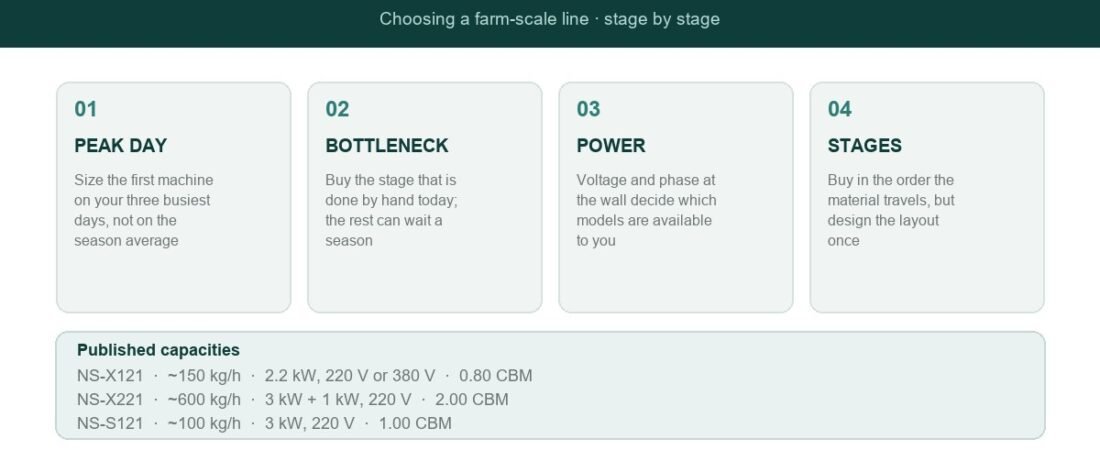
Small-scale nut processing fails for a predictable reason: the first machine is bought for the peak day and the rest of the line is bought for the average one, so the plant spends the season with one stage running flat out and three stages idle. The second most common failure is the reverse – a line is assembled stage by stage until the power supply can no longer run it.
This page is written for growers and co-operatives putting a first line together. It covers what “small scale” actually means in throughput terms, which stage to buy first, how the published capacities of our machines fit together, and the two constraints – power supply and labour – that decide the answer before any specification does. Every machine figure quoted below is a figure we publish in our own catalogue.
Last updated: 3 October 2026
The short answer
- “Small scale” is a throughput band, not a budget. Work out the kilos per hour your peak week requires before looking at any machine.
- Buy the bottleneck first. One machine that removes the constraint is worth more than three that do not.
- Match each stage to the one before it. A line is only as fast as its slowest stage, and buying a fast machine upstream just moves the pile.
- The power supply is a hard limit. A 220 V single-phase site and a 380 V three-phase site do not have the same options, and this is decided before production.
- Build in stages, but design the layout once. Adding the second machine later is normal; rebuilding the floor plan is expensive.
- A farm-scale line usually needs one operator per active stage, so a four-stage line is a four-person commitment during harvest.
- Minimum order is one unit on everything we publish, so a single machine now and the next stage next season is a normal way to buy.
What “small scale” means in numbers
The phrase means different things to different people, so it is worth fixing a definition before choosing equipment. The bands below describe the throughput of a single line, not the size of the farm.
| Band | Typical throughput | What it usually means in practice |
|---|---|---|
| Household or trial | Tens of kilos per hour | Testing a variety, a market or a process before committing land to it |
| Farm scale | Around 100-300 kg/h per stage | One grower’s harvest, processed on the days it is picked |
| Co-operative scale | Around 300-600 kg/h per stage | Several growers delivering to one point, with a short season and high peaks |
| Small commercial | 600 kg/h and above | A plant that buys in raw material rather than only processing its own |
The band that fits you is set by your peak day, divided by the hours you are willing to run. A grower with a 2,000 kg peak day who will run eight hours needs around 250 kg/h, which is farm scale. The same grower running four hours needs 500 kg/h, which is co-operative scale. The harvest does not change; the labour pattern does.
Start with the bottleneck, not the catalogue
The order of purchase matters more than the choice of model, because a line produces at the rate of its slowest stage. The sequence that works is consistent across crops.
1. Find the stage that limits output today. Usually it is the one done by hand – cracking, peeling or sorting.
2. Size that stage for the peak day, not the average. A machine sized for the average is behind precisely when it matters.
3. Check whether the next stage can absorb the new output. If it cannot, either slow the new machine down or plan the second purchase now.
4. Only then look at the catalogue. Working from the constraint inwards keeps the specification honest.
Two corollaries follow. First, it is normal to buy one machine and run the other stages manually for a season. Second, buying the fastest machine available is not the same as buying the right one, because the upstream and downstream stages still decide what the line actually delivers.
Husk removal and peeling
Removing the green husk is the first mechanical stage for macadamia and the one that decides what the shelling stage sees. Our published range covers the farm-scale band and beyond.
| Model | Machine | Capacity | Power supply | Packing volume |
|---|---|---|---|---|
| NS-X121 | Macadamia green husk peeler, small | ~150 kg/h | 2.2 kW, 220 V or 380 V | 0.80 CBM |
| NS-X123 | Macadamia green husk peeler, medium | 300 kg/h | 3 kW, 220 V or 380 V | 1.00 CBM |
| NS-X122 | Macadamia green husk peeler, large | ~500 kg/h | 4 kW, 380 V | 0.80 CBM |
| NS-X124 | Macadamia green husk peeler, industrial | 1,000 kg/h | 3 kW, 380 V | 2.10 CBM |
Note the two models published with a voltage choice: the small and medium peelers can be built for 220 V or 380 V. That flexibility is unusual in the range and it is often what lets a farm-scale line start on an existing single-phase supply. The large and industrial models are published at 380 V only.
Shelling and opening
Shelling removes the shell to release the kernel. Opening is a different job: it opens the shell in a controlled way for a specific product, and the two should not be treated as alternatives to one another.
| Model | Machine | Capacity | Power supply | Packing volume |
|---|---|---|---|---|
| NS-X221 | Macadamia nut shelling machine, standard | ~600 kg/h | 3 kW + 1 kW, 220 V | 2.00 CBM |
| NS-X222 | Macadamia nut shelling machine, heavy duty | ~200 kg/h | Confirmed in writing | 2.40 CBM |
| NS-X321 | Macadamia nut opening machine, compact | ~50 kg/h | Confirmed in writing | 1.00 CBM |
| NS-X322 | Macadamia nut opening machine, industrial | ~150 kg/h | 6 kW, 380 V | 2.70 CBM |
Two observations matter for a small line. The first is that capacity and price do not move together – the standard shelling machine is published at a higher capacity than the heavy-duty model, because the heavy-duty machine is built differently rather than bigger. The second is that the two models whose power supply we do not publish are confirmed in writing per order, which is exactly what a quotation should do.
Threshing and cashew shelling
Pine nut threshing and cashew shelling are separate families, and a farm that grows pine nuts or cashews will size them the same way – from the peak day.
| Model | Machine | Capacity | Power supply | Packing volume |
|---|---|---|---|---|
| NS-S121 | Pine nut threshing machine, standard | ~100 kg/h | 3 kW, 220 V | 1.00 CBM |
| NS-S122 | Pine nut threshing machine, high capacity | ~200 kg/h | 2 kW, 220 V, three-phase drive | 2.10 CBM |
| NS-Y121 | Cashew shelling machine | ~50 kg/h | 0.8 kW, 380 V | 3.00 CBM |
The pine nut pair is a useful illustration of why a working pattern has to be stated with a capacity. The standard model is published at around 100 kg/h on a 3 kW, 220 V supply; the high-capacity model at around 200 kg/h with a three-phase drive for continuous duty. If your threshing happens a few days a week, the two are more similar in practice than the numbers suggest; if it runs all day, they are not.
Cashew shelling is a slower stage by nature, so a cashew line is usually sized around it. At around 50 kg/h on a 0.8 kW, 380 V supply, the machine is small in electrical terms and large in labour terms, which is typical of shelling stages.
The constraint that decides everything: power supply
Electrical configuration is decided at the factory, so it has to be decided in the enquiry. For a farm-scale line it is often the first question rather than the last.
- 220 V single phase. The usual farm supply. Some of our models are published with a choice of 220 V or 380 V, which is what makes a single-phase start possible on those stages.
- 380 V three phase. Needed for the models published at 380 V, and the normal choice for a line running continuously.
- Phase conversion. Adding a converter to run a three-phase machine from a single-phase supply is a decision with real trade-offs, and it should be discussed as part of the specification rather than settled after delivery.
- Total connected load. The stages do not all run at once, and the supply has to cover the combination you will actually run together.
Our guide to voltage and power requirements for export machines goes through this in detail, and it is worth reading before the enquiry rather than after the quotation.
Buying in stages without rebuilding the line
Very few farm-scale lines are bought complete. The sequence that keeps a line coherent is to buy in the order the material travels, and to reserve the floor space for the stages that are coming.
- Stage one is almost always the hand-limited stage – usually peeling, cracking or shelling.
- Stage two is whatever is now the constraint, which is often sorting or grading rather than the next processing step.
- Leave the material handling to last. Conveyors and elevators are the easiest thing to add and the hardest to redesign around, so keep the space.
- Design the layout once, on paper, at full size. Where the material enters, where it leaves, and where a person stands at each machine. A layout that works at one stage usually still works at four.
What to measure before you buy
The numbers below come from your own records and they decide the specification more than any catalogue does.
| Measure | Why it decides the choice | What to write down |
|---|---|---|
| Peak day volume | The machine is sized on the peak, not the season | Kilos on your three busiest days last harvest |
| Hours per day available | Sets the required kg/h for that peak | Realistic running hours, not the theoretical maximum |
| Power supply at the wall | Voltage, phase and frequency, as they actually are | Measured at the installation position |
| Labour available | One operator per active stage is the usual planning figure | Who is on site during harvest |
| Floor space and access | Decides packing, access for maintenance and future stages | Length, width and door clearances |
| Material condition | Moisture and size spread change settings and, past a point, the machine | A range, not a single figure |
Frequently asked questions
How do I know which size of machine to start with?
Start from your peak day, not from your average or your budget. Divide the kilos you must process on your three busiest days by the hours you are realistically willing to run, and that gives the kg/h the first machine has to deliver. State that figure in the enquiry along with your power supply, and the model follows from it. A machine chosen this way is the one that removes the constraint rather than moving it.
Which stage should I buy first?
Usually the stage that is done by hand today – most often peeling, cracking or shelling. That is the point where labour, not equipment, is capping output. Before ordering, check that the stages either side of it can absorb the new rate; if they cannot, plan the second purchase at the same time, even if you buy it a season later.
Can I run a line on a single-phase 220 V farm supply?
On some stages, yes. The small and medium macadamia green husk peelers are published with a choice of 220 V or 380 V, and the pine nut threshing machines are published at 220 V, with the high-capacity model using a three-phase drive for continuous duty. Other models in the range are published at 380 V only. Write the supply you actually have at the wall into the enquiry and the configuration is confirmed in writing.
How many people does a farm-scale line need?
The usual planning figure is one operator per active stage, so a four-stage line is a four-person commitment while it is running. That number, not the machine capacity, is often what decides how far a farm-scale line can be mechanised in one season. Automating the material handling between stages is usually the first place the headcount comes down.
Do I have to buy a complete line?
No. Minimum order is one unit, and every machine we publish is specified and quoted the same way whether it is bought alone or as a stage on a larger line. Most farm-scale buyers start with the stage that limits them, run the rest manually for a season, and add the next machine when the volume justifies it. The important thing is to design the layout for the finished line on day one.
What information do you need to quote a farm-scale line?
The peak day volume and the hours available, the power supply measured at the installation position, the material condition including moisture and size spread, the stage you are buying and the stages you already have, and your destination port. We confirm the specification in writing before production, and we normally reply within one business day.
Tell us about your peak day
Send us the volume you handle on your busiest days, the hours you have to run it, the power supply at the installation position and the stage that limits you today, and we will tell you which model removes that limit and what the next stage has to keep up with. Reach us through the contact page.
Related reading and machines
- Macadamia green husk peeler, small NS-X121
- Macadamia nut shelling machine, standard NS-X221
- Pine nut threshing machine, standard NS-S121
- Cashew shelling machine NS-Y121
- Macadamia green husk peelers range
- How to write a nut processing machine enquiry
- Green husk peeling: timing, loss rates and settings
- All nut processing machines