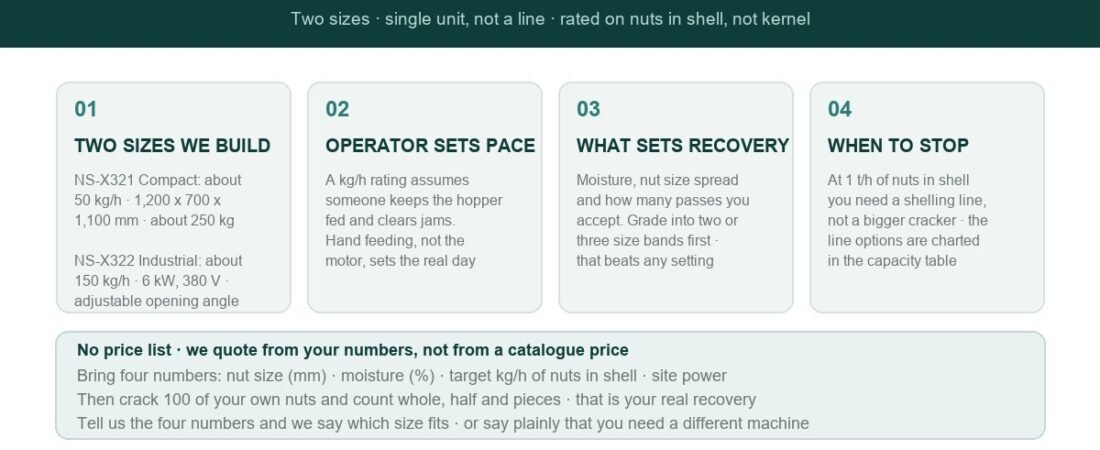
An electric macadamia nut cracker is a single-unit machine — one motor, one cracking head, no line around it — and it is the right answer for a smallholding, a sample bench or a trial batch, and the wrong answer for a commercial line. Our two motor-driven crackers run at about 50 kg/h and about 150 kg/h of nuts in shell, and which one fits you depends on three numbers: how much nut you have to get through, how whole the kernel has to stay, and what power you have on site.
This page explains what an electric cracker actually is, what really sets its output, where it stops being the right machine, and what to measure on your own nuts before you order one.
Last updated: October 2026
The short answer
- An electric macadamia nut cracker is a single unit, not a line. One motor drives a cracking head; a person feeds nuts in and takes kernel and shell out.
- Its output is quoted in kg/h of nuts in shell, not kernel. A 50 kg/h cracker at a 30% kernel yield gives you roughly 15 kg of kernel an hour, and that is the number your packing plan cares about.
- The figure that decides everything is whole kernel rate. Two crackers can run at the same speed and produce very different money, because a broken kernel sells as pieces.
- The operator is usually the bottleneck, not the motor. A kg/h figure assumes someone keeps the hopper fed and clears jams; that is a real job, not an afterthought.
- Moisture decides the result more than the machine does. Nut in shell that is too wet smears; too dry shatters. Cracking is the last step in a chain that starts with drying.
- We publish no price list. Which size fits depends on your numbers, so we quote from those instead.
What an electric cracker actually is
In this trade, “cracker” and “opening machine” mean the same thing: a machine that opens the shell to release a kernel that is supposed to stay whole. The alternative, a sheller, splits shell at higher volume and accepts more breakage. That distinction is set out in detail in shelling versus opening machines, and it matters here because a small electric unit is almost always an opening machine.
An electric cracker is defined by three things: it is driven by an electric motor rather than by hand or by air, it is a self-contained unit rather than a section of a line, and the nut passes through it once. The compact unit we build is described in our catalogue as an electric single unit; the industrial model adds adjustable opening angle and adjustable opening diameter, so the same head can be set for a different nut size instead of being shimmed for one.
The practical consequence of “single unit” is that the machine owes nothing to the rest of your process. It needs one power point and one flat surface. That is exactly why it gets bought for a sample bench: it is the cheapest honest way to find out what your own nuts do before committing to a line.
What really sets the output of a cracker
The catalogue figure is the easy part: our compact cracker is rated at about 50 kg/h of nuts in shell and the industrial model at about 150 kg/h. Three other things move the real number more than the rating does, and all three are in the buyer’s hands.
The first is operator feed rate. An electric cracker is fed by hand or from a small hopper that a person refills. Over an eight-hour day the person doing that work sets the ceiling, and a first-time owner who plans on the full rated figure for a full shift will be disappointed for the first month.
The second is nut size spread. A cracking head set for one nut size will either miss or crush the extremes of a mixed lot. Grading nuts into two or three size bands before cracking, even roughly, raises recovery more than any setting on the machine — the same logic that applies to sorting kernels by hand or by machine.
The third is how many passes you accept. Cracking twice and re-running the oversize raises recovery and doubles the labour. A farm that is paid for whole kernel should not do it; a farm selling pieces can.
The two electric crackers we build
Both models below are real production machines from our catalogue, not catalogue estimates. The capacity figures are for nuts in shell.
| Specification | NS-X321 · Compact | NS-X322 · Industrial |
|---|---|---|
| Rated capacity | about 50 kg/h | about 150 kg/h |
| Dimensions (L × W × H) | 1,200 × 700 × 1,100 mm | 1,850 × 1,200 × 1,180 mm |
| Net weight | about 250 kg | about 470 kg |
| Power supply | electric single unit | 6 kW, 380 V |
| Adjustable settings | opening head | opening angle and opening diameter |
| Body material | carbon steel | carbon steel |
| Packing volume | 1.00 CBM | 2.70 CBM |
| Packed weight | about 330 kg | about 570 kg |
Two of those rows are the ones buyers skip and then regret. The packing volume tells you what the machine costs to ship, and 1.00 CBM against 2.70 CBM is a difference you will see on a freight quote. The power supply tells you whether your site can run it at all; the industrial model wants 380 V three-phase, and what that means for a farm with a single-phase connection is covered in voltage and power requirements for export. Full line-level numbers, from huskers through to cashew machines, are collected in the capacity and power chart for all 12 models.
Where a small electric cracker is the right machine
The honest case for an electric cracker is narrow, and inside that band it is very hard to beat.
It is the right machine when your daily volume is measured in tens of kilograms of kernel, not tonnes. A 50 kg/h unit running a two-hour session covers roughly 100 kg of nuts in shell, which is a day’s work for a smallholder and a rounding error for a processing plant.
It is the right machine when you need to test your own crop before buying a line. Recovery depends on variety, moisture and nut size, and no supplier, including us, can tell you what your nuts will do without a test. Cracking a sample on a small unit and counting whole kernels is the cheapest research a buyer can do, and the measurement method itself is written up in whole kernel rate: how to measure it.
It is also the right machine when power is the constraint. A compact single unit can run where a three-phase line cannot, and on a remote site that is often the deciding factor rather than the price.
Where it stops being the right machine
An electric cracker stops being the right machine the moment output is measured in tonnes. If your target is 1 t/h of nuts in shell, you are at roughly twenty times the rated output of the compact unit, and the answer is a shelling line with conveying and separation, not a bigger cracker. That is a different purchase, described in small-scale nut processing equipment and sized in the capacity and power chart.
It also stops being the right machine when labour is expensive and steady volume exists. Above a few hundred kilograms a day, the cost of one person standing at the feed point exceeds the cost of the equipment that removes that person.
Finally, it stops being adequate when consistency across a whole lot matters more than the best-case sample. A hand-fed unit reflects the attention of whoever is feeding it that morning; a plant selling into a contract that specifies kernel size is buying repeatability as much as throughput.
What no cracker can fix
Three problems get blamed on the cracker and are almost never the cracker’s fault.
Moisture. Nut in shell has to be inside a workable range before cracking, because wet shell smears and clings while over-dry kernel shatters. The target is set out in nut in shell moisture content and the drying route that gets you there in how to dry macadamia nuts before cracking.
Dehusking timing. Green husk left on the nut starts a chemical process that damages kernel quality regardless of how gently it is later cracked. Removing it within the correct window is covered in green husk peeling: timing and loss rates.
Cracking discipline. Most breakage in a small operation comes from a few repeatable mistakes rather than from the machine: feeding mixed sizes, cracking too dry, and re-running without re-grading. Those five mistakes are listed in 5 cracking mistakes that break kernels.
A buyer who fixes these three things usually finds that the cracker they already own performs better than they thought it did.
What to measure before you order
Bring four numbers to a supplier and the specification answers itself. Nut size, in millimetres, measured across the shell on a sample of at least fifty nuts, because the opening head is set to a size. Moisture, as a percentage, measured with a meter rather than judged by feel. Target output, in kilograms of nuts in shell per hour, not per season. Power available on site, including whether three-phase exists.
Then run one test that no datasheet replaces. Take a hundred nuts, crack them, and count how many came out as whole kernel, how many as half kernel and how many as pieces. That single sample tells you the recovery you can expect from your own crop, and it is the number a supplier should be quoting against. The same figures are what a properly structured enquiry is built on, and the format is set out in what to include in a machine quotation request.
Frequently asked questions
Can an electric macadamia nut cracker keep the kernel whole?
Yes, within limits. An opening machine is designed to cut or prise the shell rather than crush it, which is why it exists alongside faster shellers. Whole kernel rate still depends mostly on nut moisture, nut size spread and how the head is set, so the same machine can produce very different results on two different lots. The only reliable way to know is to crack a hundred of your own nuts and count.
How many kilograms per hour does an electric cracker really do?
Our compact model is rated at about 50 kg/h and the industrial model at about 150 kg/h of nuts in shell. In practice, hand-fed operation, mixed nut sizes and clearing jams reduce that figure, and a realistic planning number for a first season is lower than the rating. Plan labour so that feeding the machine is somebody’s actual job.
Do I need 220 V or 380 V for a macadamia cracker?
It depends on the model. The compact single unit is built as one electric unit and the industrial model we supply draws 6 kW at 380 V three-phase. If your site only has a single-phase supply, that constraint should be stated in the enquiry, because it decides which models are even candidates rather than being a detail to sort out later.
Can one electric cracker handle different nut sizes?
To a degree. The industrial model has an adjustable opening angle and opening diameter, so it can be set for a different nut size instead of being fixed to one. Any cracking head, however, works best inside a limited size band, which is why rough grading into two or three size groups before cracking raises recovery more than most setting changes.
Is a small electric cracker worth it for two tonnes a season?
Often yes, if the work is spread over weeks and labour is available. Two tonnes of nuts in shell at 50 kg/h is about forty hours of machine time, which fits a seasonal smallholding comfortably. The calculation changes if the same two tonnes must be processed in a few days, because then the machine becomes the bottleneck and the answer is a larger unit or a line.
Next step
If you tell us the four numbers — nut size, moisture, target kilograms per hour and the power you have on site — we will tell you which of the two crackers fits, and say so plainly if the honest answer is that you need a different machine. Start with the contact form or browse the macadamia opening machines we build.