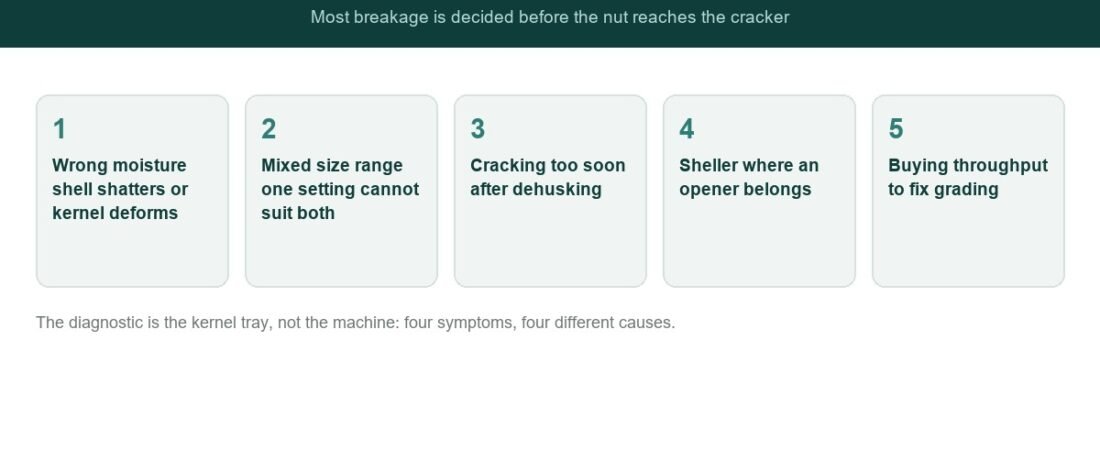
Most broken macadamia kernels are not caused by a bad machine. They are caused by five decisions taken before the nut ever reaches the cracker: cracking too wet, cracking a mixed size range on one setting, cracking too soon after dehusking, hammering a machine that should be peeling, and treating the cracker as the place to fix an ungraded feed. Each one has a symptom you can see in the kernel tray, and each one has a fix that costs less than the kernels it is destroying.
Last updated: 26 September 2026
The short answer
- Mistake 1 – cracking at the wrong moisture. Drier shell shatters and takes kernel with it; wetter kernel deforms instead of splitting cleanly. The target window matters more than the machine setting.
- Mistake 2 – one setting for a mixed size range. A single cracker setting cannot suit a 16 mm nut and a 22 mm nut at once. One of them is always wrong.
- Mistake 3 – cracking too soon after dehusking. Green husk removal and cracking are separate jobs with separate timing needs, and compressing them creates both kernel damage and mould risk.
- Mistake 4 – using a sheller where an opener belongs. A sheller removes all the shell; an opener opens and releases. Matching the machine to the job is the difference between a controlled split and a crush.
- Mistake 5 – buying throughput to solve a grading problem. If the feed is ungraded, more capacity just breaks more kernels faster.
- The diagnostic is the kernel tray, not the machine. Halves with clean faces, shattered shell mixed into kernel, and pale cracked kernels are three different problems with three different fixes.
Mistake 1: cracking outside the moisture window
Moisture is the variable that decides how the shell fails. Shell that is too dry is brittle: instead of peeling away from the kernel it fractures, and the fracture propagates into whatever is touching it. Kernel that is too wet is plastic: it deforms under the load rather than separating at the shell interface, and it comes out bruised or split down the seam.
The useful way to think about it is that you are not choosing a moisture content for the nut, you are choosing how the shell and the kernel behave relative to each other under a load. That relationship is what the cracking setting is tuned to.
Two practical consequences:
- Crack a sample before you crack the batch. Ten nuts, hand-cracked, will tell you whether the shell is peeling or shattering. It costs a minute.
- Measure moisture on the kernel, not only on the nut in shell. The number that governs how the kernel behaves is the kernel’s own moisture, and the shell can be reading drier than the kernel it contains.
The target window and the measurement method are covered in the nut in shell moisture content guide, which is the right place to start if you are unsure where your current batch sits.
Mistake 2: one cracker setting for a mixed size range
This is the most common cause of breakage that has nothing to do with the machine’s design, and it is the one operators most often blame on the machine.
A macadamia crop contains a range of nut sizes, and a single setting that opens a large nut cleanly will over-load a small one. The operator then faces a choice with no good answer: set for the large nuts and crush the small ones, or set for the small nuts and leave the large ones closed. Many operators compromise in the middle and do both badly.
The fix is upstream of the cracker, and it is cheap:
- Screen to size bands before cracking. Two or three bands is usually enough to remove most of the mismatch.
- Run each band at its own setting. The purpose-built openers are designed for this: the industrial macadamia cracking machine publishes adjustable opening angle and opening diameter, which is exactly the pair of parameters that has to move when the size band changes.
- Record the setting against the band. Without a record, the next operator starts from memory.
Ungraded feed is also the reason a machine can appear to underperform its published capacity. Capacity figures describe the machine handling a suitable feed, not the machine compensating for an unsuitable one.
Mistake 3: compressing dehusking and cracking into one day
Dehusking and cracking are two different processes with two different clocks, and the temptation to run them back to back in a single busy day is where a lot of damage starts.
Green husk removal has its own timing question, and the loss rates change depending on how long the husk is left on. That is covered in green husk peeling: timing and loss rates, and the short version is that the husk decision and the cracking decision should not be made in the same hour.
What goes wrong when they are compressed:
- Husk removal on a nut that is not ready leaves an uneven surface, which changes how the shell behaves under load.
- Cracking immediately after dehusking means cracking nuts whose shell moisture has not had time to even out.
- The drying step gets skipped or shortened, and drying is what creates the moisture window that Mistake 1 depends on.
If your operation is small, the answer is not to buy more machines. It is to accept that these are sequential steps with waiting time built in, and to schedule around that rather than against it. The macadamia cracking machine guide covers how the choice of machine interacts with that schedule.
Mistake 4: using a sheller where an opener belongs
The two words get used interchangeably and they describe different machines with different jobs.
- A sheller removes the shell from the kernel. It is built for volume, and the published capacity of the standard unit in our range is around 600 kg/h.
- An opener opens the nut and releases the kernel. It is built for a controlled split, at lower throughput – the compact unit is published at around 50 kg/h and the industrial unit at around 150 kg/h.
If your product is whole kernel, and your feed has been graded and brought to moisture, the opener is the machine matched to the job. If you put a high-throughput sheller on that job, you are asking a machine optimised for throughput to behave like a machine optimised for preservation, and the kernel tray will show it.
That does not make shellers wrong. It makes them wrong for that specific job. If you are producing for a market where kernels are further processed – or where the volume economics genuinely dominate – a sheller is the correct tool. The macadamia shelling machines range and the macadamia opening machines range both exist for that reason, and we would rather help you pick the right one than sell you the bigger one.
Mistake 5: buying throughput to fix a grading problem
This is the expensive version of Mistake 2. When whole-kernel rate is poor, the instinct is that the machine is too small or too cheap, and the answer is a bigger one.
But throughput and preservation are not the same axis. A larger machine facing an ungraded feed will break more kernels per hour, not fewer, because the underlying mismatch is still there and now it is being processed faster. The capital cost goes up and the recovery rate does not.
Before spending on capacity, do these three things:
1. Measure whole-kernel rate by batch, so you know whether the number is actually moving.
2. Screen the feed by size and re-measure. If recovery improves, the problem was grading.
3. Check moisture at crack time and re-measure. If recovery improves, the problem was timing.
Only if the number is still poor after both changes is capacity the right conversation. The measurement method is set out in the whole kernel rate guide, and the cost structure of a line is covered in what drives the price of a macadamia processing line.
Diagnosing which mistake you are making
| What you see in the tray | Likely cause | First thing to change |
|---|---|---|
| Halves with clean, bright faces | Correct split, correct size band | Nothing – record the setting |
| Many small fragments and dust | Shell too dry, or over-load for the size band | Check kernel moisture, then screen the feed |
| Kernel split down the seam, intact shell | Wet kernel, load too high for the variety | Extend drying, then re-tune the setting |
| Large nuts still closed, small nuts crushed | Mixed size range on one setting | Screen to size bands, run each band separately |
| Shell crushed into kernel, mixed output | Sheller used where an opener fits the product | Review machine-to-job match |
| Rate falls through the shift | Feed arriving in changing condition | Check whether batches are being blended |
That table is a starting point, not a diagnosis. In practice two of these usually appear together, and separating them is what the sample-crack and the batch record are for.
Frequently asked questions
How many nuts should I sample before cracking a batch?
Enough to be honest with yourself – we would suggest at least twenty, hand-cracked, and looked at rather than just counted. The point is to find out whether the shell is peeling or shattering, and that becomes obvious within a handful of nuts. The number matters less than actually doing it before the batch, not after.
Can an adjustable opener fix a feed that is not graded?
It removes part of the problem, because you can change the opening angle and diameter between size bands. What it cannot do is suit several bands at the same time. You still have to separate the bands and run them in sequence.
Does a higher-capacity machine improve whole-kernel rate?
No, and it can reduce it. Throughput and preservation are different objectives. A larger machine processes an unsuitable feed faster; it does not make the feed more suitable.
Is cracked kernel always a machine problem?
Rarely. Cracking, splitting, shattering and bruising all have identifiable upstream causes – moisture, size spread, timing after dehusking, machine-to-job match. The machine is often doing exactly what it was set to do to a feed it should not have received.
What is the minimum order, and how quickly do you reply?
Minimum order is one unit. OEM branding and customisation are available on request, specifications are confirmed in writing before production, and we normally reply within one business day.
Tell us what your tray looks like
The fastest way to get a useful answer from us is a description of your kernel tray and two numbers: your daily kernel volume and your size spread. With those we can tell you whether you are looking at a moisture problem, a grading problem or a machine-to-job mismatch – and if the answer is that you do not need to buy anything, we will say so. Reach us through the contact page.
Related reading and machines
- Macadamia cracking machine: how to choose one
- Nut in shell moisture content: the target before cracking
- Green husk peeling: timing and loss rates
- Whole kernel rate: how to measure it and improve it
- Industrial macadamia cracking machine, NS-X322, around 150 kg/h
- All nut processing machines
- Nut processing knowledge base
- Nut processing machine maintenance checklist