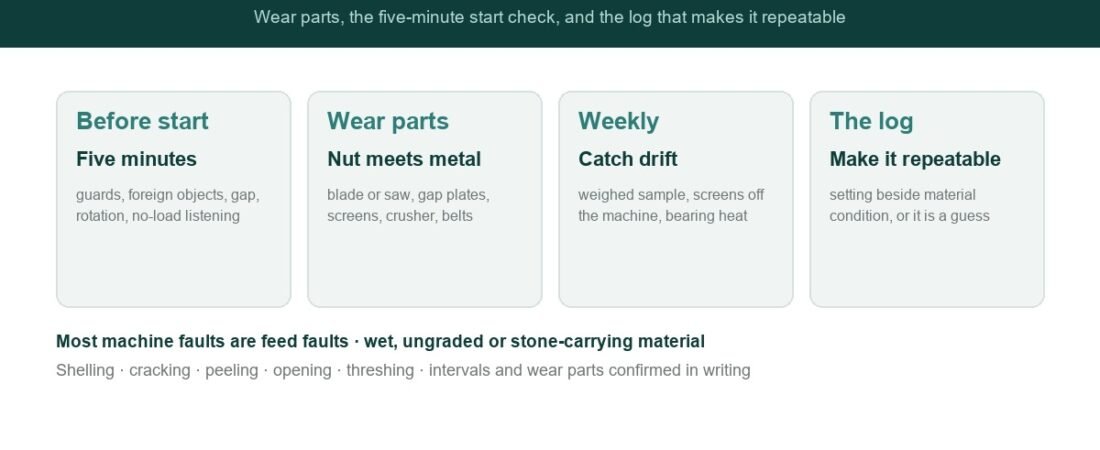
A nut machine does not wear out evenly. It wears where nut meets metal: the blade that opens a shell, the gap that sizes a kernel, the screen that lets pulp through, the impeller that carries husk away from nut. Frames, guards and motors usually outlive three sets of those parts.
This page sets out a maintenance rhythm for shelling, cracking, peeling, opening and threshing machines: what to check in five minutes before a shift, what to check weekly, what to re-check whenever the material changes, and what to write down so a setting can be repeated next season. It is written for plants running one or two shifts a day, and it reads the same for a macadamia green husk peeler, a pine nut thresher or a coffee pulper.
Last updated: 29 September 2026
The short answer
- Maintenance is a schedule plus a record. Without the record you cannot tell wear from one bad batch of nuts.
- Wear parts are the ones touching the nut: opening blade or saw, gap plates, screens, toothed crusher, husk and blower elements, belts.
- Five minutes before start is worth an hour of repair after it. Guards, rotation, foreign objects, gap setting, loose fixings.
- Most “machine faults” are feed faults. Wet, ungraded, oversized or stone-carrying material wears parts and makes defects no setting can fix.
- Every adjustment belongs in a log, written next to the material condition it was made for, or it cannot be repeated tomorrow.
- The interval that matters is the one in your machine documentation – for the machines we supply, configuration, wear parts and intervals are confirmed in writing.
What actually wears, and what you notice first
A checklist that only names parts gets skipped. A checklist that tells the operator what a worn part looks like from the platform gets used. The table below works on symptoms.
| Component | What it does | How it degrades | What you notice first | Rhythm |
|---|---|---|---|---|
| Opening blade or arc saw (opening machines) | Cuts or grouts the shell opening | Edge dulls, the land behind the edge wears | Ragged openings, more shell fragments in the kernel stream | Visual each shift; sharpen or replace per documentation |
| Gap plate and drum (shelling, cracking) | Sets the working clearance around the nut | Gap drifts with wear and with warm metal | Whole nuts in the reject, or a sudden rise in broken kernel | Verify at every start against a squeezed sample |
| Screens and perforated plates | Separate by size | Holes enlarge, plates crack at the bend | Oversize passing through, undersize retained | Weekly, and immediately after any hard or foreign object |
| Toothed crusher (threshing machines) | Breaks cones or fruit open | Teeth round off and wear unevenly | More uncrushed material, more recirculation | Weekly |
| Blower impeller and air path | Carries husk, skin or pulp away from nut | Impeller erodes, ducts leak, balance shifts | Husk returning to the nut stream, separation going soft | Weekly; full duct check at season start |
| Belts and drives | Transfer power to the working parts | Tension loss, glazing, misalignment | Slipping under load, hot pulley, belt dust on the frame | Tension by hand daily, alignment weekly |
| Bearings and seals | Support the rotating parts | Lubricant loss, product ingress past the seal | Noise, heat, play, product weeping at the shaft | Weekly by touch and by ear |
| Guards and interlocks | Keep hands out of the working zone | Removed during a jam and never refitted | Nothing at all – until there is an accident | Before every start |
Five minutes before every start
1. Guards on and fixed. Every guard that came off during yesterday’s jam goes back on before the machine turns.
2. Foreign objects out. Stones, wire, string, metal offcuts and the previous product left in the feed hopper are the fastest way to destroy a screen or an opening blade.
3. Gap setting verified, not remembered. Feed two or three nuts by hand and look at the result before the line is loaded.
4. Rotation direction confirmed after any electrical work, phase change or generator switchover. On machines with a blower stage, reversed rotation blows husk into the nut stream instead of out of it.
5. No-load listening. Ten seconds of running with an empty machine tells you more than an hour of diagnostics later: a new knock, a rub or a whine is a bearing or a loose fixing.
6. Fasteners and covers. Vibration loosens the fixings nearest the working parts first.
7. Emergency stop tested by the person who will stand next to the machine, not by whoever is closest to the panel.
The weekly checks that catch drift
Daily checks catch damage. Weekly checks catch drift – the slow change that turns a good setting into a mediocre one without anyone touching a dial.
- Weigh a timed sample. One minute of output, weighed, compared with last week. Falling output with unchanged settings is the earliest signal of wear inside the machine.
- Inspect the screens and perforated plates out of the machine, on a bench, in good light. Cracks start at bends and at the edges of holes.
- Check belt tension and pulley alignment together. Tightening a belt on a misaligned pulley shortens its life and loads the bearing.
- Touch every bearing housing after a normal run. A housing noticeably warmer than its neighbours, or warmer than last week, is a bearing telling you it is running dry or overloaded.
- Walk the air path. A leaking duct or a worn impeller edge quietly ruins separation: the machine still runs, but husk or skin starts arriving with the nut.
- Look at the discharge, not just the machine. Ragged shell edges, extra fines and kernel fragments all point back to a specific working part.
Feed condition is a maintenance item
On nut machines, the material is half the maintenance schedule. Three conditions do most of the damage:
- Moisture. Material outside the range your machine is set for either resists separation or clogs it, and clogging means recirculation, heat and wear.
- Grading. Ungraded feed means the machine is asked to work on several sizes at once. Every part wears to the worst size in the batch, and the setting that suits one size damages another.
- Foreign matter. Sand and grit are abrasive, stones and metal are destructive, and both arrive with the crop rather than with the machine.
If you cannot fix the feed, change the maintenance interval. A plant that cannot grade or dry consistently should be checking screens, blades and gap plates more often, not less.
Cleaning and product changeover
- Clean the product path, not just the visible surfaces. Material trapped in a screen, a duct or a discharge chute is what carries over between products.
- Never use water where the documentation does not allow it. Bearings, motors and electrical enclosures are the parts that turn a cleaning routine into a repair.
- After cleaning, re-check every setting that was disturbed to reach the working parts, and turn the machine over by hand where the drive allows it.
- Record the clean-down against the batch, so a later quality question can be traced back to what the machine last ran.
Lubrication without contaminating product
- Use only the lubricant the documentation specifies, and keep the container clean and closed.
- Lubricate on a schedule, not on a feeling. Over-greasing a sealed bearing is as damaging as under-greasing it, because it pushes the seal out.
- Any lubricant point near the product path deserves a check immediately after application. If grease appears where product travels, stop and correct it.
- Keep a dedicated grease gun per lubricant type. Mixing incompatible greases is a common and entirely avoidable bearing failure.
End of season: shutdown and storage
- Run the machine empty for a few minutes before shutdown, so no wet or sticky material is left sitting in the working zone.
- Clean, dry and then protect: bare or ground surfaces, exposed shafts and any unpainted metal should be treated before storage, not after rust appears.
- Release belt tension where the documentation allows it, and store spare screens and blades flat and dry.
- Note every wear part that is close to its limit, and order it now. Parts ordered out of season arrive before the crop does.
- Write the season summary while it is fresh: what was replaced, what was adjusted, what the machine did well and what it did badly.
The maintenance log
The log is the part of maintenance that most plants skip, and it is the only part that compounds. One sheet or one notebook per machine, with these columns:
| Column | Why it earns its place |
|---|---|
| Date and shift | Ties every entry to a batch and to an operator |
| Material condition | Moisture, variety, size, source – the context that made the setting right or wrong |
| Settings used | Gap, angle, diameter, water or airflow, exactly as set |
| Output measured | A weighed sample, not an impression |
| Defect seen | Whole nut, breakage, skin left on, shell in kernel |
| Action taken | Adjusted, cleaned, replaced, or left alone |
| Part replaced and its life | Builds your own replacement history instead of a supplier’s average |
| Next check due | Turns the log into a schedule |
Two seasons of that log beat any advice about typical intervals, because it describes your crop, your water and your operators.
Spare parts worth holding, by machine type
A spare that arrives in three days costs nothing. The same spare ordered in the middle of harvest costs the days the machine is stopped. What follows is the short list we see plants wish they had ordered with the machine.
| Machine type | Hold a spare of | Why it is the first thing to fail |
|---|---|---|
| Green husk peelers | Peeling or husking elements, drive belts | In direct contact with husk, grit and sap from the first day of the season |
| Shelling and cracking machines | Gap plates, working screens | Wear changes the clearance, and a changed clearance changes your breakage rate |
| Opening machines | Blade or arc saw, feed guides | The working edge dulls with every nut and the geometry is what produces a clean opening |
| Threshing machines | Crusher teeth, blower impeller, screens | Cone and shell are abrasive, and the air stage decides separation quality |
| Pulpers and wet peeling machines | Working screen, drive belts | Water plus fibre is a wear combination, and the screen blocks before it fails |
| Any machine | Bearings and seals for the main shaft, one belt set | Usually the part that was never ordered, and the one that stops the line |
Wear parts, their part numbers and the intervals for your configuration are confirmed in writing with the machines we supply, so the first spare order can be placed together with the machine rather than after the first breakdown.
Frequently asked questions
How often should I check the gap on a shelling or cracking machine?
Check it at the start of every shift against a squeezed sample of the nuts you are actually running, and re-check after any change of variety, size or moisture. The gap is the setting that decides how much kernel breakage you get, and it drifts with wear and with warm metal over a long run. A setting verified once in the morning is not a setting verified for the day.
What is the first sign that a machine needs attention?
Usually a change in output rather than a noise. A weighed one-minute sample that drops while the settings stay the same points to wear inside the machine: a dulling blade, a worn gap plate, an enlarged screen hole or a slipping belt. Noise and heat come later. This is why the log matters more than a list of parts.
Can I run a machine with the guard removed to clear a jam faster?
No. Clearing a jam is exactly when hands are closest to the working zone and when the machine is most likely to be restarted by someone else. Isolate the power, clear the blockage with a tool rather than a hand, refit the guard, and only then restart. The maintenance saving from skipping that step is minutes; the cost is not measured in minutes.
How do I know when to replace rather than sharpen a blade or saw?
Replace when the land behind the cutting edge has worn enough that sharpening would change the opening it produces, or when the part starts cracking, chipping or running out of balance. A sharpened part that no longer holds its geometry will make ragged openings no matter how well it is set. For the machines we supply, the wear parts and their replacement guidance are confirmed in writing with the order.
Does voltage or power supply change the maintenance schedule?
It changes what you check, not how often. A three-phase drive needs rotation direction confirmed after any electrical work, and a machine run from a generator needs its voltage checked under load rather than at rest. Frequency differences between countries change motor speed, which changes how the machine behaves, so the setting that worked on one supply is not automatically the setting for another.
What is the minimum order, and how quickly do you reply?
Minimum order is one unit. OEM branding and customisation are available on request, specifications are confirmed in writing before production, and we normally reply within one business day.
Send us your machine list
Tell us which machines you run, what material you feed them and what you are seeing in the discharge, and we will tell you which checks belong in your weekly routine and which wear parts you should be holding as spares. Reach us through the contact page.
Related reading and machines
- Macadamia shelling versus opening machines: which one do you need?
- Macadamia processing line layout: harvest to packed kernel
- 5 cracking mistakes that break kernels
- Whole kernel rate: how to measure it and improve it
- Macadamia nut shelling machine, standard capacity
- Macadamia nut opening machine, industrial
- All nut processing machines
- Nut processing knowledge base