A coffee processing line is not one machine, so it does not have one price. What a buyer is actually paying for is the set of stages they choose to mechanise, plus the water, the drying area, the fermentation capacity and the waste handling that have to exist around those stages. Two producers can both ask for “a coffee processing line” and be buying two different projects.
This page is written for buyers planning that spend: which stage carries most of the budget, why coffee is costed differently from a nut crop, which levers genuinely move the number, and what to put in an enquiry so the quotations you receive can be compared line by line. It does not offer a price list, because on a wet mill a price list is the fastest way to make an accurate answer wrong.
Last updated: October 2026
The short answer
- The cost is the sum of stages, not the price of a machine. Pulping, fermentation, drying, hulling and grading are separate purchases, and you can stop at any of them.
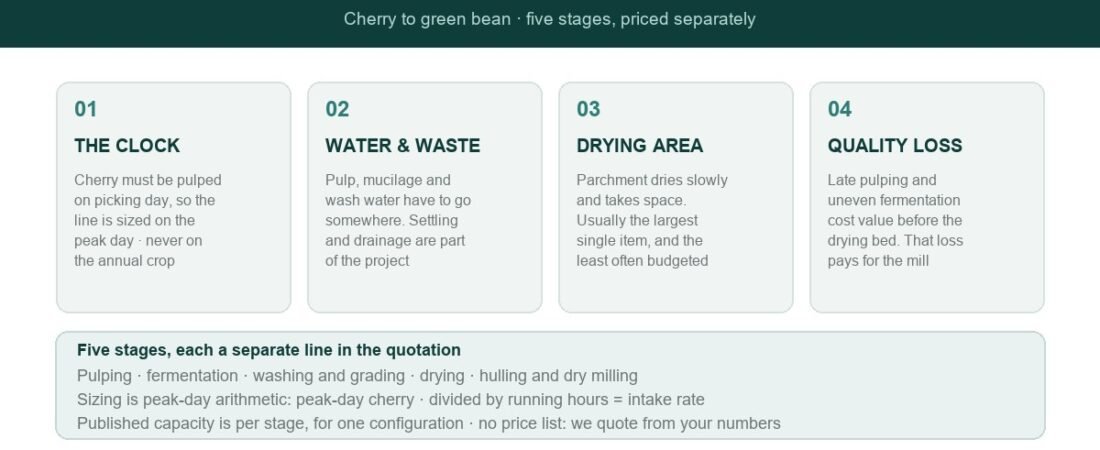
- The clock sets the capacity you have to pay for. Cherry has to be pulped on the day it is picked, so the pulper is sized on the peak picking day, not on the annual crop.
- Coffee adds a cost line that nut crops do not have: water and waste. Pulp, mucilage and wash water have to go somewhere, and handling them is part of the project.
- Drying is usually the largest single item, and the least often budgeted. Parchment dries slowly and occupies a great deal of space for the weight it represents.
- Quality loss pays for the line, not throughput. Coffee that was pulped late or fermented unevenly loses value before it ever reaches a drying bed.
- We publish no price list. Cost depends on configuration; we quote from your numbers instead.
What a coffee “processing line” actually consists of
Dongguan Nansheng Technology Co., Ltd. is a manufacturer of nut and coffee processing machinery based in Dongguan, Guangdong Province, China, building macadamia dehusking, cracking and shelling machines, cashew shelling machines, pine nut threshing machines and coffee pulpers. A coffee line is assembled from the stages below, and each stage is a separate line in a quotation.
| Stage | What it does | Why it is a budget item |
|---|---|---|
| 1. Pulping (fruit peeling) | Removes skin and pulp from cherry, and separates floaters, unripe and damaged fruit | The stage that must happen on picking day, so it fixes the intake rate of the whole line |
| 2. Fermentation | Uses tanks and controlled time to break down the mucilage still on the parchment | Cheap in equipment and expensive to get wrong; it needs tank capacity and a way to hold time constant |
| 3. Washing and grading | Removes remaining mucilage and separates parchment by density | Small machines, large effect on what the lot is worth as a grade |
| 4. Drying | Brings parchment down to a stable moisture for storage and hulling | Usually the largest single item, and frequently a building and airflow project rather than a machine purchase |
| 5. Hulling and dry milling | Removes the parchment and prepares green bean for grading and export | Decides whether the crop leaves as one mixed lot or as separated grades |
Around those five stages sit costs that never appear on a machine specification sheet: the concrete, roof and airflow over the drying area, the water supply and the drainage that carries it away, settling or recycling for pulp and wash water, storage for parchment and green bean, the first set of wear parts, freight and import duty, and the labour the mill still needs while it is running.
Where the budget goes, stage by stage
Buyers usually ask for the percentage split before they ask for a total, because the split shows which decisions actually move the number. The ranges below are a planning guide for a small-to-mid wet mill turning cherry into stable parchment or green bean. They are shares of project spend, not prices, and they overlap: a mill that already owns a covered drying floor spends nothing on a dryer, while a mill that has to build that floor moves a third of the budget into civil works.
| Stage | Typical share of project spend | What moves it |
|---|---|---|
| Pulping and wet processing | 15-25% | Peak-day throughput, stainless contact parts, continuous-duty motor rating |
| Fermentation tanks, channels and washing | 5-12% | Batch size, built or bought tanks, whether water is recirculated |
| Drying: covered area, beds or mechanical dryer | 25-40% | Whether the floor already exists, airflow, fuel or power, labour |
| Hulling and grading | 10-20% | Green-bean output, number of grades, destoner and gravity separator |
| Water supply, settling and waste handling | 10-20% | Recirculation, discharge rules, civil works |
| Freight, duty, installation and commissioning | 8-15% | Packing volume, destination, whether a technician travels |
Read the table as a way to interrogate a quotation, not as a price list. If a quote puts 60% of the total into pulping, either the scope stops there or the other lines are missing. If drying is absent from a quote that claims to take cherry through to green bean, the drying cost has not disappeared – it has moved to a line the buyer will pay for separately.
Why coffee is costed differently from a nut crop
The same shape of line — intake, conditioning, separation, drying, finishing — exists on a macadamia, cashew or pine nut project, but coffee changes the weighting of the budget for four structural reasons.
- A perishable raw material. A nut can wait in a shed; cherry cannot. Value falls from the moment it is picked, so capacity is bought for the peak day and never for the average.
- A wet process with a waste stream. Pulp, mucilage and wash water are produced in volume, and where they go is part of the project cost rather than an afterthought.
- A slow, space-hungry drying stage. Parchment holds moisture and releases it slowly, so drying area and airflow, not motor power, set how fast the mill can clear its intake.
- Value decided by time, not by size. Two lots of the same variety and the same weight can sell differently because of how many hours passed between picking and pulping, and how evenly fermentation was held.
The last point is where a coffee enquiry most often goes wrong. Buyers size the mill on the annual crop, then discover in the first harvest that the pulper cannot clear a peak picking day, and that the money saved on equipment is paid back in cherry that fermented in a heap.
The clock: what sets the capacity you actually have to pay for
Sizing a coffee mill is peak-day arithmetic, not annual arithmetic: take the weight of cherry arriving on your busiest picking day, divide it by the hours you can realistically run the mill, and size each stage against that figure. Because cherry cannot be stored, the pulper is the stage that defines the intake rate — every stage behind it is then sized to absorb what the pulper produces.
Two consequences follow for the budget. First, a mill sized on annual tonnage will be undersized for the weeks that matter. Second, the cheapest way to reduce the equipment you need is not a smaller pulper; it is a longer working day during harvest. The route from cherry to green bean, stage by stage, is mapped in the coffee processing guide, and the pulping stage itself is covered in coffee fruit peeling and wet processing.
Lever 1 — where you stop on the cherry-to-green-bean route
The largest single decision in the budget is not which model to buy, but how many stages to mechanise in the first purchase. Each stage added to the project adds its own machine, its own space and its own water or power demand.
| Scale of project | Stages usually mechanised | What it buys | What usually stays manual |
|---|---|---|---|
| Farm / micro-lot scale | Pulping, fermentation in tanks, sun or low-cost drying | Cherry cleared on picking day, and a lot that can be traced to a picking | Washing, grading and hulling, often done at a shared mill |
| Small commercial mill | Pulping, controlled fermentation, washing, raised-bed or mechanical drying, hulling | Consistent parchment and a green bean that can be sold as a graded lot | Final sorting and packing |
| Full wet mill | All five stages, sized so the bottleneck sits where you want it | Predictable output through the peak week without a seasonal labour spike | Supervision, maintenance and quality checks |
The order of mechanisation matters more than the total spend. Mechanise the bottleneck first, not the first stage in the sequence. If cherry can be pulped quickly but the parchment then sits waiting for drying space, the money spent on a faster pulper is money spent on a longer queue. The drying stage and its settings are covered in coffee drying and hulling, from wet parchment to green bean.
Lever 2 — water and waste: the cost line nobody quotes
A wet mill is a water process, and the water has to be brought in and taken away. This is the item most often missing from a first budget, and it is the one that stops a mill from operating rather than merely annoying its owner.
- Supply. Washing and transporting cherry and parchment consumes water continuously through the harvest. Where supply is limited or seasonal, storage or recycling has to be part of the plan.
- Drainage and settling. Pulp and mucilage are solids, not liquids, and they have to be separated somewhere before water leaves the site. Settling capacity is a civil works item, not a machine.
- Where the pulp goes. Pulp is organic and can be composted or used, but it has to be moved, stacked and managed. A mill that has not planned that ends up paying to have it removed.
- Water reuse. Recirculation reduces both the supply and the discharge problem, and it is usually cheaper to design in than to retrofit.
None of this appears on a machine specification sheet, which is why a coffee budget that stops at the pulper usually disappoints in the first harvest.
Lever 3 — drying: usually the largest single item
Coffee loses value slowly in the field and quickly in the wrong drying setup. Parchment has to be brought down to a stable moisture for storage and hulling, and the stage that does it is rarely the cheapest line in the project.
- Area and airflow before power. If drying happens on beds or a patio, the constraint is the size of the covered, ventilated area you can build, not the rating of a motor.
- Mechanical drying changes the cost shape. A dryer can clear a peak week that beds cannot, but it adds fuel or power, a control routine and a risk of over-drying if it is not managed.
- Evenness is what you are buying. A batch whose centre and edges dry at different rates behaves unpredictably later, so the value of a drying setup is measured in consistency rather than in speed.
- Understand the specification you work to. Your buyer’s target moisture is the authority; the discipline is reaching it evenly rather than reaching a lower number.
Lever 4 — build standard, materials and wear parts
Two pulpers with the same quoted output can differ substantially in price because of what they are made from and how they are finished.
- Material of construction. Carbon steel with a painted finish is normal for frames and guards; stainless is used where the product, water or cleaning routine demands it. Our coffee pulper is built with a carbon-steel body and an adjustable pulping gap, so the setting can be matched to the fruit rather than fixed at the factory.
- Contact surfaces and wear parts. The parts that touch fruit and parchment — screens, pulping elements, seals and bearings — are consumed by normal operation. A machine built with thicker or better-specified contact surfaces costs more up front and less per season.
- Drive and control. A three-phase drive rated for continuous duty costs more than a light-duty equivalent, and it is the difference between running through a harvest day and stopping to let a motor cool.
- Finish and protection. Painting specification and surface treatment decide how the machine looks and survives in year five, not how it performs in week one. Corrosion protection matters most where the mill is coastal or humid.
Lever 5 — what sits outside the machine price
For most coffee projects the gap between the cheapest quote and the most expensive one is not in the machines at all. It is in the scope around them.
| Item outside the machine price | Why it appears in the budget | Who normally pays |
|---|---|---|
| Power supply and site wiring | The supply on site has to match the machine’s voltage and phase before it can run | The buyer, unless agreed otherwise; the checks are covered in voltage and power requirements for export |
| Water supply, drainage and settling | A wet mill produces a waste stream that has to be handled on site | The buyer — and it is the item most often left out of the plan |
| Drying area and airflow | Drying is a space and air problem before it is a machine problem | The buyer |
| Fermentation tank capacity | Time must be held constant, which means enough tanks for the daily intake | The buyer |
| Storage for parchment and green bean | Coffee that waits must be stored without re-absorbing moisture | The buyer |
| First season of spare parts | Screens, seals and pulping elements are consumed in normal operation | Normally bought with the machine, because a separate shipment costs more |
| Freight, insurance and import duty | These follow the destination and the packing volume, not the machine price | The buyer, or included if the quotation says so |
| Installation, training and commissioning | A mill that is assembled correctly performs differently from one that is not | Depends entirely on what the quotation states |
A quotation that names only machines is not a cheaper quotation. It is a shorter one, and the missing items will be paid for later at the buyer’s own risk.
Lever 6 — quality loss: the number that pays for the mill
Because coffee loses value with time and with uneven fermentation, the return on a wet mill is driven by how much value it stops leaking, not by hourly throughput. The arithmetic uses your own prices:
1. Take the weight of cherry you expect to process in a harvest.
2. Apply your realistic outturn to get the kilograms of green bean the mill should deliver.
3. Compare that with what your current method delivers, including the lots downgraded for late pulping or uneven fermentation.
4. Multiply the difference by your own green bean price to see the value recovered per harvest.
5. Compare that figure against the cost of the stages you are considering — not against the cost of the whole mill at once.
Step 5 is the important one, because it turns an unaffordable project into a sequence. If one stage pays for itself in a harvest, that stage is the one to buy first, and the next stage can be funded out of the improvement it produced. The same reasoning, applied to a different crop, is set out in what drives the cost of a macadamia processing line, what drives the cost of a cashew processing line and what drives the cost of a pine nut processing plant.
Why we do not publish a price list
A published price is only useful if the thing it describes is identical for every buyer, and on a coffee line it never is. Capacity, material of construction, drive type, the stages included, the water and settling works, the destination port and the scope agreed with the buyer all change the number. A figure published for one configuration becomes misleading the moment it is applied to another — and it usually ends up being compared against a quotation that included less work.
What we can do is make the quotation itself comparable: itemised by machine and by scope, with the assumptions written down and the exclusions named. What a quotation should contain, line by line, is set out in what a nut processing machine quotation should contain.
How to compare two quotes for the same capacity fairly
Two quotations that both say “coffee pulper, cherry line” can differ by a large margin without either being dishonest. Before comparing totals, check that they are quoting the same thing.
| What to check | Why it changes the price | Question to ask |
|---|---|---|
| Stage list | A quote may cover pulping only, or pulping through hulling | Which stages are included, and which are excluded? |
| Material of construction | Stainless contact surfaces cost more and last differently | Which parts are stainless, and which are painted carbon steel? |
| Drive and motor rating | Light-duty and continuous-duty drives are priced differently | Is the drive rated for continuous duty through the harvest? |
| Published capacity basis | An hourly figure for one stage says nothing about the stages behind it | Which stage does the quoted capacity describe? |
| Water and settling scope | Civil works are frequently outside a machine quotation | Who designs and builds the settling and drainage? |
| Packing and shipping terms | Packing volume decides freight, and terms decide who pays it | What are the packing volumes, and what are the delivery terms? |
| Spare parts included | A first-season kit can be inside or outside the total | Which wear parts are included, and at what quantity? |
| Installation and training | Support may be by phone, by video or on site | What is included in commissioning and who is trained? |
Compare the quotes line by line against that list, and the cheapest total will usually stop looking like the cheapest project. The same method, applied to the machine you have already bought, is set out in calculating the payback period before you buy.
What to send us for a quotation
Seven numbers and facts are enough for a supplier to answer specifically rather than generally.
| What to send | Why it decides the answer |
|---|---|
| Peak-day volume of cherry | Sizing is done on the busiest picking day, not the annual crop |
| Running hours available per day | Two shifts and one shift need different machines for the same daily volume |
| Condition of the incoming cherry (ripeness, floaters, damage) | It decides how much separation the pulper has to do and how much is rejected |
| Stages you want to mechanise now, and which you may add later | Lets a supplier quote a sequence instead of one indivisible project |
| Power supply available on site (voltage, phase, kVA) | A machine that does not match the supply cannot be commissioned |
| Water supply and how waste is handled today | It decides how much of the project is civil works rather than machinery |
| Destination country and nearest port | Packing volume, freight and duty all follow from it |
Send those, plus a photograph of the fruit and of any equipment already on site, and the reply can address your mill instead of describing a catalogue. The same information is what makes a small-scale project affordable to specify, as set out in small-scale nut processing equipment.
Frequently asked questions
How much does a coffee processing line cost?
There is no single figure, because a mill is a sequence of separately priced stages and the scope around them changes the total. The number is built from the stages you mechanise, the materials and drive ratings, the drying area, the water supply and settling works, and the freight and duty to your destination. The practical approach is to price one stage at a time and compare quotations line by line, not by total.
Which stage of a coffee line is the most expensive?
It depends on configuration, but the money generally concentrates in drying, followed by the water and waste works that a wet mill requires. Pulping is a compact machine, while drying is frequently a building and airflow project, and settling, drainage and pulp handling are civil works rather than equipment. Fermentation tanks are inexpensive but have to be sized for a full day of intake, which adds cost in space rather than in machinery.
Should I buy a pulper first or a dryer first?
Buy the pulper first if cherries currently wait after picking, because value is lost from the moment it is picked and the pulper is the stage that stops that clock. Buy drying capacity first only if the mill already clears its intake but cannot stabilise the parchment, which shows up as soft or unevenly dried lots. In most small mills the pulper is the bottleneck, and the drying stage is the second purchase, sized to absorb what the pulper produces.
How much water does a coffee wet mill use?
It varies widely with the process, the equipment and whether water is recirculated, so a figure quoted for one mill is not transferable to another. What matters for planning is that washing and transport are continuous through harvest, that pulp and mucilage are solids which must be separated before water leaves the site, and that recirculation reduces both supply and discharge. Design the settling and drainage before choosing a pulper, not after.
Can the same equipment process coffee and nuts?
Generally not for the wet stages. A coffee pulper has no equivalent job in a nut line, and a dehusker set for macadamia will not thresh pine cones, because the gap, the drum and the throughput are set to the material being handled. Some machines in our range are multi-material at the dry stage, but nothing in this range is a general-purpose fruit machine. Choosing between the crops is a separate question, covered in which nut should you process.
What capacity pulper do I need?
Size it from your busiest picking day, not from your annual crop. Take the weight of cherry that arrives on that day, divide it by the hours you can realistically run the mill, and treat the result as the intake rate the pulper must hold. Every stage behind it is then sized to absorb that figure. If the answer is a larger machine than you expected, a longer working day during harvest is usually the cheaper way to close the gap.
Request a quote for your coffee line
Tell us the volume of cherry you handle on your busiest picking day, the hours you can run the mill, the condition of the incoming fruit, the stages you want to mechanise now and the stages you may add later, the power and water available on site, and the destination port. We will tell you which machines in our range fit the first stage, what the stages behind it have to be able to absorb, and how the quotation is built — including what sits outside the machine price so nothing appears later.
Send it through the enquiry form, or email nanshengtechnology@gmail.com. If you are still working out what the mill should consist of, start with the coffee processing guide and coffee fruit peeling and wet processing.
Related reading and machines
- Coffee processing: the complete guide from cherry to green bean
- Coffee fruit peeling: the wet processing basics
- Coffee pulping settings and damage control
- Coffee drying and hulling: from wet parchment to green bean
- Macadamia processing line cost: the five drivers
- What drives the cost of a cashew processing line
- What drives the cost of a pine nut processing plant
- Nut processing machine payback period: how to calculate ROI
- Which nut should you process?
- What a nut processing machine quotation should contain
- Small-scale nut processing equipment
- Coffee fruit peeling machine, NS range
- Nut and coffee processing machines: the full range
- Knowledge forum: processing guides
- what sets a nut processing plant cost