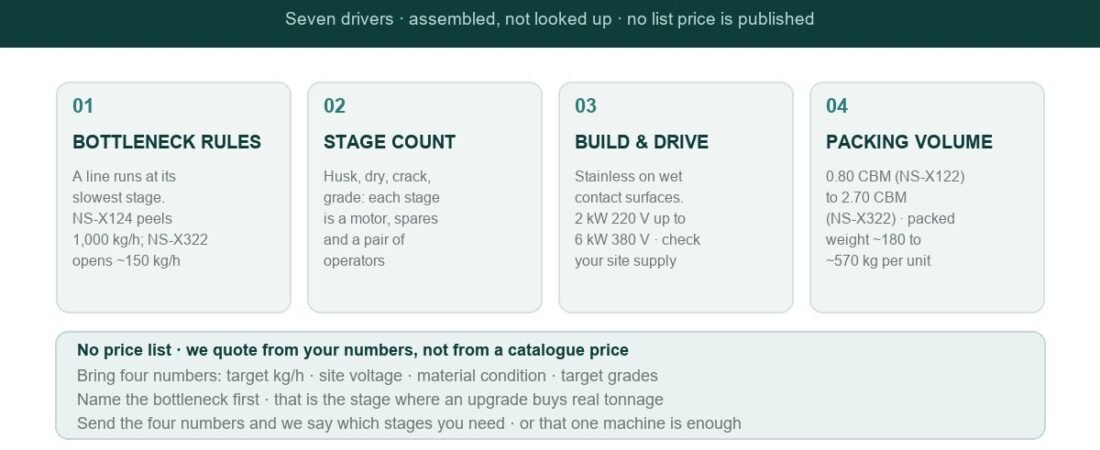
Nut processing plant cost is not a number you look up — it is a number you assemble. Two buyers can ask for “a 500 kg/h macadamia line” and receive quotes that differ by more than the machines differ, because a plant cost is set by throughput at the bottleneck, how many stages the process actually needs, what the parts are made of, what power you have on site, how much tooling and changeover hardware comes with it, how much of the line is automated, and how much volume it takes to ship.
This page breaks those seven drivers down one at a time, shows what each one changes, and gives the order in which it is usually worth spending. Prices are not published; every figure below is either a build fact or a way to check something on your own nuts.
Last updated: October 2026
The short answer
The single biggest cost driver is throughput at the bottleneck stage, not the throughput printed on the largest machine. After that, cost follows the number of stages the process needs, then the build and materials, then power and drive, then tooling, automation and finally shipping volume. If you want to move a quote up or down without changing the output, you change the build, the drive or the amount of changeover hardware — not the frame size.
Single machine, line, and plant are three different purchases
Buyers use these words interchangeably and suppliers price them differently.
- A machine is one unit doing one job: a green husk peeler, a thresher, a cracker. Its cost is driven by capacity, build and drive.
- A line is the sequence of machines that takes one input to one output — cherry to green bean, nuts in shell to packed kernel. Its cost is driven by the number of stages and by how well the stages are matched to each other.
- A plant adds everything around the line: feed and take-away conveying, drying capacity, dust and husk handling, power distribution, spares, and the building or yard the line sits in.
Most quote comparisons go wrong here. A “line” from one supplier may include conveying and dust handling that another supplier leaves to you, which is why two apparently identical quotes are not identical at all.
The seven things that set a plant cost
1. Throughput at the bottleneck, not the biggest machine
A line runs at the speed of its slowest stage. If your green husk peeler handles 1,000 kg/h but your dryer can only take 300 kg/h, you paid for a 1,000 kg/h machine and got a 300 kg/h plant. Cost should be allocated to the bottleneck: that is the stage where an upgrade buys you real tonnage, and the stage where overspending buys you nothing. Our green husk peelers, for example, are built across a range that starts at 300 kg/h and reaches 1,000 kg/h, which means the same crop can be handled by very different plant sizes depending on the bottleneck.
Before you compare quotes, write down your peak day in tonnes and divide by the hours you can realistically run. That number — not your season total — is what every stage has to keep up with. The capacity and power chart lays the 12 models out side by side for exactly this comparison.
2. How many stages the process needs
Stage count is the quiet multiplier. Macadamia moves through husking, drying, cracking or opening, and grading. Cashew moves through steam cooking, shelling, shell separation, drying, peeling and grading. Coffee moves through pulping, fermentation, washing, drying and hulling. Pine nut moves through cone threshing, drying, shelling and kernel separation.
Each stage is a machine, a motor, a set of spares and a pair of operators. Cutting one stage out — usually by accepting a longer dwell time elsewhere, or by selling a lower-grade fraction instead of refining it — is often the largest single saving available, and it is a process decision rather than a hardware decision. The coffee, cashew and pine nut guides each show where a stage can be skipped legitimately.
3. Materials and build
Carbon steel and stainless steel can look identical in a photograph and behave nothing alike in a wet process. Stainless on contact surfaces is not decoration: on coffee pulping, where fruit acid and water are present every hour of the shift, it is what decides whether the machine is still accurate in year three. Our macadamia shelling machines are built with a stainless body; the green husk peelers use carbon steel, which is appropriate for a dry abrasive job and is part of why those machines sit where they do in the range.
Ask two questions of any quote: which surfaces touch the product, and what material are they. The answer usually explains a large part of any price difference you cannot otherwise account for.
4. Drive, power supply and voltage
The motor and the supply you have available are a real cost line, and they are not always aligned. A machine rated for 220 V cannot simply be plugged into a 380 V three-phase supply, and a three-phase machine will not run on a domestic single-phase installation. Drive choice also carries operating cost: a three-phase drive built for continuous duty is what allows a machine to run a full shift without a stop for cooling.
In the range, the pine nut thresher is a 2 kW, 220 V machine built for continuous duty, the industrial macadamia opener is a 6 kW, 380 V machine, and one green husk peeler model is offered as 3 kW at either 220 V or 380 V. That last option is often the cheapest way to fit an existing site. The full picture, including what to send your electrician, is in voltage and power requirements for export.
5. Tooling, screens and changeover parts
Two machines with the same frame can be quoted with different amounts of tooling: additional screens or grading plates, a spare set of the parts that wear fastest, the tools needed for a gap or angle adjustment. Because these parts are cheap to add at the factory and expensive to ship later, they belong in the first order — but they should be visible. If a second quote looks lower, check what tooling is inside it before concluding the machine is cheaper.
The distinction between parts that wear predictably and parts that fail unpredictably is worth understanding before you agree a list; it is set out in warranty and spare parts, and the practical version is in the maintenance checklist.
6. How much of the line is automated
Automation is the easiest line item to overspend on, because it is sold as labour saving and is priced as hardware. Continuous automatic feeding and discharging removes two people per shift and reduces the variability that damages kernels, which matters at high tonnage and matters much less on a smallholding that runs a few hundred kilograms a day.
A useful test: multiply the operators saved by your wage rate by the number of shifts per year, then compare that with the automation premium. If the payback is longer than your season, buy the manual or semi-automatic version and put the money into the bottleneck instead. The arithmetic is worked through in payback period.
7. Packing volume and shipping
Packing volume is the cost line buyers most often forget, because it is not part of the machine. Two units of similar capacity can occupy noticeably different crate volume, and crate volume is what you pay for on a container. In the range, packed volumes run from 0.80 CBM for one green husk peeler model to 2.70 CBM for the industrial macadamia opener, and packed weights run from about 180 kg to about 570 kg on those same units — a difference that changes how many machines travel together in one container.
When you compare landed cost rather than machine cost, this is where the ranking can change. If you are moving a first line into a farm site, small-scale nut processing equipment covers the configurations that ship and commission most easily.
Cost drivers at a glance
| Driver | What it changes | How to check it yourself |
|---|---|---|
| Throughput at the bottleneck | The real tonnage of the whole plant | Peak day in tonnes divided by realistic running hours |
| Number of stages | Machine count, spares, operators | Write the process as a numbered list of stages and mark the ones you can legitimately skip |
| Materials and build | Life of the machine in a wet or abrasive job | Ask which surfaces touch the product and what they are made of |
| Drive and power | Whether it runs at all on your site, and for how long per shift | Write down your available voltage and phase before quoting |
| Tooling and changeover parts | How many nut sizes one machine can cover | Ask what is included and what the spare set costs |
| Automation level | Operators per shift and batch-to-batch consistency | Operators saved, times wage, times shifts per year |
| Packing volume and weight | Landed cost and machines per container | Ask for packed CBM and packed weight, not just machine weight |
Why two quotes for the “same” capacity differ
Once you have the seven drivers, the differences stop looking random. One quote specifies stainless contact surfaces and the other carbon steel. One includes a spare wear set and three screens, the other includes none. One is 380 V three-phase and needs an electrical upgrade at your site; the other is offered at the voltage you already have. One bundles conveying and dust handling; the other expects you to arrange it.
None of that means the higher quote is better. It means the two quotes are for two different scopes, and the only useful comparison is a scope-by-scope one. A quotation request that lists your capacity, power, materials and tooling expectations gets answered in one round instead of three; what to include in a quotation request is written for exactly that.
The order to spend money in
- Fix the bottleneck first. Additional capacity anywhere else is money that does not move your tonnage.
- Buy the wear parts with the machine. They are cheapest at the factory and their absence is what turns a one-day stoppage into a three-week one.
- Then buy grading. Consistent input size improves recovery on every stage downstream, which is usually a better return than a larger drive.
- Then buy automation. Only where the operator arithmetic pays it back inside your season.
- Last, buy scale. A second line, a bigger building or a second shift are all reversible; a machine that is too large for your feed is not.
What to have ready before you ask for a price
Five things, and they take twenty minutes to collect: the nut and the process route, your peak day in tonnes and your realistic running hours, the voltage and phase available on site, the moisture and size spread of your incoming material, and the output grades you intend to sell. With those five, a supplier can size the stages and quote a scope. Without them, any quote you receive is a guess with a number attached.
If you have not chosen the nut yet, or you are weighing two, which nut should you process compares macadamia, cashew, pine nut and coffee on the same terms.
Line costs by nut
Each of these breaks the same seven drivers down against one crop, including which stage usually dominates and where the money is typically wasted.
- What drives the price of a macadamia processing line
- Cashew processing line cost
- Coffee processing line cost, cherry to green bean
- Pine nut processing plant cost
To see how the stages map onto real machines, the product range groups the 12 models by crop, and the knowledge base indexes every guide by process step.
Frequently asked questions
How much does a nut processing plant cost?
There is no published figure, because the number is assembled from the seven drivers above rather than taken from a list. What can be said is the shape of it: cost tracks the bottleneck capacity, the number of stages, and the build and drive you choose — not the season total you hope to process. Send your peak day in tonnes, your running hours, your site voltage, your material condition and your target output grades, and you will get a scoped answer instead of a range.
What is the single biggest cost driver?
Throughput at the bottleneck stage. Every other driver either supports that number or is optional. This is also why upgrading the wrong machine produces no extra output: if the dryer is the bottleneck, a faster cracker changes nothing about how many tonnes leave the plant in a week.
Does a larger machine always cost less per tonne?
Usually, but only if the feed and the downstream stages can keep up. Beyond that point a larger machine does not lower your cost per tonne — it raises your capital tied up in idle capacity. The safe rule is to size the plant to your realistic peak day, then improve recovery and uptime rather than buying headroom you cannot feed.
Why do two suppliers quote differently for the same capacity?
Because “same capacity” rarely means the same scope. Differences usually sit in the materials on contact surfaces, the drive and voltage supplied, the tooling and spare wear set included, and whether conveying and dust handling are in the quote. Comparing the scope line by line explains almost every gap that looks arbitrary at first.
Should I buy one large machine or two smaller ones?
It depends on your peak day and on what a stoppage costs you. Two smaller units in parallel keep you running when one is being serviced and let you add capacity in steps, at the price of a second drive, a second set of spares and more floor space. A single large unit is simpler and usually cheaper per tonne, but any failure stops the whole line. If your crop is short and concentrated, the parallel option is often the better risk decision.
Request a quote or ask a question
We quote from your numbers rather than from a list price. Send the nut, your target kg/h at the bottleneck, the voltage available on site and the output grades you intend to sell, and we will confirm which stages you need, what the packing volume comes to, and whether a single machine or a matched line fits better. Use the contact form to start.
Related reading and machines
- Capacity and power: a reference chart for 12 models
- Voltage and power requirements for export
- Payback period: calculating ROI before you buy
- Small-scale equipment for a farm-scale line
- Macadamia green husk peelers, 300 to 1,000 kg/h
- Coffee fruit peeling machines
- nut processing line staffing by capacity
- site works in the plant budget