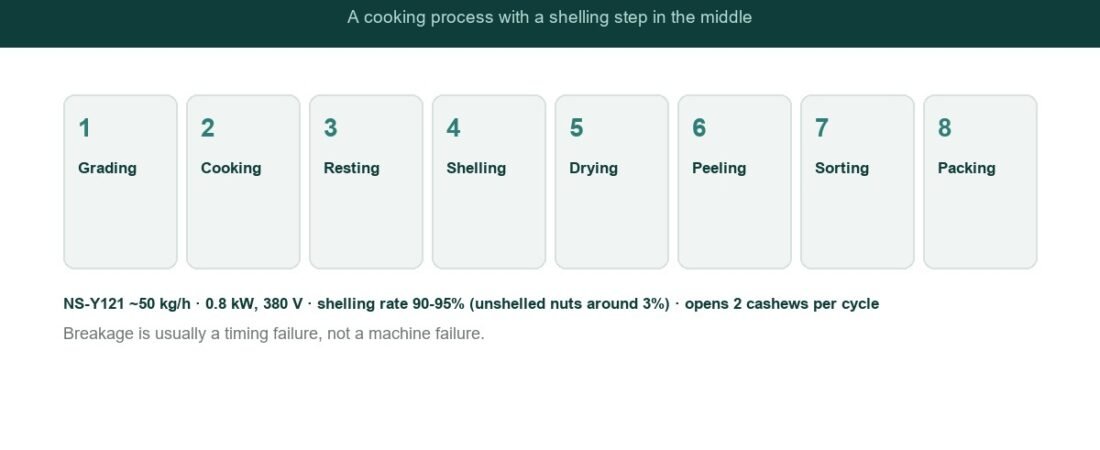
Cashew is the most awkward nut in this catalogue to process, and the reason is chemical rather than mechanical. The shell contains a caustic oil that will burn skin and ruin a batch of kernels, and the kernel inside is soft enough to be marked by the shell it came out of. Every stage of a cashew line exists to manage those two facts: cook the shell so it releases cleanly, get the kernel out before it dries hard, and keep the two away from each other while it happens.
This guide follows a cashew line from intake to packed kernel, names the decision each stage makes, and sets out the published figures for the shelling machine we build. Where a stage sits outside what we manufacture, we say so.
Last updated: 27 September 2026
The short answer
- Cashew is a cooking process with a shelling step in the middle. Cook badly and shelling damages the kernel; shell badly and you lose kernels you already paid to cook.
- The shell must be cooked before it is cracked, because raw shell is both too tough to open cleanly and full of oil that contaminates the kernel.
- The kernel is most fragile immediately after cooking and most robust once dried. The gap between those two states is where whole kernel recovery is won or lost.
- Breakage is usually a timing failure, not a machine failure. Cook time, rest time and shelling temperature decide most of the outcome.
- Grade is decided at sorting, but earned earlier. No sorting line can repair a split caused at shelling.
- One published model covers small and mid-size shelling duties: the NS-Y121 at around 50 kg/h, 0.8 kW on 380 V, with a published shelling rate of 90-95%.
Why cashew is a different problem from other nuts
On a macadamia or pine nut line the enemy is moisture: the wrong moisture makes shell and kernel respond to load in ways that damage the kernel. Cashew has that problem too, but it also has a second one, and it is worse.
The shell contains cashew nut shell liquid (CNSL), a phenolic oil that is caustic enough to blister skin and harmful enough to leave a permanent mark on kernel. A crack that lets shell fragments contact kernel is therefore not just a mechanical failure, it is a quality failure: the kernel is downgraded or rejected even though it is physically whole.
That is why a cashew line is built around the cooking step. Cooking softens the shell structure so it releases the kernel along the shell interface instead of tearing through it, and it makes the shell easier to handle without smearing oil across the kernel. Everything downstream is arranged around protecting what the cooking step achieved.
The eight stages of a cashew line
1. Reception and grading. Remove stones, foreign matter and undersized nuts. Consistent nut size is what makes the cooking step repeatable.
2. Steam cooking or roasting. Heat the shell to a state where it cracks cleanly. This is the stage that decides the rest of the day.
3. Cooling and resting. Bring the batch down and let it settle before shelling. Shelling hot is one of the most common causes of kernel damage.
4. Shelling. Open the shell and separate kernel from shell, without transferring force into the kernel. This is the stage our shelling machine covers.
5. Drying. Reduce kernel moisture before peeling and storage, so the kernel firms up and the testa loosens.
6. Peeling. Remove the testa without breaking the kernel or leaving fragments on it.
7. Grading and sorting. Separate whole kernels from splits and pieces, and remove shell fragments and discoloured kernels.
8. Packing. Protect the kernel from moisture and light, and from the handling that creates the last losses of the day.
What each stage decides
| Stage | What it decides | How it fails |
|---|---|---|
| Reception and grading | Whether cooking is repeatable | Mixed nut sizes cook unevenly |
| Cooking | Whether the shell releases the kernel | Under-cooked shell tears kernel; over-cooked kernel firms and cracks |
| Cooling and resting | The condition the sheller actually sees | Hot shell transfers heat and force into the kernel |
| Shelling | Whole kernel share of everything that follows | Crushing, splitting, oil contamination |
| Drying | Kernel firmness before peeling and storage | Soft kernel tears at peeling; wet kernel moulds in store |
| Peeling | Testa-free, unmarked whole kernel | Fragments left on kernel; kernel scratched or split |
| Grading and sorting | Sellable grade and price band | Splits sold as wholes; shell fragments in the pack |
| Packing | Condition on arrival | Moisture regain, crushing in transit |
Where kernel breakage actually happens
When a line reports falling whole kernel recovery, the investigation usually starts at the sheller and finds the cause one or two stages earlier. Work backwards:
| Symptom | Usual cause | Where to look first |
|---|---|---|
| Kernels split cleanly along the centre | Shell too brittle, or force too high | Cook time and cooling, then sheller setting |
| Kernels bruised or dented, shell still intact | Kernel too soft – batch shelled too hot | Cooling and resting time |
| Whole kernel share drops through the shift | Batch temperature creeping up, or feed rate pushed | Feed rate and the cooking cycle record |
| Oil marks on kernel surfaces | Shell fragments crossing into the kernel stream | Separation and handling after shelling |
| Testa fragments that will not peel off | Kernel dried before peeling | Order of the drying and peeling steps |
| Good result in the sample, poor result in the pack | Losses after shelling | Grading and packing handling, not the machine |
The published figures for the shelling stage
These are the figures we publish for the cashew shelling machine we build. They describe the machine, not your material: the shelling rate in particular is a published figure that you should verify on your own nuts, with your own cooking cycle, before you plan a business around it.
| Specification | NS-Y121 |
|---|---|
| Published capacity | ~50 kg/h |
| Power supply | 0.8 kW, 380 V |
| Dimensions (L x W x H) | 1,450 x 700 x 1,200 mm |
| Machine weight | ~200 kg |
| Published shelling rate | 90-95% (unshelled nuts around 3%) |
| Cycles | Opens 2 cashews per cycle |
| Packing volume | 3.00 CBM |
| Packed weight | ~280 kg |
Two of those rows deserve a comment. The first is the shelling rate: a rate of 90-95% is a statement about how many nuts the machine opens in a pass, and it is not the same as whole kernel recovery, which also depends on your cooking, cooling and handling. The second is the cycle description – opening two cashews per cycle describes the working principle of the machine, which is a controlled opening action rather than a bulk crushing action. That distinction is why the setting matters as much as the throughput.
Sizing a cashew line
The arithmetic is the same as for any nut line: divide your peak daily intake by the effective hours you can actually run, and compare the result against the published capacity with a derating allowance. At a published 50 kg/h, the NS-Y121 covers a peak day of around 300 kg across a seven-hour effective shift, and a bigger day is covered by running more hours rather than by a bigger machine – which is usually the cheaper answer.
The full method, with worked examples and a table of stages to check, is set out in how to size a pine nut processing line. The stages differ between crops; the calculation does not.
Two cashew-specific constraints enter the calculation:
- Cooking capacity is often the real bottleneck. If the cooker handles less per batch than the sheller handles per hour, the sheller waits, and the schedule is set by the cooker.
- The rest period is scheduled time. If the batch has to rest for hours between cooking and shelling, those hours exist whether or not they appear in your plan. See cashew steam cooking and shelling: temperature and timing.
What we make, and what we do not
We build peeling, threshing and cracking machines for macadamia, pine nut and coffee, and the cashew shelling machine covered above. We do not build cooking vessels, dryers, peeling lines, graders or packing equipment, and we will say so plainly rather than sell you something adjacent. If you send us the stages you still need, we will tell you which ones we cover.
What buyers actually ask for
Cashew kernel is traded by grade, and the trade uses standard designations – whole white kernels in the larger size bands, then splits, then pieces – so the practical question for a processor is how much of the crop arrives in the top band and how much falls to pieces. That ratio is not decided by the grader: it is decided by cooking, cooling and shelling, and it is revealed by grading.
Three checks give you a picture of your own line without any laboratory:
1. Weigh a sample of intake and a sample of finished kernel. The ratio tells you your recovery, and it is the figure a buyer will ask about first.
2. Count whole against split in a fixed sample of output. Do it every shift, at the same point in the flow, so the figures are comparable.
3. Inspect for oil marks and testa fragments. These are the defects that downgrade otherwise whole kernels, and they point at separation and handling rather than at the machine.
Frequently asked questions
Do I need to cook cashew nuts before shelling them?
Yes, for any commercial line. Raw shell is tough enough that cracking it imposes force on the kernel, and the shell liquid inside contaminates kernels that come into contact with it. Cooking softens the shell structure so it opens along the shell interface, and it makes the whole operation safer to handle.
What is the difference between shelling rate and whole kernel recovery?
Shelling rate describes how many nuts the machine opens in a pass – the NS-Y121 is published at 90-95%, with unshelled nuts around 3%. Whole kernel recovery describes what proportion of the output is unbroken and sellable. The two move independently: a machine can open nearly every nut and still deliver a poor whole kernel share if the batch was cooked or cooled incorrectly.
How much can a small cashew line produce in a day?
Work from effective hours rather than the calendar. At a published ~50 kg/h, the NS-Y121 delivers around 350 kg across a seven-hour effective shift and around 300 kg across six. If your peak day is larger than that, the usual answer is more hours or a second unit rather than a bigger single machine, because cooking and resting capacity has to move with it.
Where does most kernel breakage come from?
From timing rather than from force. Shelling a batch too hot, or too long after cooking, or with too little rest before feeding, all produce splits and bruises that no machine setting can undo. If your breakage rate changes during a shift, look at batch condition first – see cashew shelling machines: reading the numbers.
Can one cashew shelling machine handle different nut sizes?
The machine opens cashews through a controlled action, and nut size affects how it behaves, but the honest answer is that mixed sizes in one batch produce mixed results. Grade before cooking, so that each batch is cooked for a size rather than for an average.
Does the machine come with support for the rest of the line?
We supply the shelling machine and the published specifications that go with it, and we will tell you which stages you still need from elsewhere. OEM branding and customisation are available on request, specifications are confirmed in writing before production, minimum order is one unit, and we normally reply within one business day.
Send us your nut size and your peak day
Tell us your nut size range, your peak daily intake and how many hours you can run, and we will tell you whether one NS-Y121 covers the duty and where your cooking and resting capacity needs to sit. Reach us through the contact page.
Related reading and machines
- Cashew shelling machine: reading the numbers before you buy
- Cashew steam cooking and shelling: temperature and timing
- How to size a pine nut processing line
- Sorting kernels: manual vs machine grading
- Macadamia processing line layout: harvest to packed kernels
- Cashew shelling machine, NS-Y121, around 50 kg/h
- Cashew shelling machines
- All nut processing machines
- Nut processing knowledge base
- How to inspect and commission a nut processing line