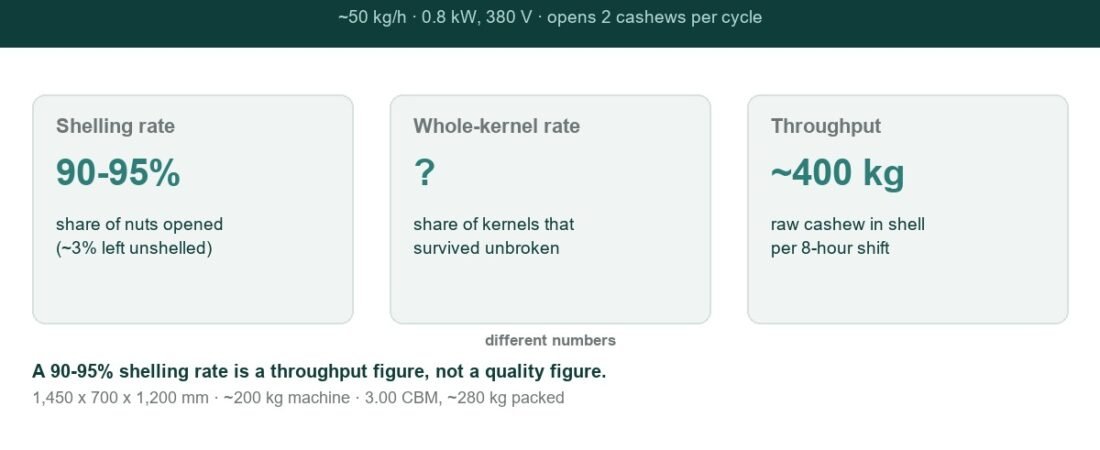
A cashew shelling machine is quoted with two figures that look similar and mean different things: how many nuts it opens, and how many kernels come out whole. The NS-Y121 opens two cashews per cycle at around 50 kg/h with a published shelling rate of 90-95%, and this page explains what those figures do and do not promise, how the throughput arithmetic works out over a shift, and which site conditions you should check before you commit to a machine that weighs about 200 kg and ships in 3.00 CBM.
Last updated: 24 September 2026
The short answer
- Shelling rate is not whole-kernel yield. A 90-95% shelling rate describes how many nuts are opened. How many kernels survive whole is a different measurement, and it is the one that decides your revenue.
- The NS-Y121 opens two cashews per cycle at about 50 kg/h. That is roughly 400 kg of raw cashew in shell over an eight-hour shift, before the usual derating for loading and clearing.
- The motor is small: 0.8 kW on a 380 V three-phase supply. Cheap to run, but your site has to have three-phase power in the first place.
- Freight is decided by weight and volume, not by capacity. The machine weighs about 200 kg, packs into 3.00 CBM, and ships at about 280 kg packed.
- Grading before shelling is where whole kernels are won. A wide spread of nut sizes through an ungraded feed is the most common cause of breakage that has nothing to do with the machine.
- The published rate refers to cashew. The machine is sold as a cashew and peanut sheller, but the 90-95% figure is a cashew figure. Confirm the rate on the material you actually buy.
What a shelling rate of 90-95% actually measures
A shelling rate is a count: of the nuts that went in, how many came out opened. It is a throughput measure, and it is honest as far as it goes. What it is not is a quality measure.
Two different machines can both claim 90-95% while producing very different amounts of usable kernel, because the figure says nothing about what happened to the kernels that were opened. In cashew, as in every nut, the money is in the whole kernel, and breakage is what takes it away.
So when you compare quotations, ask for both numbers and ask for them on your material:
- Shelling rate. Share of nuts successfully opened.
- Whole-kernel share. Of the kernels released, how many came out unbroken.
We publish the first figure for the NS-Y121, including the roughly 3% of nuts left unshelled. We will not publish a breakage figure we have not measured on your cashew, because in cashew the answer depends heavily on how the feed was conditioned and graded before it reached the machine. If whole-kernel share is what you are optimising, tell us how you condition your shell and we will confirm how the machine should be set up for it.
The NS-Y121 in its own numbers
| Specification | Value |
|---|---|
| Model | NS-Y121 |
| Capacity | ~50 kg/h |
| Dimensions (L x W x H) | 1,450 x 700 x 1,200 mm |
| Weight | ~200 kg |
| Power supply | 0.8 kW, 380 V |
| Shelling rate | 90-95% (unshelled nuts around 3%) |
| Cycles | Opens 2 cashews per cycle |
| Packing volume | 3.00 CBM |
| Packed weight | ~280 kg |
Those are the published figures for the machine, and they are the ones to plan against. The cashew shelling machine product page carries the same table, and the machine sits in the cashew shelling machines range.
Throughput arithmetic: from 50 kg/h to a working shift
The arithmetic is simple, and running it yourself is the fastest way to find out whether this machine is the right size for you.
- Nameplate. 50 kg/h on raw cashew in shell.
- An eight-hour shift. 50 x 8 = about 400 kg of feed.
- A realistic day. Subtract loading, clearing jams, changing batches and operator breaks. The machine does not run flat out for eight hours, and no honest capacity figure pretends it does.
The product page describes the intended application as small commercial cashew workshops starting at about 400 kg per shift, and household or farm-scale processing. That framing is deliberate: the NS-Y121 is a first machine, not the middle of a line.
If your target is far above 400 kg per shift, the right answer is not to run this machine for sixteen hours. It is to buy capacity, or to move to a different stage of equipment. We would rather tell you that than sell you the wrong size twice.
Why two cashews per cycle is a design choice, not a limitation
Opening two nuts per cycle is what lets a 0.8 kW motor reach 50 kg/h. The machine gets its throughput from a steady working rhythm rather than from brute force, and that has three practical consequences:
- The electrical requirement stays small. A 0.8 kW three-phase motor is a far lighter load than the motors on a full cashew line, which matters if your site’s supply is limited.
- Throughput is set by cycle rate, not by pressure. The machine’s output is a function of how steadily it cycles, which is why machine condition and a clean, well-sized feed matter more than pushing it harder.
- It is a hand-fed machine in practice. One operator keeps it loaded, and that person is part of your capacity calculation, not an afterthought.
Where shelling sits in a cashew line
Shelling is one step, and it is worth knowing which steps come before and after it, because they change what the machine can achieve.
| Stage | Purpose | Typical equipment |
|---|---|---|
| Drying and conditioning | Make the shell brittle enough to open cleanly | Dryer, steamer or roaster, depending on process |
| Grading | Remove the wide size spread that causes breakage | Size screens or graders |
| Shelling | Open the shell and release the kernel | Cashew shelling machine |
| Kernel drying | Bring the released kernel to a stable condition | Dryer |
| Peeling | Remove the testa from the kernel | Kernel peeling machine |
| Grading and packing | Split by size and prepare for sale | Graders, packing equipment |
We build the peeling, cracking and threshing machines in this range rather than every stage of a cashew line, and we will say so plainly when you ask for a line recommendation. Send us the conditioning method you use and we will confirm how the NS-Y121 should be set for it. If you are planning several stages at once, the same layout logic we set out for nuts applies, and we have written up how machine pricing is structured when you are costing a line rather than a single unit.
What to check on site before you order
- Power. 380 V three-phase for a 0.8 kW motor. Confirm the supply exists at the point of use, not just at the site entrance.
- Floor space. The machine is 1,450 x 700 x 1,200 mm. Add room for the operator, the infeed and the outfeed, because all three are part of the working footprint.
- Freight. 3.00 CBM and about 280 kg packed, against a machine weight of about 200 kg. Get this number from us before you compare landed cost with anyone else.
- Downstream capacity. A sheller that outruns your drying and peeling capacity just moves the bottleneck.
- Volume, not price alone. Ask one supplier to quote the machine and another to quote the same machine plus freight and packing, and you will see how much of the difference was never the machine.
Frequently asked questions
What is the difference between shelling rate and whole-kernel rate?
Shelling rate counts how many nuts were opened – the NS-Y121 publishes 90-95%, with roughly 3% left unshelled. Whole-kernel rate counts how many of the released kernels survived unbroken. The first is a throughput figure, the second is a quality figure, and only the second one maps directly to what a buyer pays you for.
How many cashews can the NS-Y121 process in a day?
At about 50 kg/h, an eight-hour shift handles roughly 400 kg of raw cashew in shell. Real output is lower once loading, clearing and batch changes are counted, and it depends on nut size, moisture and how well the cashew was graded before it reached the machine.
Does better grading really change the outcome?
Yes, and it is the cheapest improvement available to you. A feed with a wide spread of nut sizes gives the machine two different jobs at once, and one of them will be set wrong. Grading first narrows the range the machine has to handle.
What power supply and floor space does the NS-Y121 need?
The machine runs a 0.8 kW motor on 380 V three-phase and measures 1,450 x 700 x 1,200 mm. Because the motor is small, the electrical load is far lighter than a full cashew line, but the three-phase supply has to be available where the machine will stand.
Can the same machine shell peanuts?
The NS-Y121 is sold as a small cashew and peanut shelling machine, so it handles both. Cashew is the primary application and the published 90-95% shelling rate refers to cashew specifically, so treat the peanut application as a second job to confirm with us rather than as an equivalent rating.
What is the minimum order?
Minimum order is one unit. OEM branding and customisation are available on request, and specifications are confirmed in writing before production.
Request a quote or ask a question
Send us your daily cashew volume, the conditioning and grading method you use, your power supply and your destination port, and we will come back with price, packing size, shipping options and lead time – usually within one business day.
- Email: nanshengtechnology@gmail.com
- Phone / WhatsApp: +86 133 7302 3075
Browse the full product range or read more processing guides in the knowledge forum.
Related reading and machines
- Machine: Cashew shelling machine NS-Y121
- Category: Cashew shelling machines
- Guide: What drives the price of a processing line
- Guide: Raising the whole-kernel rate
- All machines: Agricultural processing equipment
- Cashew processing: the complete guide
- Cashew steam cooking and shelling
- Cashew kernel peeling without breakage