Cashew shelling is the step where a small processor either becomes a business or stays a kitchen operation. The work is simple to describe and hard to do at volume: score the shell, open it without cutting the kernel, and separate the shell fast enough that the kernel does not sit in a pile of caustic shell liquid.
The decision between hand shelling and a machine is usually argued as a philosophy. It is not. It is a utilisation question. A 50 kg/h machine is expensive if you run it four hours a week and cheap if you run it two shifts a day. This guide sets out the arithmetic, using our own NS-Y121 as the worked example, so you can put your numbers in and see which side of the line you are on.
The short answer
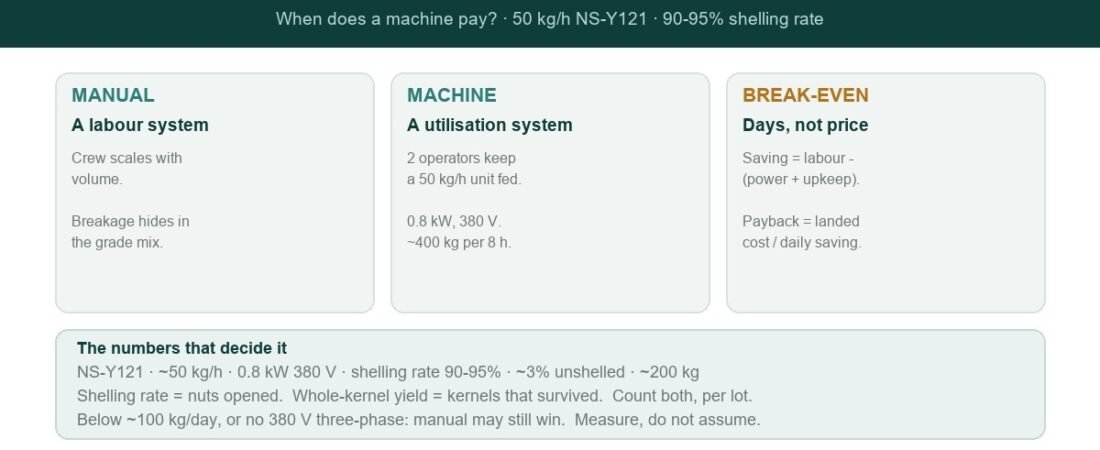
- Manual shelling is a labour system, not a free option. Its cost is workers × hours × wage, plus supervision, training, turnover and inconsistent breakage.
- Machine shelling is a utilisation system. Its cost is the landed machine price, power, two operators and maintenance, divided by the hours you can actually keep it fed.
- The NS-Y121 is rated at about 50 kg/h, uses a 0.8 kW three-phase motor on 380 V, and publishes a 90–95% shelling rate with roughly 3% unshelled nuts.
- Shelling rate is not whole-kernel yield. A machine can open 95% of nuts and still lose money if it breaks the kernels that buyers pay a premium for. Measure both.
- Measure your own manual rate before you calculate anything. One hour with a stopwatch and a scale is worth more than any generic benchmark.
Definition: the break-even point is the number of production days at which the daily labour saved by the machine equals its landed cost. It is not the machine price divided by the manual wage; power, maintenance, utilisation and uptime all belong in the denominator.
What manual shelling actually costs
The visible cost is the wage bill. The expensive part is everything around it.
Labour scales linearly with volume. If one worker shells 2 kg of raw cashew in an hour, a 400 kg day needs 25 workers over an eight-hour shift. That is the example we use below, and it is deliberately labelled an example: your own rate depends on nut size, moisture, knife technique and how much of the kernel you are willing to break.
Breakage is invisible in the wage bill. Hand shelling can protect whole kernels in skilled hands, but it is not consistent across a crew. A new worker, a dull knife or a batch that has dried too far changes the breakage rate, and the loss shows up in the grade mix weeks later, not at the shelling table.
Supervision and training are real costs. A crew of 25 needs a supervisor, a sharpening routine, gloves, eye protection and a clean sorting surface. Turnover means retraining. None of these lines appear in a simple wage comparison, but they are part of the daily cost.
The harvest does not wait. Manual shelling sets a hard ceiling on daily intake. If the peak harvest delivers 800 kg a day and the crew can shell 400 kg, the rest sits in shell and loses quality. The cost of that delay is usually larger than the wage difference.
Quality consistency is a commercial cost. Export buyers and roasters expect a stable grade mix. A manual crew can produce excellent kernels, but the variance between workers is wider than between machine runs. If your buyer samples every lot, variance becomes a price issue.
What a machine changes, and what it does not
The NS-Y121 is an entry-level cashew and peanut sheller. It opens two cashews per cycle at around 50 kg/h, publishes a 90–95% shelling rate with about 3% unshelled nuts, and runs on a 0.8 kW three-phase motor at 380 V. It weighs about 200 kg and packs into 3.00 CBM at about 280 kg packed weight.
Those numbers answer three questions and leave two open.
- It answers the throughput question. At 50 kg/h, an eight-hour shift has a theoretical ceiling of 400 kg. Real output is lower because of feeding, adjustments, breaks and uptime.
- It answers the power question. The motor is small, but it needs a 380 V three-phase supply. A site with only single-phase power needs that resolved before the machine is ordered.
- It answers the labour question. Two operators can keep a 50 kg/h unit fed and inspected. That is the number to put against the manual crew.
- It does not answer the whole-kernel question. Shelling rate counts opened nuts, not intact kernels. Ask for the whole-kernel yield on your own sample, not a single headline percentage.
- It does not answer the utilisation question. A machine that runs one hour a day has the same capital cost as one that runs sixteen. Only your volume can answer whether that is efficient.
| Item | Manual shelling | NS-Y121 | Full cashew line |
|---|---|---|---|
| Typical daily output | Crew-dependent (example: 16 kg per worker per day) | ~400 kg per 8 h at 50 kg/h | 1.6–8 t per 8 h at 200–1,000 kg/h |
| Labour | High; scales with volume | 2 operators | 4–12 crew, depending on stages |
| Shelling rate | Skill-dependent | 90–95% published; ~3% unshelled | Line-dependent; measure at each stage |
| Whole-kernel control | Skill-dependent; wider variance | Mechanical, then hand inspection | Mechanical plus grading and sorting |
| Power | None | 0.8 kW, 380 V three-phase | 3–30+ kW, site-dependent |
| Best fit | Below roughly 100 kg/day, or trial lots | 200–500 kg/day | Above 1 t/day |
The table is a starting point, not a selection rule. The full line is not automatically better: it needs more capital, more floor space, more power and a crew that can keep it fed. The right question is which configuration removes the bottleneck you actually have.
The break-even arithmetic
Use this formula, then replace every assumption with your own measurement:
Daily saving = manual labour cost − (machine labour + power + maintenance).
Payback days = landed machine cost ÷ daily saving.
Here is a worked example for 400 kg of raw cashew in shell per day. Every number is an assumption, not a quotation: a manual rate of 2 kg per worker per hour, an eight-hour shift, a wage of USD 6 per day, two machine operators, power at USD 0.15 per kWh, and USD 3 per day for maintenance and wear parts. Substitute your own rates.
| Cost line | Manual | NS-Y121 |
|---|---|---|
| Daily target | 400 kg | 400 kg |
| Throughput basis | 2 kg per worker per hour | 50 kg/h |
| Hours | 8 | 8 |
| People | 25 workers | 2 operators |
| Wage | USD 6/day | USD 6/day |
| Labour cost per day | USD 150.00 | USD 12.00 |
| Power | None | 0.8 kW × 8 h × USD 0.15 = USD 0.96 |
| Maintenance and wear parts | Knives, PPE, sharpening (not costed) | USD 3.00/day (example) |
| Total daily cost | USD 150.00 | USD 15.96 |
| Daily saving | — | USD 134.04 |
At USD 134 per day, the payback depends entirely on the landed machine cost. The table below shows the arithmetic across three illustrative cost levels. Use the quoted landed cost, including freight, duty and installation, not the ex-works price.
| Landed machine cost | Saving USD 80/day | Saving USD 110/day | Saving USD 134/day |
|---|---|---|---|
| USD 5,000 | 63 days | 45 days | 37 days |
| USD 10,000 | 125 days | 91 days | 75 days |
| USD 20,000 | 250 days | 182 days | 149 days |
Three cautions before you use the result. The example assumes eight productive hours; apply your real uptime, not the catalogue ceiling. It excludes financing, floor space, a power upgrade and the cost of learning to run the machine. And it values only labour: if the machine also raises whole-kernel yield or reduces rework, the true payback is shorter than the table shows.
Where manual still wins
Manual shelling is not irrational. It wins in four situations.
- Very small volume. Below roughly 100 kg a day, a 50 kg/h machine may sit idle for most of the week. Idle capital is still capital.
- Highly variable nut size. If every lot is a different grade and the machine needs frequent adjustment, a skilled crew can be more flexible for trial quantities.
- No three-phase power. The NS-Y121 is published at 380 V three-phase. If the site cannot supply it, the comparison is not between manual and machine; it is between manual and a power upgrade.
- Traceability by one worker. Some specialty buyers want a small lot handled by one identified person. That is a service niche, not a volume business.
In each case, the honest comparison is total cost per kilogram of saleable kernel, not cost per kilogram of raw nut. A manual crew that breaks fewer kernels can be cheaper per saleable kilogram even when its wage bill is higher.
What decides the machine’s real output
A published 50 kg/h rating is a configuration number. Five variables decide what you actually get:
- Size grade. Cashew nuts vary by origin and grade. Feeding mixed sizes without calibration raises unshelled nuts and broken kernels.
- Moisture. Too dry and the kernel is brittle; too wet and the shell is tough and the kernel adheres. The target is specific to your process, not a universal number.
- Blade and gap condition. A worn edge or a drifted gap changes the cut. Inspect and log it at the start of every shift.
- Feed discipline. The machine opens two cashews per cycle. Overfeeding to chase throughput is the fastest way to raise breakage.
- Uptime. Cleaning, adjustment and spare-part changes are part of the day. A machine that runs six productive hours is a 300 kg machine, not a 400 kg machine.
Power quality belongs on the list too. A small motor is sensitive to voltage drop and phase imbalance, especially on a shared rural supply. If the site voltage swings at peak, the machine will trip or run hot, and the payback calculation will be wrong for a reason that has nothing to do with shelling.
A one-hour trial that settles the argument
Do not choose from a catalogue. Run the same sample through both methods and count four outputs: opened, unshelled, broken and whole.
- Step 1 — Sample. Take 20 kg that represents your normal grade mix. Record moisture and size distribution.
- Step 2 — Manual baseline. Weigh the raw nuts one worker shells in 60 minutes. Count whole, broken and unshelled. Repeat with a second worker; use the average, not the best.
- Step 3 — Machine run. Set the gap, run the same grade for 60 minutes, and weigh the output. Count the same four categories.
- Step 4 — Calculate. Shelling rate = opened ÷ total. Whole-kernel yield = whole ÷ total kernel. Throughput = output kg ÷ hours.
- Step 5 — Compare cost per saleable kilogram. Include labour, power, maintenance and the value difference between whole and broken kernels.
- Step 6 — Run again. Change one setting at a time. A second hour at a different gap is more informative than a second opinion.
If the machine wins on cost per saleable kilogram at your volume, it is the right machine. If it wins on throughput but loses on whole-kernel yield, the problem is the setting or the sample, not the concept. Fix the setting before you reject the machine.
What to send before a quotation
A supplier cannot size a cashew shelling machine from a daily tonnage alone. Send these seven details and the answer becomes a specification rather than a brochure:
- Raw cashew in shell, with origin and size grade.
- Current daily volume in kg, and the peak-day volume during harvest.
- Measured manual shelling rate, if you have one, in kg per worker per hour.
- Moisture condition and the drying method used before shelling.
- Target product: whole kernels, splits, or both, with the grade mix you sell.
- Supply voltage, phase and whether 380 V three-phase is available at the panel.
- Destination port and the packing volume you can accept.
If you already run a line, send the current breakage and unshelled percentages. That tells us whether the gap is the machine, the feed or the preparation before shelling. Our cashew shelling numbers guide explains how to read those figures, and the cashew processing guide shows where shelling sits in the full sequence.
Frequently asked questions
Is a manual cashew shelling machine cheaper than a fully automatic line?
It has a lower capital cost and a higher labour cost per kilogram. Whether it is cheaper overall depends on your daily volume and wage rate. Use the payback formula above with your own numbers, not a generic percentage.
What is the shelling rate of the NS-Y121?
The published figure is 90–95%, with about 3% unshelled nuts. That is a one-pass shelling rate. It is not the same as whole-kernel yield, which must be measured separately on your sample.
How many workers does a 50 kg/h machine replace?
There is no universal number. In the worked example, a manual rate of 2 kg per worker per hour and an eight-hour shift means 25 workers for 400 kg. If your workers shell 4 kg/h, the same output needs about 13. Measure your own rate before comparing.
Can the NS-Y121 run on single-phase 220 V?
The published specification is 0.8 kW at 380 V three-phase. Do not assume a single-phase option. Confirm the supply at your panel before ordering, and read our voltage and power guide if the site is not yet wired.
Does a higher shelling rate always mean a better machine?
No. A machine can open more nuts and break more kernels at the same time. Compare cost per kilogram of saleable whole kernel, not the shelling percentage alone.
What is the minimum volume that justifies a machine?
Run the payback table with your landed cost and your daily labour saving. If the payback is longer than the harvest season you can keep the machine fed, manual shelling may be the better first step. If it is shorter than one season, the machine is doing the work for free after that.
Can one machine handle both cashew and peanut?
The NS-Y121 is described as a cashew and peanut sheller. Confirm the settings and wear parts for each product with the supplier, and run a sample of each before committing to a mixed schedule.
Related reading and machines
- NS-Y121 cashew shelling machine: specifications and enquiry
- Cashew shelling machine: reading the numbers
- Cashew processing: the complete guide
- Cashew processing line cost: what drives the price
- Cashew kernel grades: what W180 to W450 mean
- How to dry cashew nuts before shelling
- Manual vs machine nut sorting
- Send your sample data and ask for a quotation
Send us your daily volume, measured manual rate and target grade mix. We will tell you whether a 50 kg/h unit is the right size, and what the sample says about whole-kernel yield before you commit.