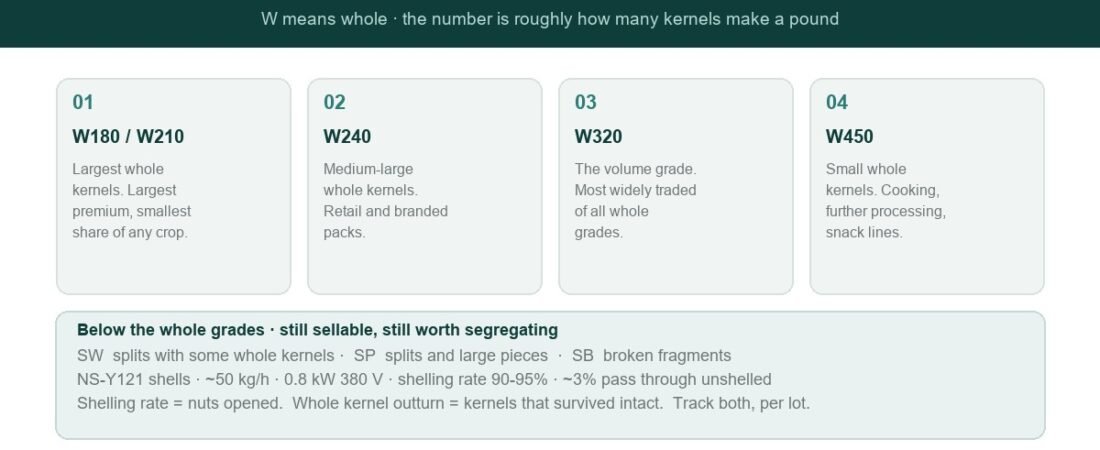
Cashew kernel grades are named by count, not by size in millimetres. A W320 is a whole kernel that runs roughly 320 to the pound, and a W240 is a larger kernel that runs roughly 240 to the pound. That single convention explains most of the confusion buyers meet when they compare offers from India, Vietnam, Brazil and West Africa.
It also explains where the money is. Everything the market pays for — wholeness, count, colour — is decided upstream of the grading table, at the steam cooker, the sheller and the peeler. This page sets out what the grade names mean, how the whole grades sit above the splits and the broken, and which settings on your own line move the mix.
Last updated: October 2026
The short answer
W means whole, and the number is roughly how many kernels make a pound, so the smaller the number the larger the kernel. W180 is the largest whole grade normally traded; W450 is the smallest. Below the whole grades sit splits and broken kernels, which sell at a fraction of whole prices.
Because of that, your revenue is decided by the share of kernel weight that lands in the whole grades — not by total tonnage and not by how fast the sheller runs. The number worth tracking on your own line is whole kernel outturn, measured per lot of raw nut in shell.
What the letters and numbers mean
Two letters, one number, and the number is a count.
- W stands for whole, meaning a kernel that is intact rather than split or broken.
- The number is the approximate number of kernels per pound. W180 runs about 180 kernels to the pound, W320 about 320. A smaller number therefore means a bigger kernel.
- Grades are defined within a tolerance, and the tolerance — not just the headline number — is what a contract fixes. Two buyers asking for “W320” may be specifying different count windows, so the count range belongs in writing on the contract, not assumed.
- The main whole grades traded are W180, W210, W240, W320 and W450. W320 is usually the volume grade: the largest share of any normal crop lands there, and it is the grade most often quoted in market reports.
- Alongside the whole grades, lots are graded as splits (pieces that are still large, sold as SW and SP) and broken (smaller fragments sold as SB). Off-colour kernels — sometimes described as scorched — are graded separately rather than blended into a white grade.
| Grade | Approximate kernels per pound | Position in the mix | Where it usually goes |
|---|---|---|---|
| W180 | about 180 | Largest whole kernel | Premium retail packs, gifting, high-end confectionery |
| W210 | about 210 | Large whole kernel | Retail packs, premium snack lines |
| W240 | about 240 | Medium-large whole kernel | Retail and branded packs |
| W320 | about 320 | Medium whole kernel; the volume grade | The most widely traded grade; retail and ingredient use |
| W450 | about 450 | Small whole kernel | Cooking, further processing, snacks |
| SW | splits with some whole kernels | Below the whole grades | Confectionery and bakery where shape matters less |
| SP | splits and large pieces | Below the whole grades | Confectionery, bakery, sauces |
| SB | broken fragments | Bottom of the grade ladder | Paste, butter, fillings, ingredient blends |
Why the grade mix, not the tonnage, decides the money
Two processors can each shell the same number of tonnes in a season and end it with very different revenue, because whole kernels and broken kernels are different products. A whole grade sells at a premium; splits and broken sell into ingredient markets at a fraction of that.
The practical consequence is that the target on the line is not “open more nuts per hour”. It is “keep more kernels whole”. A line that runs a little slower and delivers a higher whole share can beat a line that runs faster and turns its best kernels into splits.
This is where a common reading error costs money. A machine described as having a shelling rate of 90-95% is telling you how many nuts got opened, not how many kernels survived intact. Our NS-Y121 cashew shelling machine, for example, is rated at a shelling rate of 90-95% with roughly 3% of nuts passing through unshelled — that is a statement about opening, and it is a different measurement from whole kernel outturn. Both numbers belong on the same page of your comparison, and they answer different questions.
Where the grade mix is decided on the line
The grade mix is set at four places, and three of them come before the grading screens.
1. Conditioning before shelling
The shell has to release the kernel without gripping it. Under-conditioned shell clings and tears kernels open at the cut; over-conditioned kernels go soft and deflect instead of separating cleanly. Steam cooking and soaking time are the levers here, and the correct setting depends on the moisture and size of the incoming raw nut, which is why a single setting rarely suits a whole season. The temperature and timing side of this step is set out in cashew steam cooking and shelling.
2. The shelling cut itself
Shelling separates kernel from shell by impact or by shear, and the clearance at the cut is what protects the kernel. Too tight and the blade or the impact edge marks whole kernels; too loose and nuts pass through unshelled. This is the setting to adjust first when the split percentage rises without any other change on the line. How machine ratings are worded — capacity, shelling rate, cycles — is covered in reading the numbers before you buy.
3. Drying between shelling and peeling
After shelling, kernels are dried so the testa (the thin skin) will flake off. There is a window: dry enough for the skin to release cleanly, but not so dry that the kernel becomes brittle and snaps during handling. Kernels that are too dry break at the peeler; kernels that are too wet keep the skin and need a second pass, which costs surface and pushes good kernels down a grade.
4. Peeling and sizing
Peeling removes the testa; sizing decides which screen a kernel falls through and therefore which grade it is counted as. Both are grade-forming steps. An over-aggressive peel takes surface off whole kernels and shows as scuffing; screen sets that are too coarse merge two grades together and make the lot harder to sell as a named count. Kernel peeling without breakage deals with the peeling side in detail.
The settings that move the mix
| Setting | What it changes | What to check first |
|---|---|---|
| Steam and soak time | Whether the shell releases the kernel or grips it | Try a small batch at two timings and compare split percentage, not throughput |
| Sheller clearance | Kernel damage at the cut | Track split percentage as you adjust; change one variable at a time |
| Drying time before peeling | Testa flaking against kernel brittleness | Look at breakage at the peeler, not at the dryer outlet |
| Peeling aggressiveness | Surface quality of whole kernels | Check for scuffing on the largest grade in the lot |
| Screen set and cut points | Where the boundary falls between whole grades | Weigh each screen fraction; a wide middle screen hides a poor mix |
What to measure per lot
Four figures, recorded for every batch of raw nut in shell, will tell you more than any single throughput number:
- Whole kernel outturn — the share of kernel weight that ends in the whole grades.
- Split and broken percentages — the size of the loss you are taking below whole.
- Colour and off-colour share — how much of the crop is separating into off-colour rather than white grades.
- Screen fraction weights — the actual distribution across your screens, which shows whether your cut points match the grades you are selling.
Measure them per lot rather than per season. Raw nut quality varies between deliveries, and a fall in whole share is often a raw material change rather than a machine fault — which is only visible if the baseline is recorded lot by lot.
Grades below whole, and what to do with them
Splits and broken kernels are not waste. They sell into confectionery, bakery, pastes and fillings, and for many processors they are the difference between a viable season and a marginal one. Two rules keep them valuable:
- Segregate, do not blend. Off-colour kernels and broken fragments should be graded out into their own lots. Blending a small quantity of off-colour material into a white whole grade risks the whole lot, and buyers test for it.
- Sell splits as a product, not as a residue. A consistent split specification, with a stated size range, sells better than an ungraded “splits and pieces” lot — the same discipline as the whole grades applies, at a lower price point.
If you are weighing how much grading equipment to add, the decision behaves like the rest of the line: grade at the stage where the value is created, and size the stage to your peak day rather than your season total. The nut processing plant cost guide sets out the order in which it is usually worth spending, and the capacity and power chart puts the 12 models side by side.
Frequently asked questions
What does W320 cashew mean?
W stands for whole and 320 is approximately the number of kernels per pound, so a W320 is a medium-sized whole kernel. Smaller numbers mean larger kernels, which is why W180 commands a higher price than W450. The exact count tolerance is fixed by the standard or contract you sell against, so confirm the window in writing rather than assuming the headline number is exact.
Which cashew grade is the most valuable?
Generally the largest whole grades, W180 and W210, because there is less of them in any crop and demand is steady. Price does move: a short crop or a shift in retail demand can narrow the gap between neighbouring grades. The grade that matters most to your revenue, though, is not the top of the ladder but the whole-to-split ratio you achieve on your own line, since that is the part you control.
Does a higher shelling rate mean more whole kernels?
No, and treating the two as the same figure is a costly mistake. Shelling rate describes how many nuts the machine opens. Whole kernel outturn describes how many kernels come out intact. A machine can open every nut on the line and still leave you with a poor grade mix if the conditioning or the clearance is wrong. Track both, and track them per lot.
Can one machine produce all the grades?
No single machine produces grades; the grading screens sort what the line delivers. What the upstream machines decide is the mix the screens have to work with — a better sheller and a better peeling setting move weight into the whole grades, while the screens then separate W240 from W320. Sizing and screening choices are covered alongside the line cost question in cashew processing line cost.
How do I improve my whole kernel share?
Start with conditioning and sheller clearance, because those two account for most kernel damage, then look at drying before peeling. Measure split and broken percentages before and after each single change, one variable at a time, and use a small batch rather than a full run while you are testing. If the split percentage rises after a raw material change, the setting is usually the cause rather than the machine.
Request a quote or ask a question
We quote from your numbers rather than from a list price. Tell us the raw nut you are working with, your target kg/h, the grade mix you want to sell and the voltage available on site, and we will confirm which stages your line needs and how the shelling and peeling stages should be set for the count you are aiming at. Start with the contact form, or see the cashew shelling machine and the cashew shelling machines category.
Related reading and machines
- Cashew Processing: The Complete Guide
- Cashew Steam Cooking and Shelling: Temperature and Timing
- Cashew Kernel Peeling Without Breakage
- Cashew Shelling Machine: Reading the Numbers Before You Buy
- Cashew Processing Line Cost: What Drives the Price
- Nut Processing Plant Cost: What Sets the Number
- Whole Kernel Rate: How to Measure It and What Actually Improves It
- Nut Processing Machine Capacity and Power: A Reference Chart for 12 Models
- Cashew Shelling Machine NS-Y121
- Cashew Shelling Machines (category)