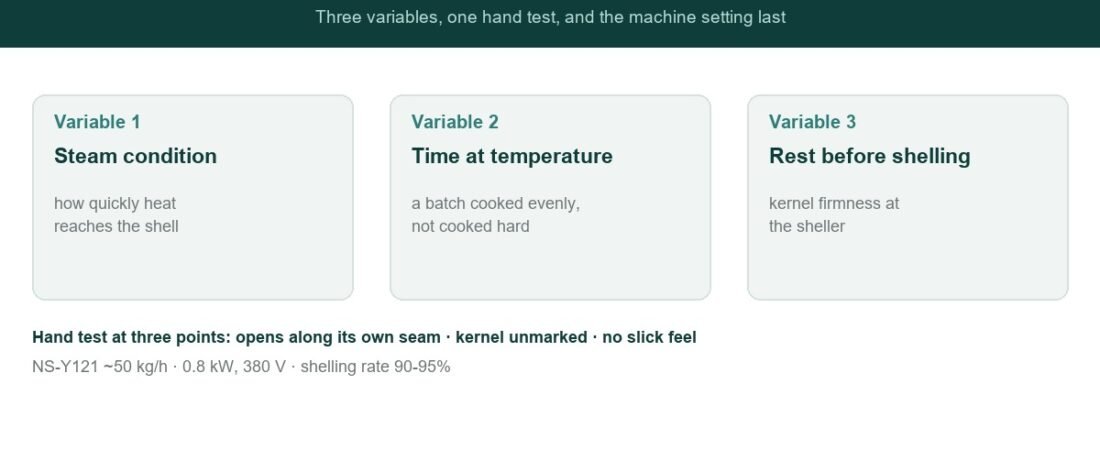
Two stages decide what a cashew line is worth: the cooking step, which sets the condition of the shell, and the shelling step, which converts that condition into whole kernels or into pieces. Everything between them is time – time at temperature, and time spent resting before the sheller sees the batch.
This page covers what steam cooking has to achieve, the three variables you can actually control, how to tell by hand whether a batch is ready, and how the published figures for our shelling machine relate to what happens upstream of it.
Last updated: 27 September 2026
The short answer
- Cooking exists to make the shell fail along its own interface. A shell that releases cleanly is a cooked shell; force is not the answer.
- Three variables decide the batch: steam condition, time at temperature, and the rest period before shelling.
- Shelling a hot batch damages kernels. The kernel is softest immediately after cooking and firms up as it cools and dries.
- Rest time is not optional and not slack. It is a scheduled stage, and it belongs in your daily capacity calculation.
- The machine setting is the last variable, not the first. If the batch is wrong, no setting recovers the kernels.
- Published, verifiable figures for the sheller: NS-Y121 at around 50 kg/h, 0.8 kW on 380 V, shelling rate 90-95% with unshelled nuts around 3%.
Why the shell has to be cooked before it is cracked
Cashew shell is not a brittle shell like macadamia. It is tough, and it contains cashew nut shell liquid (CNSL) – a caustic oil that will mark a kernel permanently on contact. Those two properties set the whole design of the line.
Cooking does three things:
1. It changes the shell structure so that the shell fails along the boundary between shell and kernel, rather than through the kernel.
2. It lowers the force needed to open the nut, which is what makes a controlled opening action possible at all.
3. It makes the shell safer to handle by driving off and collecting part of the shell liquid rather than leaving it free to smear onto kernels during shelling.
That is why the honest description of a cashew line is a cooking process with a shelling step inside it. The shelling machine – the NS-Y121 in our range – is designed to open two cashews per cycle through a controlled action, and controlled action only works on a nut whose shell has already been prepared.
The three variables you can control
Industry practice varies by region, cooker design and nut size, and the ranges below are commonly quoted industry ranges rather than specifications of any machine we build. We do not manufacture cookers, and we do not publish cooking parameters as if we did. What matters is that you control the three variables deliberately instead of by habit.
| Variable | What it controls | Too little | Too much |
|---|---|---|---|
| Steam condition | How quickly heat reaches the shell | Shell stays tough, kernel tears at shelling | Kernel firms up and cracks; colour suffers |
| Time at temperature | How completely the batch is cooked | Uneven batch: some nuts open cleanly, some do not | Kernel cooked hard, more splits and discolouration |
| Rest time before shelling | Kernel firmness and shell condition at the sheller | Hot, soft kernel; bruising and denting | Shell re-tightens and becomes brittle again |
The interaction is what makes cashew processing difficult to automate by recipe. A batch cooked longer at a lower steam condition is not the same as a batch cooked briefly at a higher one, even if both reach a similar temperature, because the shell and the kernel absorb heat at different rates. That is why the practical control is a hand test rather than a timer alone.
How to tell a batch is ready
The test is behavioural, and it takes a handful of nuts from three places in the batch – not from the top of the pile.
1. Open one by hand. A ready shell yields along its own seam with modest hand pressure. A shell that resists is under-cooked; a shell that crumbles into flakes is over-cooked.
2. Look at the kernel you just released. It should come away clean, unmarked and slightly flexible. A kernel that is dented by the shell during opening was shelled too hot. A kernel that snaps is a sign the batch has gone past its window.
3. Check for oil. If your fingers feel slick after the test, part of the shell liquid has been released onto the surface rather than drained away, and the batch will mark kernels at shelling.
4. Repeat at three points in the batch. Uneven cooking is the most common cause of an “unexplainable” breakage rate. If the top of the batch behaves differently from the middle, the batch needs more time or a smaller load, not more force at the sheller.
5. Write the result down. Time, batch weight, nut size and the hand-test outcome are the four things that make tomorrow’s batch repeatable.
Cooling and resting: why shelling hot is a loss
Immediately after cooking, the kernel is soft and the shell is at its most pliable. Both properties are useful to have and both are dangerous to act on. Feed a hot batch to a sheller and the machine does exactly what it is designed to do – open nuts – but the kernel deforms under the opening action, then dries in that deformed shape. The result is a whole kernel by weight and a bruised kernel by grade.
The rest period exists to trade a few hours of your day for whole kernel recovery. Two consequences follow for planning:
- Rest time is capacity, not slack. If the batch rests for hours, those hours occupy space, and that space has to exist.
- The rest period has to be uniform. A batch where part has rested and part has not behaves like a mixed batch at the sheller, which is why large batches are usually split for cooking rather than cooked in one deep load.
The interface with the sheller
The sheller is the stage that converts a good batch into a good yield, and it is worth being precise about what the machine controls and what it does not. These are the published figures for the machine we build:
| Specification | NS-Y121 |
|---|---|
| Published capacity | ~50 kg/h |
| Power supply | 0.8 kW, 380 V |
| Dimensions (L x W x H) | 1,450 x 700 x 1,200 mm |
| Machine weight | ~200 kg |
| Published shelling rate | 90-95% (unshelled nuts around 3%) |
| Cycles | Opens 2 cashews per cycle |
| Packing volume | 3.00 CBM |
| Packed weight | ~280 kg |
Read the shelling rate row carefully. A published 90-95% describes how many nuts the machine opens, and around 3% for unshelled nuts describes what is left unopened. Neither figure is a promise about whole kernels: that depends on the condition of the batch you feed it, which is the subject of this page. When a line reports a shelling rate inside the published band and a whole kernel share that it does not like, the machine is doing its job and the cooking, cooling or resting step is not.
Measuring the result without a laboratory
You only need a scale and ten minutes:
1. Weigh the intake for a measured run – for example, a ten-minute run at steady feed.
2. Weigh the kernel output and the shell output separately, and check the shell stream for kernels and the kernel stream for shell.
3. Split the kernel sample into whole and broken, and count oil-marked kernels and testa fragments separately from broken ones. They have different causes and different fixes.
4. Compare against your own previous runs, not against a target from someone else. A number you cannot reproduce is not a benchmark.
If you need the arithmetic for how much daily intake the machine covers, it is the same calculation used for any nut line, and it is set out in how to size a pine nut processing line.
A batch record for the cooking and shelling stages
| Column | Why it is there |
|---|---|
| Date, lot and nut size band | Cooking is only repeatable for a consistent size |
| Batch weight | Explains results that time alone cannot |
| Steam condition and time at temperature | Your starting point for tomorrow |
| Hand-test result at three points | The control that actually decides whether to shell |
| Rest time before shelling | The variable most often left out of the record |
| Feed rate and setting at the sheller | Separates machine behaviour from batch behaviour |
| Published shelling rate achieved | How many nuts opened, in total |
| Whole kernel share, from a weighed sample | What the batch was actually worth |
| Oil marks and testa fragments | Points at separation and handling, not at force |
Common mistakes
| Mistake | What it costs | The fix |
|---|---|---|
| Shelling straight from the cooker | Bruised kernels that look whole | Schedule the rest period |
| Cooking one deep batch instead of two even ones | Uneven batch, uneven breakage | Split the load, cook each to the same standard |
| Judging readiness by timer alone | Wrong batch condition on a different nut size | Hand-test at three points |
| Turning up force when kernels break | More breakage, more oil | Check batch condition first, then the sheller |
| No record of the cooking cycle | No way to repeat a good day | Use the batch record above |
Frequently asked questions
How long should cashew be steamed before shelling?
There is no universal figure, and anyone who gives you one without asking about your nut size, cooker and batch weight is guessing. The reliable method is a hand test at three points in the batch: a ready shell opens along its own seam under modest hand pressure and releases an unmarked kernel. Record the time that produced that result for that batch weight and size band, and you have a starting point rather than a recipe.
Why do my kernels break even though the shelling rate is good?
Because shelling rate and whole kernel recovery measure different things. The NS-Y121 is published at a 90-95% shelling rate with around 3% unshelled nuts, and that describes how many nuts open – not how many kernels survive unmarked. Breakage that survives a good shelling rate is almost always a batch condition problem: cooking, cooling or rest.
Can I shell nuts immediately after cooking if I use a lower force setting?
No. The problem is not the force level, it is the physical state of the kernel, which is soft and deformable while hot. It dents under an opening action that would be harmless on a rested batch, then dries in that shape. Reducing force on a hot batch produces unopened nuts rather than undamaged kernels.
How should the cooked batch be stored while it rests?
With airflow and without stacking depth. The batch needs to release heat and moisture evenly, so a deep pile rests unevenly – the outside cools while the middle stays hot. Spread the batch, rest it in a known quantity, and record the rest time rather than estimating it.
Does cooking affect the colour of the final kernel?
Yes. Cooking and drying conditions both influence kernel colour, and colour is one of the things buyers judge. This is a reason to control the batch by test rather than by habit: the same time and steam condition that opens a nut cleanly can still produce a kernel outside your buyer’s colour expectation.
What is the minimum order, and how quickly do you reply?
Minimum order is one unit. OEM branding and customisation are available on request, specifications are confirmed in writing before production, and we normally reply within one business day.
Tell us your nut size and your cooking cycle
Send us your nut size band, your batch weight and what your cooking cycle looks like now, and we will tell you what to change first and where the NS-Y121 sits in the flow. Reach us through the contact page.
Related reading and machines
- Cashew processing: the complete guide
- Cashew shelling machine: reading the numbers before you buy
- How to size a pine nut processing line
- Whole kernel rate: how to measure it and improve it
- Cashew shelling machine, NS-Y121, around 50 kg/h
- Cashew shelling machines
- All nut processing machines
- Nut processing knowledge base