Most nut processing plant site decisions are made backwards. A building is available, the rent is low, and a road runs past the gate, so the line is designed around the building. Six months later the transformer cannot start the largest motor, the well runs dry in the dry season, or the only workers with sorting experience live two hours away. None of those problems shows up in a property brochure.
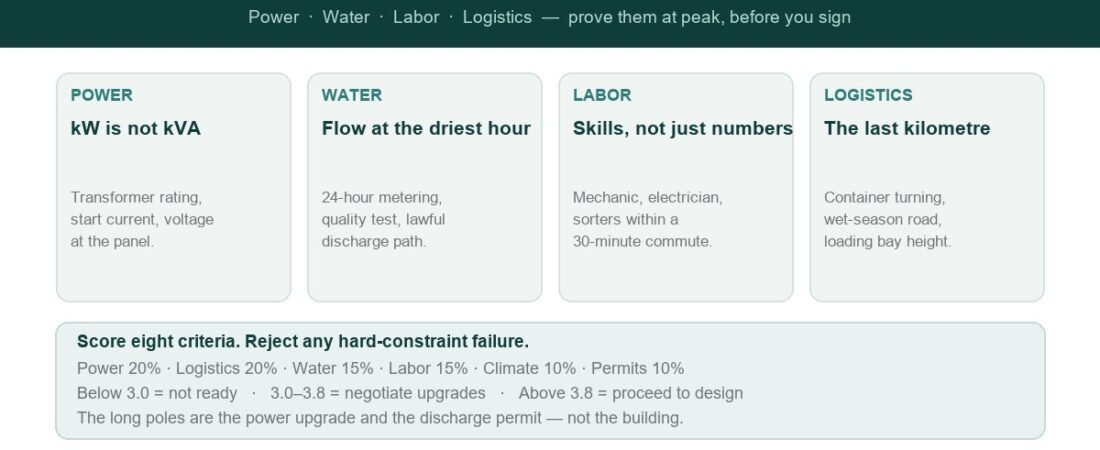
This guide sets out the order we use with buyers: define the line’s peak demand first, then prove that the site can supply four continuous inputs — power, water, labor and logistics — and finally test three hard constraints that can reject a site regardless of how well it scores. It is written for macadamia, cashew, pine nut and coffee projects, and it is about evidence rather than rules of thumb.
The short answer
- Site selection is a capacity decision before it is a property decision. The line’s peak hour defines what the site must deliver.
- Four inputs must be measured at peak, not averaged across the year: power, water, labor and logistics.
- Three hard constraints can reject any site: climate and flood risk, zoning and permits, and effluent or waste discharge.
- Score eight criteria with evidence. A site that fails a hard constraint is rejected even if its total score is high.
- The longest lead items are usually the power upgrade and the discharge permit, not the building. Confirm both before you order machines.
Definition: site selection is the process of proving that a location can deliver four continuous inputs — power, water, labor and logistics — at the line’s peak demand, before construction begins.
What this guide covers, and what it does not
This page is about the piece of land and the services connected to it. It does not repeat four subjects that already have dedicated guides:
- The cost structure of a plant, including the difference between machine price and landed project cost, is covered in nut processing plant cost.
- The arrangement of machines inside the building is covered in macadamia processing line layout.
- The sequence from installation to stable production is covered in nut processing line commissioning.
- The import, shipping and customs sequence is covered in importing a nut processing machine from China.
Keeping those decisions separate matters. A site can be excellent for construction and poor for commissioning, and a cheap building can be the most expensive part of the project if the power upgrade takes nine months.
The four inputs that decide the site
Every nut line, from a 50 kg/h single machine to a 1,000 kg/h multi-stage plant, depends on the same four inputs. What changes is the peak demand and the consequence of failure.
| Input | What the line needs | How to verify it | Typical failure |
|---|---|---|---|
| Power | Connected kW, starting current, voltage, phase, stable supply | Read the transformer nameplate, log voltage for seven days, measure phase balance at peak | “Three-phase is available” turns out to mean a shared 30 kVA transformer |
| Water | Flow, pressure, quality and a legal drainage path | Meter the supply for 24 hours, test the farthest outlet, survey drain invert and outlet | The well yields enough in winter and not enough in the dry season |
| Labor | Headcount by skill, shift pattern and season | Map travel time, survey wages, list nearby employers and training providers | Enough people, not enough sorters or mechanics |
| Logistics | Raw inbound, finished outbound, container and cold-chain access | Drive the route in the worst season, measure gate and turning radius | A 40 ft truck cannot enter the yard or turn at the loading bay |
The order matters. Power and water are the two inputs that usually cannot be fixed quickly. Labor can be trained and logistics can sometimes be outsourced, but a transformer upgrade or a new discharge permit can take a season or more.
Power: kW is not kVA, and connected load is not starting load
A machine’s published power rating tells you what it draws while running. It does not tell you what the site must supply at the moment the largest motor starts. That distinction is where most power-related site failures begin.
Our own range illustrates the spread. The published figures below come from the product catalogue and are the numbers a buyer should use when comparing models.
| Model | Typical capacity | Published power | Voltage | Site question it raises |
|---|---|---|---|---|
| NS-X121 | ~150 kg/h | 2.2 kW | 220 or 380 V | Can the site deliver the chosen voltage at the panel, not only at the meter? |
| NS-X124 | ~1,000 kg/h | 3 kW | 380 V | Is the transformer shared, and what else starts on the same feeder? |
| NS-X221 | ~600 kg/h | 3 kW + 1 kW | 220 V | Are the two circuits on separate breakers and is the neutral sized correctly? |
| NS-X322 | ~150 kg/h | 6 kW | 380 V | What is the voltage drop between the transformer and the panel? |
| NS-S122 | ~200 kg/h | 2 kW | 220 V | Is single-phase power stable through the harvest season? |
| NS-Y121 | ~50 kg/h | 0.8 kW | 380 V | Is a small three-phase supply actually available, or only single-phase? |
When you assess a site, ask for seven things:
1. Transformer rating and ownership. Record the nameplate kVA, who owns it, and whether other businesses share it.
2. Distance and cable size. A transformer that is adequate on paper can deliver a poor voltage at the end of an undersized cable.
3. Phase balance. Measure each phase at peak. A line added to an already unbalanced supply will trip or overheat.
4. Largest motor starting current. Ask the machine supplier for the starting method and current, not only the running kW.
5. Voltage at peak. Log it for at least seven days, including the hours when neighbouring irrigation or processing loads are running.
6. Generator strategy. If a generator is required, size it for the largest motor start plus the running load, not for the sum of connected kW.
7. Upgrade path. Ask the utility for the cost and lead time of a larger connection in writing. This is often the single longest task in the project.
The export voltage question deserves its own check. A machine rated for 220 V or 380 V is not automatically suitable for every 220 V or 380 V supply. Frequency, phase configuration and the actual voltage at the panel all matter. Our guide to machine voltage and power requirements for export explains the terminology, and the capacity and power chart shows how motor loads accumulate across a line.
Water: three streams, one permit
Water is usually discussed as a single number — litres per day. In practice a nut plant has three streams with different quality and different legal consequences.
Process contact water touches the product. It needs to meet the quality standard your buyer or food-safety system requires, and it usually needs a documented test.
Cleaning water is used for floors, equipment and crates. It can be lower quality, but it still has to go somewhere legal.
Domestic water serves staff and offices. It is easy to overlook, and it becomes a problem when the plant runs two or three shifts.
Coffee is the outlier in this group. Wet processing — pulping, fermenting and washing — uses far more water than dry nut handling, and the wastewater carries organic load. If you are planning a coffee line, read coffee fruit peeling and wet processing and coffee drying and hulling before you choose the site. A site that is perfect for macadamia drying may be unacceptable for a coffee wet line.
Cashew has a different water dependency: steam cooking. If the process includes steam, the site needs boiler feedwater, a boiler house and a fuel or power source. The cashew processing guide and cashew steam cooking and shelling set out where that step sits in the line.
Macadamia green-husk peeling uses water for washing, and the husk itself becomes a solid waste stream. The four green-husk models — small, medium, large and industrial — have different throughputs but the same site question: where does the husk go, and how is the wash water separated from it?
To verify a water supply, do four tests:
- Meter the source for 24 hours and record the lowest flow, not the best.
- Measure pressure at the farthest outlet while the largest user is running.
- Test hardness, iron and pH if the water contacts product or feeds a boiler.
- Survey the drain invert level and the legal outlet. Confirm that the outlet is not a storm drain.
Effluent is a hard constraint, not a score item. A site without a lawful discharge path is not a candidate, even if every other input is good.
Labor: the site must fit the shift, not just the payroll
A nut line needs more than operators. It needs sorters, a mechanic, an electrician, a quality checker, a supervisor and a packer, and the mix changes with capacity. The line staffing by capacity guide gives the crew ranges; this section is about whether the site can supply that crew reliably.
| Role | Why the site matters | How to test |
|---|---|---|
| Machine operators | Shift start and overtime depend on travel time | Map a 30-minute travel isochrone from the gate |
| Sorters and graders | Peak-season demand can double the crew | Ask three local employers how they recruit at harvest |
| Mechanic | Breakdowns need a response within hours, not days | List workshops and spare-parts suppliers within 60 minutes |
| Electrician | Motor, panel and voltage faults are the most common stoppage | Confirm a licensed industrial electrician, not a domestic installer |
| Quality checker | Final kernel quality is decided at the sorting table | Check whether a local training or food-safety provider exists |
| Supervisor | Two shifts need two supervisors | Compare local wages for equivalent food-factory roles |
Three labor tests are worth doing before you commit:
1. Travel time at shift change. Drive the route at the hour workers would travel, not at midday.
2. Employer competition. A site beside a larger factory may have a deep labor pool and a high turnover problem at the same time.
3. Housing and transport. If the plant runs a harvest campaign, where will seasonal workers stay, and who pays for transport?
A site with a willing workforce but no mechanic is a site that stops for a week when a bearing fails. Labor quality is part of the site, not a separate HR issue.
Logistics: the hidden cost is the last kilometre
Inbound raw material and outbound finished product put different demands on a site. Raw nuts arrive in sacks, bins or bulk, often with high moisture and a short quality window. Finished kernels leave in cartons, vacuum packs or chilled consignments, and the buyer’s specification may not tolerate a long wait at a dock.
| Check | Why it matters | Pass condition |
|---|---|---|
| Gate width and height | Container trucks and delivery lorries must enter without reversing onto a public road | Truck can enter and leave forward |
| Turning circle | A 40 ft container truck needs more space than a farm lorry | Loaded truck can turn at the loading bay |
| Yard surface and drainage | Wet-season mud delays intake and damages packaging | All-weather surface with falls to drainage |
| Loading bay height | Forklift and truck bed must align safely | Dock level or ramp matches the fleet |
| Road class and bridge limits | A shorter route is useless if a bridge cannot take the load | Route surveyed in the wet season |
| Distance to port or airport | Export kernels may need a cold chain and a cutoff time | Transit time fits the buyer’s cutoff |
| Weighbridge access | Intake and dispatch need verified weights | Public or private weighbridge within a short drive |
| Neighbour access | Dust, noise and traffic can trigger complaints | Site plan keeps noisy operations away from boundaries |
The most common mistake is measuring distance instead of time. A site 40 km from the farm can be slower than a site 80 km away if the shorter route crosses a river or a market town. Drive both routes during harvest, when the roads are busiest and the raw material is most perishable.
Three hard constraints that override the score
A weighted score is useful for comparing good sites. It is not a way to average away a fatal flaw. These three constraints are pass or fail.
1. Climate and flood risk. Check humidity, temperature range, prevailing wind and flood history. Kernel storage is sensitive to moisture, and a site that floods once can destroy a season. Ask for the flood map and speak to neighbours, not only the seller.
2. Zoning, permits and neighbours. Confirm that food processing is allowed, that the building can be used for it, and that noise, dust, odour and traffic will not create a complaint or a closure. A pre-application meeting with the local authority is cheaper than a retrofit.
3. Effluent and waste. Confirm a lawful discharge path for wash water and a destination for husk, shell, coffee pulp or boiler ash. If the site cannot handle waste, it cannot handle the line.
Rule: if any hard constraint fails, reject the site. Do not raise the other scores to compensate.
A scoring matrix you can defend
Use a simple 1–5 scale and write down the evidence behind each score. The weights below reflect the difficulty of fixing each item after construction. Change them only if your project has a specific reason.
| Criterion | Weight | What a 5 looks like | What a 1 looks like |
|---|---|---|---|
| Power | 20% | Dedicated transformer, measured stable voltage, clear upgrade path | Shared supply, voltage swings, no upgrade commitment |
| Logistics | 20% | All-weather access, container turning, short reliable route | Narrow gate, weak bridge, seasonal road closure |
| Water | 15% | 24-hour metered flow, tested quality, lawful outlet | Dry-season shortage or no legal discharge |
| Labor | 15% | Skilled mix within 30 minutes, low turnover | No mechanic, long travel, seasonal shortage |
| Climate | 10% | Stable humidity, no flood history, suitable storage | Flood risk or uncontrolled humidity |
| Permits | 10% | Food processing allowed, pre-application positive | Unclear zoning or likely complaints |
| Expandability | 5% | Room for a second line and a second transformer | No space beyond the first line |
| Upgrade cost | 5% | Minor works only | Major power, water or drainage works |
The decision rule is deliberately blunt:
- Any hard-constraint failure: reject.
- Weighted score below 3.0: not ready; keep looking.
- Weighted score 3.0 to 3.8: negotiate or budget the upgrades, then re-score.
- Weighted score above 3.8: proceed to layout and quotation.
Record the evidence next to each score. A score without a measurement is an opinion, and opinions are difficult to defend when the project budget is reviewed.
The site visit checklist
Bring measuring tools, not only a camera. The visit should produce numbers that can be compared across candidate sites.
| What to measure | Tool | Pass condition |
|---|---|---|
| Voltage at the panel, each phase | Multimeter or logger | Within the supplier’s tolerance at peak |
| Transformer rating and ownership | Nameplate and utility confirmation | Capacity covers the line with headroom |
| Largest motor starting current | Supplier data and clamp meter | Supply and protection can absorb the start |
| Water flow at the farthest outlet | Flow meter and pressure gauge | Stable flow at peak demand |
| Water quality if it contacts product | Laboratory test | Meets the buyer or food-safety standard |
| Drain invert and outlet | Level and site survey | Gravity flow to a lawful outlet |
| Floor slab and ceiling height | Tape and structural report | Fits the largest machine and maintenance access |
| Gate, yard and turning circle | Tape and a test drive | Loaded truck can enter, turn and leave forward |
| Wet-season road condition | Site visit in the wet season | Route remains passable |
| Flood history | Local records and neighbours | No recurrent flooding at the building |
| Labor travel time | Map and a shift-hour drive | Core roles within 30 minutes |
| Permit status | Pre-application meeting | Food processing is permitted |
Photograph the nameplates, the drain outlet, the gate and the turning area. Those four photographs answer more questions than a wide shot of the building.
Four mistakes that cost the most
Signing the lease before the power study. The building is the visible cost; the transformer is the hidden one. Confirm the supply before you commit to the site.
Accepting “three-phase is available” without kVA and starting current. Availability is not capacity. Ask for the nameplate and the utility’s written confirmation.
Counting workers without counting skills. A village with 200 able-bodied workers may still have no industrial electrician. The skill mix decides uptime.
Forgetting the truck. A site that looks generous with a car can be impossible with a 40 ft container. Test the vehicle you will actually use.
A fifth mistake is designing for the average season. Peak harvest is the only period that matters for intake, staffing and water. If the site works in the average week but fails in the peak week, it does not work.
What to send us before a layout or quotation
A supplier cannot size a line or propose a layout without site data. Send the following and the conversation becomes specific:
- Target capacity in kg/h and the product mix (macadamia, cashew, pine nut, coffee).
- Raw material form: in shell, green husk, parchment, cherry or kernel.
- Utility data: transformer kVA, voltage, phase, water source and flow, drainage.
- Site plan with building dimensions, door heights and yard turning area.
- Photographs of the panel, transformer, water outlet and access road.
- Labor plan: shifts, headcount and the roles you will recruit locally.
- Logistics: inbound distance, outbound destination and vehicle type.
Our quotation guide explains how to compare offers on the same basis, and nut processing plant cost shows where the site works sit in the project budget. If you already have a building, the layout guide explains how to test whether the line fits before you buy.
Frequently asked questions
What is the minimum plot size for a nut processing plant?
There is no universal number. The plot must hold the production building, raw material intake, finished goods storage, packing, loading, waste and an expansion bay. Start from the layout, then add yard and turning space. A 1,000 kg/h line needs more space for intake and dispatch than a 150 kg/h line, even if the machine footprint is similar.
Can I run a nut processing line on single-phase 220 V?
Some models can. In our range, the NS-X121, NS-X221 and NS-S122 are published with 220 V options. Larger models such as the NS-X124 and NS-X322 are published at 380 V. The site question is not only phase but starting current and voltage stability at the panel. Confirm both with the supplier and the utility.
Do I need a boiler for a cashew plant?
Only if the process includes steam cooking. Cashew lines that use steam need a boiler house, feedwater treatment and a fuel or power source. Macadamia shelling and opening generally do not. Decide the process before you choose the site, because a boiler changes the building, the permits and the water demand.
How much water does a nut processing plant use?
It depends on the process. Dry macadamia shelling uses far less than coffee wet processing, and cashew steam cooking adds boiler feedwater. Do not size the supply from a generic figure. Meter the source for 24 hours, measure peak flow at the farthest outlet, and design for the harvest peak.
Should the plant be near the farm or near the port?
It depends on what you are moving. A high-moisture raw material with a short quality window usually favours a site near the farm. Imported raw material favours a site near the port. Export kernel favours reliable access to a container terminal and a cold chain. Score both options with the same matrix rather than choosing by distance alone.
How long does site preparation take?
The building is rarely the long pole. A power upgrade, a discharge permit or a zoning approval can take months. Ask the utility and the local authority for written lead times before you set an equipment delivery date. Ordering machines before utilities are confirmed is the most common cause of a plant that is installed but cannot start.
Can the plant be expanded later?
Yes, if the site is chosen for it. Leave a defined expansion bay, a second transformer pathway and room for additional water and drainage capacity. Retrofitting expansion into a fully built site is usually more expensive than buying a slightly larger plot at the start.
Related reading and machines
- Nut processing plant cost: where the money goes
- Macadamia processing line layout
- Nut processing line commissioning
- Importing a nut processing machine from China
- Nut processing line staffing by capacity
- Machine voltage and power requirements for export
- Nut processing machine capacity and power chart
- Macadamia green husk peelers
- Coffee fruit peeling machines
- Cashew shelling machines
Send us your capacity, product mix and site data, and we will tell you which parts of the site need to be confirmed before a layout can be drawn.