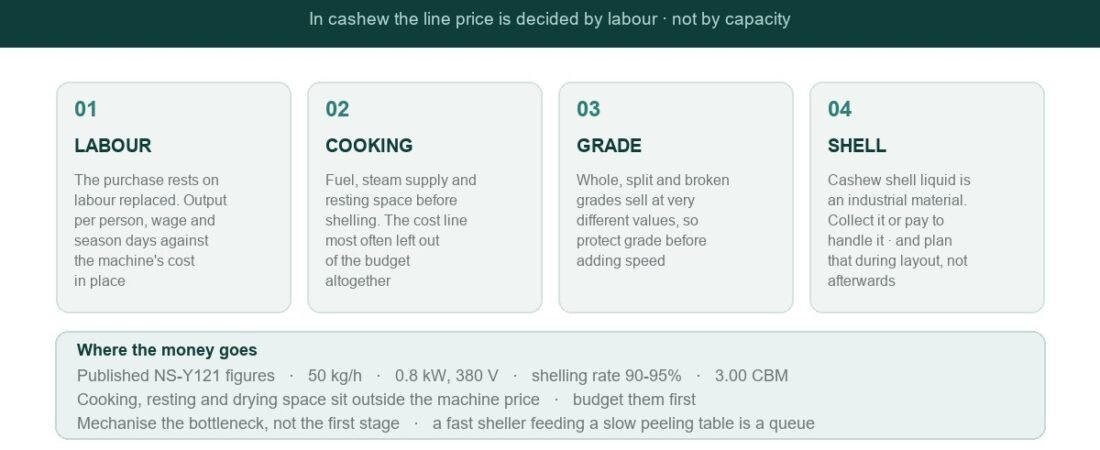
Cashew is the one nut crop where the cost of a processing line is not mainly decided by capacity. It is decided by labour. Cashew has traditionally been shelled and peeled by hand almost everywhere it is grown, so a machine is rarely bought to do something that is impossible by hand — it is bought to do the same job with fewer people, more consistently, and with fewer broken kernels.
That changes what a cashew cost calculation has to contain. This page sets out the stage list you are actually buying, the cost lines that sit outside the machine price (cooking fuel and resting space are the two most commonly forgotten), how to build the labour-arbitrage calculation the decision really rests on, and what to send an equipment supplier so their quotation can be compared with anyone else’s.
Last updated: October 2026
The short answer
- The investment case in cashew is labour, not throughput. Compare the labour your current method consumes against the labour the machine replaces, and let that difference pay for the equipment.
- Cooking is a cost item, not a footnote. Steam or roast cooking needs fuel, a steam supply and time; it also needs resting space before shelling, and that space is part of the plant.
- Grade decides the revenue, not weight. Two lines processing the same tonnage can sell different values, because whole kernels, splits and broken grades are different products.
- The shell is not only waste. Cashew shell liquid is a byproduct with industrial uses; whether you recover it or pay to handle it changes your cost per kilogram.
- The cheapest way to lose money is a fast machine that breaks kernels. Shelling rate and whole-kernel output are different measurements, and only the second one is revenue.
- No supplier can quote your cashew line from a catalogue page. Nut size, moisture, cooking method, labour cost and target grade all change the configuration — and therefore the price.
What a cashew line is made of
Dongguan Nansheng Technology Co., Ltd. is a manufacturer of nut and coffee processing machinery based in Dongguan, Guangdong Province, China, building macadamia dehusking, cracking and shelling machines, cashew shelling machines, pine nut threshing machines and coffee pulpers. Our own cashew machine covers the shelling stage. The rest of the line, which decides most of the project cost, is set out below.
| Stage | What it does | Where the cost sits |
|---|---|---|
| 1. Raw nut intake and cleaning | Removes foreign matter and sizes the incoming crop | Labour and a clean, dry storage area |
| 2. Steam cooking or roasting | Conditions the shell so it can be cracked without crushing the kernel | Fuel or steam, plus the resting space after cooking |
| 3. Shelling | Opens the shell and releases the kernel | The machine, its power, and the labour it replaces |
| 4. Shell separation and shell-oil handling | Separates kernels from shell and deals with the shell liquid | Handling and disposal, or recovery if you collect it |
| 5. Drying (pre-peeling conditioning) | Brings the kernel to a condition in which the testa can be removed cleanly | Heat and airflow — a room, not just a machine |
| 6. Peeling (testa removal) | Removes the inner skin without scratching or splitting the kernel | Where the highest-value labour sits; the most common manual stage |
| 7. Grading | Splits the output into whole, split and broken grades | People, sieves, or a grading machine; decides the price realised |
| 8. Packing and storage | Protects the kernel and preserves grade | Packaging material and a dry store |
Two structural points follow. First, only one of those eight stages is a machine purchase in the usual sense for many projects; the others are a mixture of fuel, space, labour and process control. Second, the stages after shelling decide the grade, and grade is where the money is — which is why a cashew budget that stops at the sheller usually disappoints.
Cost driver 1 — labour: the calculation the purchase actually rests on
In cashew, the honest way to justify a machine is to measure what the same work costs today, without it. The calculation has five inputs, and every one of them is yours, not the supplier’s.
1. Daily output per person at your current shelling or peeling stage, measured over a real day rather than an optimistic one.
2. The wage and total employment cost per person, including the costs that sit above the wage.
3. The number of working days in your season — cashew seasons are shorter than the calendar year in most origins.
4. The output the machine is expected to deliver at your nut size and condition.
5. The whole cost of the machine in place, which is not only the machine: it includes freight, import charges, site preparation, power connection and the first set of wear parts.
Divide the in-place cost by the seasonal labour saving, and you get a payback measured in seasons. That number is comparable between two machines in a way that a purchase price never is — and it is the reason a slightly more expensive machine that reduces re-work at peeling can beat a cheaper one.
The same logic applies to shelling rate versus labour output. Our cashew shelling machine, the NS-Y121, is published at 90-95% shelling rate with around 3% unshelled nuts and opens two cashews per cycle, at roughly 50 kg/h. Those figures describe what the machine does; the labour calculation describes what it is worth to you. How that shelling rate should be read is covered in cashew shelling machine shelling rate and output.
Cost driver 2 — cooking: fuel, steam and the space you forgot to budget
Cooking is unique to cashew among the crops we build for, and it carries costs that never appear on a machine specification.
- The energy source. Steam from a boiler, or roasting over a heat source, both need a supply that has to exist before the cooker can run. On a site without steam, this is a project of its own.
- The resting time and the space it needs. Shelling hot is a loss, so cooked nuts rest before cracking. That resting volume is a room or a bay, and it has to be built whether or not anyone mentions it in the quotation.
- The consistency cost. Uneven cooking shows up later as breakage at shelling and as uneven peeling. The control measures that keep a batch even — and how to tell a batch is ready without a laboratory — are set out in cashew steam cooking and shelling.
- The reheat cost of stopping. A cooking stage started and stopped around an unreliable shelling rate wastes fuel. Matching the cooking batch to what the sheller can actually take is a cost decision, not only a process one.
Cost driver 3 — grade: the cost line that behaves like revenue
Cashew kernels are sold as whole kernels, splits and broken grades, and the price difference between those categories is large. That has a direct consequence for the budget: a line that produces more whole kernels is worth more than a line with the same tonnage and a higher breakage rate, even if it costs more to buy.
Where grade is lost:
| Loss | Where it happens | What it costs you |
|---|---|---|
| Broken kernels | Shelling, when the shell is cracked with too much force or at the wrong angle | Whole-grade kernels become splits or pieces |
| Scratched or split kernels | Peeling, when the testa is removed from a kernel that is too dry or too wet | Cosmetic downgrade, and re-work |
| Uneven results across a batch | Cooking, when conditioning is inconsistent | Mixed output that has to be graded down as a lot |
| Loss during handling | Transfer between stages | Small, repeated, and invisible in a monthly total |
The practical budgeting point: put money into the stages that protect grade before putting money into speed. A faster sheller in front of a peeling stage that scratches kernels simply produces downgraded kernels faster. Where the losses occur at peeling, and how to measure them in ten minutes, is covered in cashew kernel peeling without breakage.
Cost driver 4 — the shell: a disposal cost or a byproduct
Cashew shell liquid is a real industrial material, and the shell itself has fuel uses. Whether that becomes a cost or a credit depends entirely on how the line is set up:
- If nothing is collected, the shell and its liquid are a handling and disposal cost, and they usually arrive with an odour and a housekeeping problem.
- If the liquid is collected, the handling cost can be partly offset and the shell becomes easier to store or sell on.
- If the shell is burned for heat, part of the cooking fuel can come from the process itself — a genuine operating-cost reduction on sites that already run a furnace.
The engineering decision (extraction, drainage, or simple containment) belongs in the layout phase, because retrofitting collection after the line is built costs far more than including it.
Cost driver 5 — what sits outside the machine price
As on any processing line, the gap between two cashew quotations is usually in the scope around the machines.
| Item | Why it is in the budget |
|---|---|
| Power supply and site wiring | The machine cannot run until the supply matches the nameplate — see voltage and power for export orders |
| Cooking fuel and steam supply | Determines the cooking method you can actually operate |
| Resting and drying space | Airflow and volume, not a machine; usually the largest single building item |
| Grading labour or equipment | Decides which grades you can separate and sell separately |
| Storage for raw nuts and finished kernels | Protects both the raw material and the grade |
| First season of wear parts | Consumed in normal operation, and much cheaper shipped with the machine |
| Freight, duty and clearance | Follows the destination and packed volume — see importing a nut processing machine from China |
Where the budget goes, stage by stage
Buyers usually ask for the percentage split before they ask for a total, because the split shows which decisions actually move the number. The ranges below are a planning guide for a small-to-mid line. They are shares of project spend, not prices, and they overlap: an operation that already owns a drying floor spends nothing on a dryer, while one that has to build that floor moves a large part of the budget into civil works.
| Stage | Typical share of project spend | What moves it |
|---|---|---|
| Steam cooking or roasting | 15-25% | Batch size, fuel or steam, resting space |
| Shelling | 15-25% | Nut size, shelling rate, number of units |
| Kernel peeling | 10-18% | Whole-kernel target, peeling method, labour |
| Drying and grading | 12-20% | Moisture target, number of grades, dryer capacity |
| Packing and food-safety fit-out | 8-15% | Vacuum or bag packing, pest control, floor finish |
| Freight, duty, installation and commissioning | 8-15% | Packing volume, destination, technician travel |
Read the table as a way to interrogate a quotation, not as a price list. If one stage takes more than half the total, either the scope stops there or the other lines are missing. If a stage you know you need is absent, that cost has not disappeared – it has moved to a line you will pay for separately.
Why we do not publish a price list
The configuration of a cashew line depends on nut size, incoming condition, the cooking method you can support, the labour you are replacing, and the grades you intend to sell separately. Two buyers asking for “a cashew line” are usually asking for two different projects, and a published figure for one of them becomes misleading for the other — normally in the direction of an unfair comparison, because the published number describes less scope than the quotation it is set against.
What we can do instead is make the quotation comparable: the machine and its published figures, the scope, the exclusions and the assumptions in writing. The structure to expect is set out in what a nut processing machine quotation should contain.
How to phase the investment
Most cashew projects we are asked about cannot fund all eight stages at once, and they do not need to. The sequence that works is driven by which stage is limiting output today:
| If your limit is… | Mechanise first | What it buys |
|---|---|---|
| Cracking speed, with labour already stretched | Shelling | Removes the bottleneck and the largest repetitive labour block |
| Breakage and uneven cracking | Cooking control, then shelling | Protects grade before adding speed |
| Peeling throughput and scratches | Conditioning (drying) and peeling method | Raises the whole-kernel share, which is revenue |
| Mixed output that sells as one lot | Grading | Lets you sell grades separately instead of discounting the lot |
The rule is the same as on any nut line: mechanise the bottleneck, not the first stage in the sequence. A faster sheller feeding a slow manual peeling table produces a queue, not a profit. That logic, applied crop by crop, is set out in the cashew processing guide and, for a different nut, in what drives the cost of a macadamia processing line.
What to send us for a cashew quotation
| What to send | Why it changes the answer |
|---|---|
| Nut size and origin | Determines the shelling setting and the expected breakage |
| Incoming condition (moisture, cleanliness, foreign matter) | Decides how much cleaning and drying has to sit ahead of the machine |
| Daily volume at peak, and the hours you can run | Sizes the stage, using your real working day |
| Your current method and labour used per day | Turns the quotation into a payback calculation rather than a price |
| Cooking method available on site | Steam, roast or none — the sheller has to match what arrives at it |
| Target grades and market | Decides whether grading has to be mechanised now or later |
| Power supply on site (voltage, phase, capacity) | A machine that does not match the supply cannot be commissioned |
| Destination country and port | Packing, freight and duty follow from it |
Send those and the reply can be about your line rather than about a catalogue. If the cashew decision is being made alongside other crops, small-scale nut processing equipment covers how to buy the first machine without buying the wrong one.
Frequently asked questions
How much does a cashew processing line cost?
There is no single figure, because a cashew line is eight stages and most projects mechanise only some of them. The price is the sum of the machines you choose, plus cooking fuel and steam supply, resting and drying space, grading, storage, power supply on site, and freight and duty to your destination. The useful way to price it is stage by stage, starting with the stage that limits your output today.
Why is cashew processing more labour-intensive than other nuts?
Because cashew has traditionally been shelled and peeled by hand in almost every producing country, and because the kernel is fragile enough that careless mechanisation loses grade rather than gaining speed. Shelling and testa peeling are the two stages that consume the most labour. That is also why the investment case for a cashew machine is usually built on labour replaced rather than on tonnage processed.
Is a cashew shelling machine worth it compared with manual shelling?
It depends on your labour cost and your season length, and the comparison is easy to make once you have both numbers. Measure your output per person per day, the total employment cost per person, and the number of working days in your season, then compare that seasonal labour figure against the machine’s cost in place. If the saving covers the machine within a season or two, the machine is justified regardless of its purchase price.
What is the most expensive part of a cashew processing line?
It varies, but the two items buyers most often under-budget are not machines at all: the cooking stage with its fuel, steam supply and resting space, and the conditioning and peeling steps that decide how many whole kernels you finish with. Peeling is where the highest-value labour sits, and cooking is where uneven conditioning creates losses that only appear later.
Does the cashew shell have any value?
Yes. The shell contains cashew shell liquid, an industrial material, and the shell itself can be used as fuel. Whether that becomes a credit or a cost depends on whether the line is designed to collect and drain the liquid and whether you have a use for the shell. Planning that during layout is much cheaper than retrofitting collection later.
What cashew figures are published for your machine?
Our cashew shelling machine, the NS-Y121, is published at roughly 50 kg/h, 0.8 kW at 380 V, with a 90-95% shelling rate and around 3% unshelled nuts, opening two cashews per cycle, with a packing volume of 3.00 CBM and a packed weight of about 280 kg. Those are published figures for the shelling stage only; the stages around it are specified per project.
Tell us your nut size and your peak day
Send us your nut size and origin, the volume you handle on your busiest day, the hours you can run, your current method and how much labour it takes, the cooking method available on site, your target grades, the power supply you have, and your destination port. We will tell you which machine fits your shelling stage, what the stages around it have to be able to absorb, and how the quotation is built — including the scope that sits outside the machine price.
Reach us through the enquiry form, or email nanshengtechnology@gmail.com. If you are still at the stage of comparing the whole line, the cashew processing guide maps all eight stages and is the best place to start.
Related reading and machines
- Cashew processing: the complete guide, stage by stage
- Cashew shelling machine: shelling rate and output
- Cashew steam cooking and shelling: temperature and timing
- Cashew kernel peeling: how to avoid breakage and scratches
- Macadamia processing line cost: the five drivers
- Pine nut processing plant cost: where the money goes
- Importing a nut processing machine from China: key steps
- What a nut processing machine quotation should contain
- Small-scale nut processing equipment
- Cashew shelling machine NS-Y121
- Nut processing machines: the full product range
- Knowledge forum: processing guides
- the seven cost drivers of a nut processing plant
Related reading: Cashew kernel grades: what W180 to W450 mean for your line — how conditioning, sheller clearance and peeling set the whole-to-split ratio that decides the grade mix.