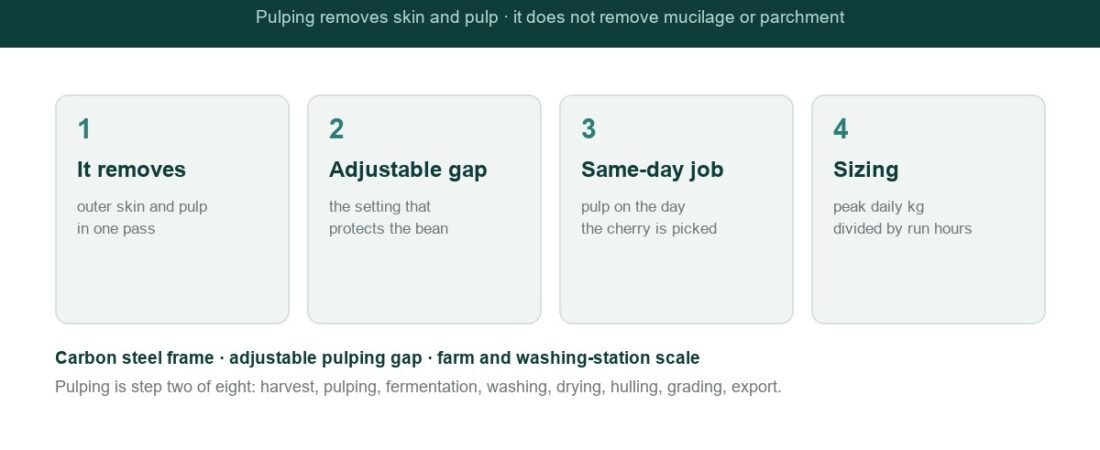
Pulping is the first machine step after picking, and it is the step that decides how much of the rest of your process can go right. A coffee fruit peeling machine removes the outer skin and the pulp from fresh cherries in one pass so the beans can move into fermentation and drying. This page explains what the machine does and does not do, why the pulping gap is adjustable, how to time pulping after harvest, and how to size a pulper from your own daily cherry volume instead of from a model name.
Last updated: 24 September 2026
The short answer
- A coffee fruit peeling machine removes the outer skin and the pulp in one pass. It does not remove mucilage, parchment or the hull: those are separate stages with separate equipment.
- Pulping is a same-day job. Cherry is living fruit. The sooner it is pulped after picking, the less of the process you are leaving to chance.
- The pulping gap is the setting that decides quality. Set too tight it clips parchment and damages beans; set too loose it leaves pulp on the bean. This is the adjustment to understand before any other.
- Adjustability matters because cherries change. Size and ripeness vary between varieties, altitudes and even between weeks of the same harvest, so a fixed gap is a fixed defect rate.
- Our machine is built for farm and small washing-station scale. Carbon steel frame, adjustable pulping gap, designed to pair with fermentation tanks and raised drying beds.
- Size from your daily volume, not from a model name. Send us your daily cherry volume in kilograms and your power supply, and we confirm the model in writing before quoting.
What the machine does, and what it does not
Pulping, also called de-pulping, is the mechanical separation of the cherry skin and pulp from the beans inside. It is a first-stage tool, and it is worth being precise about the boundary, because most mistakes in a new coffee line are not machine faults at all. They are expectations attached to the wrong stage.
- It removes skin and pulp. That is its job, in one pass, on freshly picked cherry.
- It does not remove mucilage. Mucilage is the slippery layer still clinging to the parchment after pulping. It comes off in fermentation and washing, or in a mechanical demucilager, but not in the pulper.
- It does not hull. Parchment is removed at the dry-mill stage, after the coffee has been dried down to a stable moisture content.
- It does not grade. Size and density separation is a separate step, and on a small farm it is usually the step that decides what you can sell.
Five layers, five different jobs
Coffee is a fruit whose layers each have their own removal stage. Fixing this in your head prevents most of the confusion in equipment quotations.
| Layer | What it is | Removed by |
|---|---|---|
| Outer skin | The red or yellow cherry skin | Coffee fruit peeling machine (pulping) |
| Pulp | The fleshy fruit layer under the skin | Coffee fruit peeling machine (pulping) |
| Mucilage | The sticky pectin layer on the parchment | Fermentation and washing, or a demucilager |
| Parchment | The papery husk around the green bean | Hulling, after drying |
| Silverskin | The thin layer on the bean itself | Roasting |
A quotation that treats peeling and hulling as one word is a quotation you cannot compare against another supplier’s.
The full sequence is short enough to write on the wall: harvest, pulping, fermentation, washing, drying, hulling, grading, export. Our machine owns the second step only, and it is designed to hand off cleanly to the third.
The pulping gap: the one setting worth understanding
The pulping gap is the clearance between the pulping surface and the screen or drum that holds the cherry back. It decides how hard the machine works the fruit.
- Too tight. The machine grips cherries harder than necessary. Parchment gets clipped, beans get nicked, and you have created a defect that no later stage can repair.
- Too loose. Skin and pulp pass through with the beans. The pulper looks gentle, and your fermentation and drying problems double.
- Not adjustable. Whichever of the two failures you have, you keep it. A gap set for one harvest week will be wrong for the next.
That is why our specification lists the pulping gap as adjustable, and why we treat it as the most important mechanical feature on a small pulper. Setting it is a two-minute job done the right way: run a representative sample, then inspect the output, not the machine.
Timing: pulping is a same-day job
Cherry is living fruit. Picked and left in a sack or a heap, it keeps respiring and heating, and it begins fermenting on its own terms rather than yours. Pulp before that happens and you are managing a process you control. Pulp after it and you are managing a problem.
The practical rule for a farm or small washing station is to pulp on the day of picking. If your harvest volume makes that impossible, the answer is not to leave cherry waiting longer. It is to add pulping capacity, or to strip-pick and pulp in smaller batches.
We use the same logic on the nut side of this business, where green husk peeling timing sets loss rates in exactly the same way: a step that takes minutes to run is a step whose timing sets the ceiling on everything downstream.
Manual or motor-driven: the real decision
- A manual pulper’s throughput is the operator. Output scales with how many people you can stand at the machine, and labour is the cost that rises with it.
- A motor-driven machine’s throughput is the drive. It removes the operator from the rate equation, which matters most during the peak weeks when picking labour is already stretched.
- The pulping gap principle is identical on both. The mechanical feature that protects your beans does not change with the drive type.
If your harvest is family-scale and labour is available, a manual machine is honest equipment. If your peak week already strains your picking crew, a motor-driven pulper is the difference between pulping on the day of picking and not.
How to size a coffee pulper
Sizing is arithmetic, and it starts with two numbers you already have.
1. Your peak daily cherry volume in kilograms. Use your best harvest day, not your average.
2. The hours you can realistically keep the machine running. Pulping competes with picking, transport and drying.
Divide the first by the second. That is your required hourly throughput. Then derate it: no machine runs flat out for a full working day once loading, clearing, batch changes and the operator’s own pace are counted.
If your figure lands between two machine sizes, choose the larger and run it for fewer hours. A pulper that is slightly oversized is comfortable. A pulper that is slightly undersized pushes you straight back into the storage problem described above.
The machine we build
| Specification | Value |
|---|---|
| Machine type | Coffee cherry pulper / fruit peeling machine |
| Application | Removing outer skin and pulp from fresh coffee cherries |
| Pulping gap | Adjustable |
| Body material | Carbon steel |
Model, capacity and power rating depend on the daily volume you need, which is why we confirm those figures in writing with the quotation rather than quoting one nameplate number to every buyer. The frame is carbon steel and the design is deliberately simple: farm-scale equipment earns its keep by being repairable, not by being clever. The machine is built to pair with fermentation tanks and raised drying beds, and it sits inside our coffee fruit peeling machine range.
Four mistakes a new coffee line makes at the pulping step
- Pulping cherry that was picked days ago. The machine cannot recover fruit that has already begun fermenting uncontrolled.
- Leaving the gap on the factory setting for a whole season. Cherry changes through the harvest. So should the setting.
- Sizing on an average day. Machines are bought for the peak day and paid for all year.
- Expecting the pulper to deliver clean parchment. Clean parchment is the output of fermentation, washing and drying. The pulper starts that sequence; it does not finish it.
Frequently asked questions
What exactly does a coffee fruit peeling machine do?
It removes the outer skin and the pulp from freshly picked coffee cherries in a single pass, leaving beans in parchment ready for fermentation and drying. The step is also called pulping or de-pulping. Mucilage removal, hulling and grading all happen later, with different equipment.
Why is an adjustable pulping gap worth paying attention to?
Because cherry size and ripeness change through the season and between varieties. An adjustable gap lets one machine pulping small or fully ripe cherry gently and cleanly today, then handle a different lot next month, without clipping parchment or leaving pulp on the beans.
Because cherry size and ripeness change through the season and between varieties. An adjustable gap lets one machine pulp a small or fully ripe cherry gently and cleanly today, then handle a different lot next month, without clipping parchment or leaving pulp on the beans.
How do I choose the right size of coffee pulper?
Take your peak daily cherry volume in kilograms, divide it by the hours you can actually run the machine, then derate the result for loading and clearing. Send us those two numbers and we will confirm which model fits, rather than leaving you to guess from a capacity table.
Do you supply the equipment that comes after pulping?
We supply the fruit and nut peeling, cracking and threshing machines in this range, and we can advise on the stages that follow pulping in a coffee line. Ask us for a line recommendation and we will tell you plainly which parts we build and which parts you should source locally.
What is the minimum order, and how long does a quotation take?
Minimum order is one unit. OEM branding and customisation are available on request, specifications are confirmed in writing before production, and we normally reply within one business day.
Request a quote or ask a question
Tell us your daily cherry volume, the machine action you want, your power supply and your destination port, and we will come back with price, packing size, shipping options and lead time, usually within one business day.
- Email: nanshengtechnology@gmail.com
- Phone / WhatsApp: +86 133 7302 3075
Browse the full product range or read more processing guides in the knowledge forum. If you are designing a whole line rather than buying one machine, the way we lay out stages is written up in this line-layout guide.
Related reading and machines
- Machine: Coffee fruit peeling machine
- Category: Coffee fruit peeling machines
- Guide: Green husk peeling: timing and loss rates
- Guide: How to lay out a processing line
- All machines: Agricultural processing equipment
- Coffee pulping: settings and damage control
- Coffee processing: complete guide from cherry to green bean