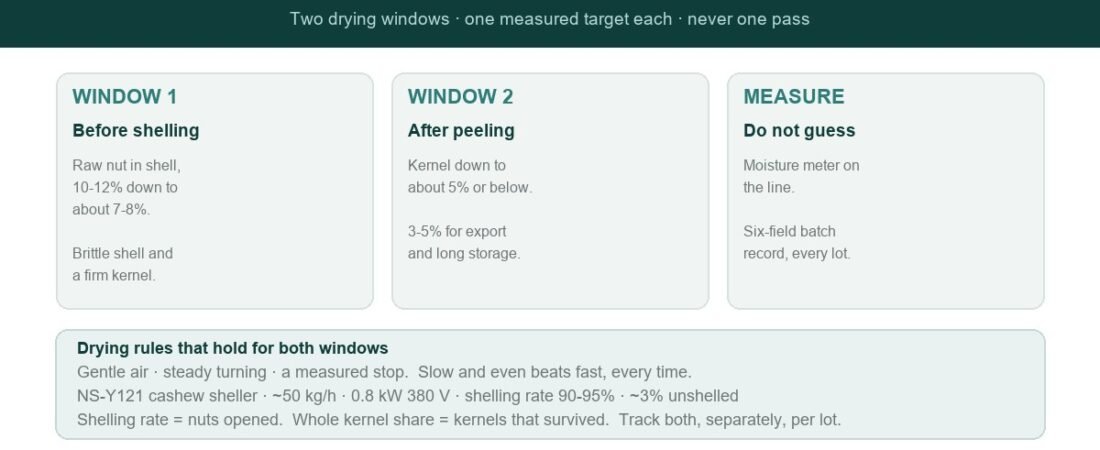
Cashew drying is not one job, it is two, and they happen at opposite ends of the line. First the raw nut in shell has to come down to a moisture band where the shell turns brittle and the kernel stops being soft enough to smear. Then, after the nuts are opened, the kernel itself has to come down again to a moisture level that survives storage and export without going rancid or mouldy.
Get the first window wrong and your shelling rate looks fine while your whole-kernel share quietly collapses. Get the second window wrong and the loss shows up months later, in a container, as a rejected lot. This page sets out what each window is for, the moisture bands processors work to, how to measure without a laboratory, and where drying goes wrong on a working line.
Last updated: October 2026
The short answer
There are two drying windows in a cashew line, and they have different targets.
- Before shelling, the raw nut in shell is dried so the shell becomes brittle and the kernel firms up. Processors typically work in a band around 7% to 8% for the nut going into conditioning and shelling, having brought it down from the 10% to 12% band it usually arrives in. The exact figure depends on your crop, your conditioning step and your buyer’s specification.
- After shelling and peeling, the kernel is dried to a storage band. The widely used target is about 5% moisture or slightly below, with export and long-storage contracts often asking for the 3% to 5% range.
The two windows share one rule: moisture is removed slowly and evenly, and it is measured, not guessed. A dryer that removes water faster than the kernel can equalise produces case-hardening — dry on the outside, still wet in the middle — which is the single most common reason a lot fails a moisture check after it looked dry.
The two drying windows in a cashew line
| Stage | What goes in | What drying is for | Typical working band | If it goes wrong |
|---|---|---|---|---|
| Window 1 — before shelling | Raw cashew nut in shell (RCN) | Make the shell brittle and firm the kernel so the sheller can cut without smearing or shattering it | Around 7-8% after drying, from a 10-12% starting band | Soft, leathery shell: poor shelling rate, kernel smeared at the cut, high breakage |
| Window 2 — after shelling, around peeling | Kernels, with or without testa | Loosen the testa so peeling is clean, and bring the kernel to a moisture level that stores and ships safely | About 5% or below; 3-5% for long storage and export | Rancidity, mould, aflatoxin risk, weight and grade loss on arrival |
Window 1: drying raw cashew nuts before shelling
A cashew shell is not a hard shell like a macadamia shell. It is fibrous, it holds CNSL (the dark phenolic oil between the shell layers), and when it is wet it behaves like leather — it bends and smears instead of cracking cleanly. A sheller cutting a wet nut does not so much open it as crush it.
Drying does three things at once:
- It stiffens the shell so the blade or the impact point fractures it instead of tearing it.
- It firms the kernel, which reduces the tendency of the kernel to deform and smear at the cut.
- It reduces the water load carried into the conditioning step, so the conditioning stage is working on a consistent feed instead of a variable one.
Raw nuts arrive at very different moisture levels depending on how they were harvested, how long they sat, and how humid the region is. Nuts that were picked and bagged in a wet week can be well above the band; nuts that sat on a drying floor for a week can be below it. That spread is why the first job of the drying stage is not drying — it is separating incoming lots and measuring them, so that the dryer is only ever finishing the job rather than correcting for a surprise.
Sun beds or a mechanical dryer
Both are used in commercial cashew plants, and many plants run both.
| Method | What it suits | Strengths | Watch out for |
|---|---|---|---|
| Sun drying on beds or yards | Small and medium lines, dry-season production | No fuel cost, gentle, no case-hardening risk | Weather-dependent; needs turning; needs covered storage the moment rain threatens; large floor area per tonne |
| Mechanical dryer (hot air) | Year-round production, humid regions, consistent feed | Controllable, repeatable, runs in any weather | Over-drying and case-hardening if the air is too hot or the batch is moved too fast; fuel and power cost |
The choice is usually made by climate and calendar, not by preference. A plant in a two-season region can often sun-dry for part of the year and needs a mechanical dryer to keep the line running through the wet months. A plant running a continuous line needs the mechanical dryer to hold the feed constant regardless of the sky.
Whichever route you take, the operating rule is the same: gentle air, steady turning, and a measured stop. Drying is finished when the lot reaches the band, not when the clock says it is finished.
Conditioning is not the same as drying
These two are often confused, and the confusion costs money.
Drying removes water. Conditioning — steam cooking, roasting or hot-oil treatment — changes the shell and the kernel so that the shell releases cleanly and the CNSL can be recovered. Conditioning is a process step with its own settings; drying is a moisture step with its own target.
In practice the two run in sequence, and the order matters. A wet nut going into a steam cooker absorbs the wrong amount of heat and comes out with a shell that still fights the blade. A properly dried nut going into the same cooker behaves predictably. This is why the drying stage is worth getting right even on a line where the conditioning step is doing the visible work — the conditioning step has a forward order in the same line, and you can read how that sequence is laid out in how cashew steam cooking and shelling fit together.
Window 2: drying kernels after shelling and peeling
Once the nut is open, the kernel is exposed and the rules change. Kernel moisture matters for three separate reasons, and only one of them is about the sheller.
1. Testa removal. The thin skin on the kernel releases cleanly at the right moisture and tears or sticks at the wrong one. Peeling losses that look like a peeler problem are very often a drying problem, which is why the peeling page on this site starts with the dryer rather than with the blade: see cashew kernel peeling without breakage.
2. Storage and transport. Cashew kernels are high in oil. Above the safe band, the risk of mould and of aflatoxin formation rises, and the oil begins to go rancid. This is the failure that does not appear until the container is opened.
3. Saleable weight and grade. Moisture is weight. Under-dried kernels that lose water in transit lose weight and can drop a grade; over-dried kernels become brittle and turn whole grades into splits at the packing table — which is exactly the mechanism described in what W180 to W450 actually mean.
The working target is a kernel at about 5% moisture or below, with 3% to 5% the band most often written into long-storage and export specifications. Confirm the number with your buyer before you set the dryer, because the penalty for a lot that arrives above specification is paid by the seller.
How to measure kernel moisture without a laboratory
You do not need a lab to run this stage properly, but you do need a number rather than a feeling.
- A moisture meter is the practical instrument on the line: fast, repeatable, and good enough to hold a band. Check it against a reference sample, and keep the calibration note with the batch record.
- The oven method — a weighed sample dried at a fixed temperature and reweighed to constant weight — is the reference check. It is slow, so it is used to validate the meter rather than to run every batch.
- The hand and teeth test is a field check, not a decision. A properly dried kernel bites with a clean snap and does not leave a soft centre. It is useful for spotting a lot that is obviously wrong; it is not a substitute for a reading.
- A batch record is the part most plants skip and the part that makes the result repeatable. Lot, incoming moisture, dryer setting, time, outgoing moisture, and who checked it. Six fields. Without them, tomorrow’s setting is a guess again.
Sizing the dryer against the sheller
Dryer capacity is a throughput question, and throughput questions are arithmetic, not opinion. Work it in this order.
1. Start from the sheller’s input rate. The published capacity of our cashew shelling machine, the NS-Y121, is around 50 kg/h of nut, opening two cashews per cycle, with a published shelling rate of 90-95%. Over a single 8-hour shift that is in the region of 400 kg of nut.
2. Convert nut to kernel. Kernel outturn is the share of nut weight that comes back as saleable kernel, and it is typically in the low twenties per cent. At roughly 23%, 400 kg of nut yields in the region of 90 kg of kernel. Carry your own measured outturn, not this example.
3. Convert that to water to be removed. A raw nut lot moving from a 10-12% band down to 7-8% means removing a few percentage points of its weight; a kernel lot moving from 6-7% down to 5% means very little water by comparison. The first window carries almost all of the water load, and that is the stage that decides how much drying area or dryer throughput you actually need.
4. Then add the safety margin. A dryer sized exactly to the average day will fail in the wet season. Size to your wettest realistic month and to your longest realistic batch, and keep the covered buffer storage that lets you hold a lot for another day rather than pushing the dryer.
The figures in step 1 are published machine figures. The moisture bands and the outturn in steps 2 and 3 are industry-typical ranges quoted as an example of the method. If you send us your crop, your local climate and your shift pattern, our engineers will work the numbers against your case and recommend a dryer size rather than a rule of thumb. The same arithmetic framework, applied across machine types, sits in our capacity and power reference chart.
Where cashew drying goes wrong
| Symptom | Usual cause | Where it shows up |
|---|---|---|
| Shell smears and tears at the cut | Nut still too wet; drying time cut short to keep the line fed | Low shelling rate, kernel smeared at the cut, high breakage |
| Kernel splits at the packing table | Over-dried, brittle kernel | Whole grades converted to splits and broken |
| Dry outside, soft inside | Air too hot or batch moved too fast; case-hardening | Lot fails a moisture re-check after it looked dry |
| Mould or rancid smell after storage | Kernel packed above the storage band | Rejection or claim at destination, months later |
| Testa sticking, poor peel | Kernel at the wrong moisture for peeling, or drying uneven across the batch | Peeling loss that no peeler adjustment fixes |
| Results differ from batch to batch | No lot separation and no batch record | Every day is a fresh guess |
What changes between a small line and an industrial one
On a small line, drying is usually a controlled pass across beds or a small batch dryer, and the person running it knows every lot. The risk is that the record lives in one person’s head.
On an industrial line, drying is a continuous stage with a setpoint and a throughput, and the risk moves to the other side: the stage becomes a black box that the operator trusts. The two failure modes are mirror images. The small line needs a written record; the large line needs a real sampling routine and a person whose job it is to check the outgoing moisture, not just the setpoint.
Both are fixed the same way — separate the lots, measure the incoming moisture, set the stage against the measurement, and verify the outgoing moisture before the lot moves on.
Frequently asked questions
What moisture should cashew nuts be before shelling?
Processors typically work to a band of roughly 7% to 8% for the nut going into conditioning and shelling, having dried it down from the 10% to 12% band it commonly arrives in. The number that matters in a contract is your buyer’s specification, and the number that matters on the line is the one you have actually measured for that lot.
What is the correct moisture for storing cashew kernels?
About 5% or below is the widely used storage target, and 3% to 5% is the band most often written into long-storage and export specifications. Packing above the band is the risk that produces mould and rancidity after the container has already shipped.
Can I dry cashew nuts in the sun instead of buying a dryer?
Yes, and many commercial plants do. Sun drying suits small and medium lines in dry-season production and costs no fuel, but it depends on weather, needs turning, needs a large floor area per tonne, and needs covered storage within reach the moment rain threatens. Plants that must run year-round in a humid region still need a mechanical dryer for the wet months.
Does drying affect the shelling rate, or only the whole-kernel share?
Both. A wet nut lowers the shelling rate because the shell tears instead of fracturing, and it also lowers the whole-kernel share because the cut smears the kernel. A lot that is over-dried can hold a high shelling rate while still losing whole kernels to brittleness. Track the two figures separately — the difference between them is explained in what a shelling rate of 90-95% actually measures.
How do I know when a batch is dry enough?
Measure it. A moisture meter gives you a repeatable reading on the line; the oven method is the slow reference check that validates the meter; the hand and teeth test is a field check that spots an obviously wrong lot but does not replace a reading. Then write the number into a batch record, so the next batch starts from a known setting instead of from memory.
Request a quote or ask a question
If you tell us the crop, the region and the capacity you are targeting, we will work through the drying and shelling stages against your actual numbers and recommend a configuration. We do not publish list prices, because a cashew line is sized to the crop and the site rather than sold off a shelf; send us your details through the contact form and our engineers will come back with a specification and a quotation.
Related reading and machines
- Cashew processing: the complete guide — the whole line from intake to packed kernel, with drying in its place in the sequence
- Cashew shelling machine numbers — what the published NS-Y121 figures do and do not promise
- Cashew kernel peeling without breakage — why peeling loss usually starts in the dryer
- Cashew processing line cost — where the money in a cashew line actually goes
- How to store cashew kernels – moisture, heat and shelf life after drying
- How to dry macadamia nuts — the same two-window logic applied to a different crop
- Nut in shell: moisture content targets — the moisture framework this page uses
- Cashew shelling machine NS-Y121 and the cashew shelling machine range