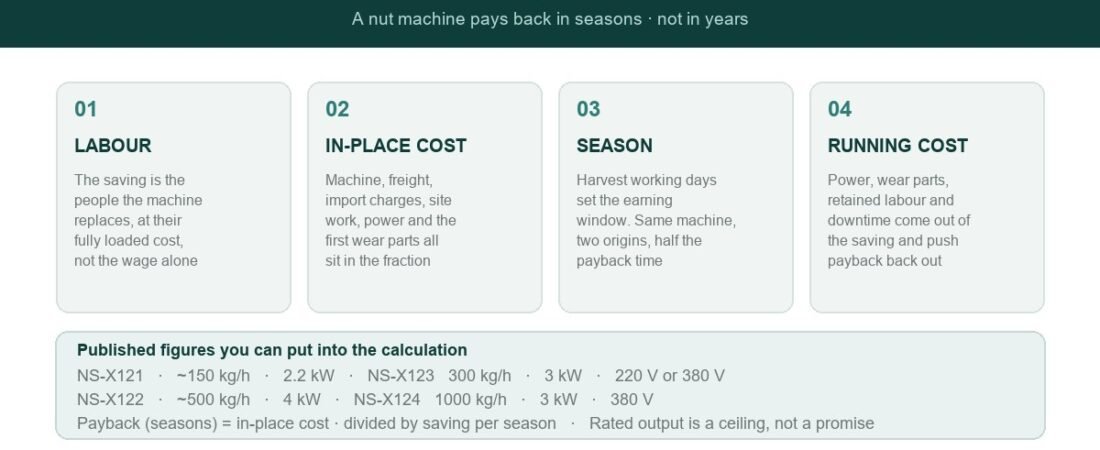
Price is the first number a buyer asks for and the last number that should decide the purchase. What actually settles a machine decision is how long the machine takes to pay for itself — and that number is not a property of the machine. It is calculated from your crop, your labour and your season.
This page sets out the five inputs a payback calculation needs, works one through end to end, shows why two machines with identical capacity can have very different payback periods, and separates what genuinely shortens payback from what only looks like it does. The numbers in the worked example are illustrative placeholders. Every input that matters has to come from your own site.
Last updated: October 2026
The short answer
- Payback on a nut processing machine is measured in seasons, not years. Most macadamia, cashew, pine nut and coffee crops are harvested for a few months a year, so the machine earns for a few months a year.
- The saving being counted is labour and grade, not tonnage. A machine that raises throughput without reducing labour or protecting kernel grade has changed very little on the cost side.
- Compare in-place cost, not purchase price. Freight, import charges, site preparation, power connection and the first set of wear parts belong in the number you divide.
- Season length is the single biggest variable. The same machine can pay back in two seasons at one origin and five at another, with no change to the machine at all.
- The honest answer to “how long” is a range. A payback period quoted for your site without your inputs is a guess dressed as a figure.
- Faster is not the same as better. In cashew and macadamia the whole-kernel rate moves revenue more than hourly capacity does.
What a payback period actually measures
A payback period is the time it takes for the savings a machine creates to equal the whole cost of putting it into service. Written as a formula:
Payback (in seasons) = In-place cost ÷ Saving per season
Two things follow immediately.
First, the denominator is a saving, which means it has to be measured against a method you are already using. If you currently peel macadamia by hand, the saving is the labour you no longer need plus the kernels you no longer break. If you currently hire a contractor’s machine, the saving is the contract fee you stop paying. If you are building from nothing, there is no saving to count — you are comparing a capital cost against revenue, which is a different calculation and needs a business plan rather than a payback period.
Second, both sides of the fraction are yours. A supplier can publish capacity, power and dimensions; only you know what a person-day costs you or how long your season runs. That is why payback is the buyer’s calculation, and why a supplier who hands you a payback figure without asking about your wage rates is guessing.
The five inputs the calculation needs
| Input | What to measure | Where buyers get it wrong |
|---|---|---|
| Labour replaced | Output per person at the stage being mechanised, over a full real day | Using a best-case morning instead of a full day |
| Employment cost | Wage plus every cost that sits above the wage | Counting the wage only |
| Season length | Working days in your harvest season | Using 365 days, or a generic 250 working days |
| Machine output | Output at your nut size, moisture and condition | Reading the catalogue rating as guaranteed output |
| In-place cost | Machine, freight, import charges, site work, power, first wear parts | Stopping at the ex-works or FOB price |
The fifth input is the one that turns an apparently strong case into a marginal one. A machine priced at the factory gate still has to travel, clear customs, be unloaded, be connected to power and be given a first set of wear parts before it produces anything. Each of those is a real cost line, and each belongs on the same side of the fraction as the machine itself. The document set and the freight conversation are covered separately in importing a nut processing machine from China.
A worked example — macadamia green husk peeling
The numbers below are placeholders chosen to make the arithmetic visible. Replace every one of them with your own before using the result.
The situation. A grower currently dehusks macadamia by hand at the front of the season, using a crew of eight for a 90-day harvest, at a fully loaded employment cost of 12 currency units per person-day. The crew delivers roughly 400 kg of dehusked nut in shell per day.
Step 1 — the seasonal labour bill. 8 people × 90 days × 12 = 8,640 per season.
Step 2 — what the machine replaces. A machine rated at 300 kg/h does not replace eight people hour for hour, because dehusking is seasonal, batch-fed and paced by the rest of the shed. A realistic first estimate is that it removes five of the eight, leaving three to feed, sort and handle.
Step 3 — the seasonal saving. 5 people × 90 days × 12 = 5,400 per season.
Step 4 — the in-place cost. Machine price, freight, import charges, a level concrete pad and a power connection. In this example, assume it totals 16,000.
Step 5 — payback. 16,000 ÷ 5,400 = 2.96 seasons, so effectively three harvests.
That is the whole calculation. Notice how sensitive it is to the two inputs people most often assume. If the season is 60 days rather than 90, payback stretches to roughly 4.4 seasons. If the fully loaded cost per person-day is higher, payback shortens. The machine’s specification has not changed at all.
Why two machines of the same capacity can pay back differently
Capacity is the most visible number on a specification sheet and one of the least useful for payback. The table below lists published figures for four macadamia green husk peelers of different sizes. Read it as a spread of options rather than a ranking: the right machine is the one whose output matches your peak intake over the harvest, because a machine that is too large sits idle and a machine that is too small creates a queue the crew still has to clear by hand.
| Model | Rated output | Power | Volume | Net weight |
|---|---|---|---|---|
| NS-X121 | ~150 kg/h | 2.2 kW, 220 V or 380 V | 0.80 CBM | ~176 kg |
| NS-X123 | 300 kg/h | 3 kW, 220 V or 380 V | 1.00 CBM | ~220 kg |
| NS-X122 | ~500 kg/h | 4 kW, 380 V | 0.80 CBM | ~180 kg |
| NS-X124 | 1000 kg/h | 3 kW, 380 V | 2.10 CBM | ~360 kg |
Three payback consequences follow from a table like this.
- Power is rarely the deciding line. The spread from 2.2 kW to 4 kW is small against a season of labour. It decides whether the machine can run on your supply at all, not whether it pays back. The practical question is whether your site is single-phase or three-phase, which is covered in machine voltage and power requirements for export.
- Weight and volume decide the installation cost. A heavier, larger machine needs a stronger floor, a different unloading plan and more freight. That is a real addition to the in-place cost, and it belongs inside the fraction.
- The rated output is a ceiling, not a promise. Nut size, moisture and how evenly the crop is fed all move real output away from the rated figure. Treat the rating as the top of the range you are buying.
The same logic applies across the range: a compact macadamia nut opening machine at around 50 kg/h and an industrial unit at around 150 kg/h are different purchases with different in-place costs, and the smaller one can have the shorter payback at a smallholder intake. Similar spreads exist in pine nut threshing machines and in cashew shelling machines, where the published shelling rate and whole-kernel behaviour matter more than the hourly figure.
Running cost: the part most budgets leave out
The calculation above treats the seasonal saving as gross. Running costs come out of it, and they lengthen payback. The honest list is short, but it is not empty.
- Electrical running cost. Multiply the motor rating by the hours the machine actually runs in a season. For most nut machines this is modest, because a short season limits the total hours.
- Wear parts. Any machine that contacts the nut has components that wear. Ask what they are, what they cost and how often they are replaced — before comparing prices with another supplier.
- The labour you keep. Machine dehusking still needs people to feed, inspect and handle output. The saving is the people removed, not all of them.
- Downtime during the harvest. A stopped machine in a short season is expensive in a way that never appears on a specification sheet. Spare part availability and a planned maintenance routine protect payback more than any other single habit; a practical routine is set out in the nut machine maintenance checklist.
Season length is the biggest lever you cannot buy
Of the five inputs, four can be improved by better operating decisions. Season length is the one you inherit.
This has a consequence that surprises buyers: the same machine is a much better purchase in a long season than in a short one, even at identical wage rates. A region with a four-month harvest gives the machine roughly twice the earning window of a region with a two-month harvest. Nothing about the equipment changed.
Two practical responses follow. The first is to measure your own season in working days instead of assuming a figure from a different origin. The second is to consider whether the machine can be used outside the primary crop — a dehusker or thresher that also handles a second crop, or a sheller used for contract work, spreads the fixed cost across more earning days. The capacity and power numbers for the full range are collected in the nut processing machine capacity and power chart.
What genuinely shortens a payback period
1. Mechanising the stage that actually employs the most people. In cashew that is usually peeling or shelling; in macadamia it is often dehusking at the front of the season.
2. Protecting kernel grade. Whole kernels and broken kernels are different products at different values, so anything that reduces breakage raises revenue without raising throughput. How whole-kernel share is measured is set out in whole kernel rate in macadamia.
3. Running the machine for more days per season, whether by a second crop or by contract work for neighbouring growers.
4. Getting the timing right at the front of the process. Husking too early or too late changes loss rates and re-work, which is covered in green husk peeling timing and loss rates.
5. Sizing correctly. A machine matched to peak intake runs near its rating; an oversized machine spends the season partly idle.
What does not shorten it
- A higher hourly rating on paper. If the bottleneck is downstream, extra speed at the front simply builds a queue.
- A lower purchase price from an unfamiliar supplier. A cheap machine with no spare parts reachable inside your season can cost more in lost harvest than it saved at purchase.
- Buying the largest unit available “just in case”. Idle capacity still has to be paid for, housed and maintained.
- A quoted payback figure from a supplier. Without your wage rates and season length it is an assumption, not a calculation.
What to send a supplier so the comparison is like-for-like
Ask for a quotation that states, in writing: the model and configuration, rated output and the nut condition that rating assumes, motor rating and voltage and phase, overall dimensions and packed volume, net and gross weight, the wear parts list, and what is included in the price and what is not. What to include in that request is set out in nut processing machine quotation.
With those fields filled in for two or three suppliers, the payback calculation becomes comparable, because the in-place cost can finally be built for each option on the same basis. Without them, you are comparing a factory-gate price with a delivered price and calling the difference a saving.
Frequently asked questions
What is a good payback period for a nut processing machine?
There is no single good number, because the answer depends entirely on how long your season is. The practical test is whether the machine pays for itself inside the harvests you can realistically service. If the calculation stretches past four or five seasons at your own wage rates and season length, the case is fragile, and the configuration should be re-examined before you commit rather than after installation.
How do I calculate the payback period on a macadamia dehusker?
Multiply the number of people the machine removes by their fully loaded daily employment cost, then by the working days in your season. That gives the seasonal saving. Divide the total in-place cost of the machine by that saving and you have payback measured in seasons. Use a real full-day output figure for the people, not a best-case hour, and include the people you will still need.
Is it cheaper per kilogram to buy a bigger machine?
Not automatically. A larger machine spreads its purchase price over more kilograms, which looks better on paper, but it also raises freight, floor and power costs, and if your intake does not fill it, it runs partly idle through a short season. Size the machine to your peak harvest intake rather than to the lowest theoretical cost per kilogram, and compare total in-place cost instead of purchase price.
Do I count the machine price or the total installed cost?
Use the total in-place cost. That means the machine, freight, import charges, site preparation, the power connection and the first set of wear parts. Dividing only the purchase price by the seasonal saving produces an optimistic payback that will not survive contact with the installation invoice, and it makes two suppliers with different scopes impossible to compare fairly.
How long is a macadamia harvest season?
It varies by origin and by variety rather than being a fixed figure. Most origins run a harvest of a few months, with dehusking at the very front of it. Because the entire payback calculation is divided by season length, it is worth measuring your own season in working days rather than borrowing a number from another country or another grower.
Can a supplier tell me my payback period?
A supplier can state capacity, power and dimensions accurately, but a payback period also needs your wage rates, your season length and your current method. Any figure offered without those inputs is an assumption rather than a calculation. What is genuinely useful to request from a supplier is a like-for-like quotation with the configuration written down, so you can run the calculation yourself with your own numbers.
Next step
Dongguan Nansheng Technology Co., Ltd. builds macadamia dehusking, cracking and shelling machines, cashew shelling machines, pine nut threshing machines and coffee pulpers in Dongguan, Guangdong Province. We publish our rated output and power figures, and we would rather send you a configuration sheet you can put into your own payback calculation than a number without context.
If you want to run this calculation on a specific machine, send us the stage you are trying to mechanise, your peak daily intake, your nut size and your site power supply. We will reply with the configuration, the published figures for it and the parts list, so the comparison is honest in both directions. Start from our product range or the macadamia green husk peelers, and use the contact form when you are ready.
Related reading and machines
- Macadamia green husk peeler, industrial NS-X124 — 1000 kg/h at 3 kW, 380 V
- Macadamia green husk peeler, large NS-X122 — around 500 kg/h at 4 kW, 380 V
- Macadamia green husk peeler, medium NS-X123 — 300 kg/h, 220 V or 380 V
- Macadamia green husk peeler, small NS-X121 — around 150 kg/h, 220 V or 380 V
- Macadamia green husk peelers, all models
- What drives the price of a macadamia processing line
- What drives the cost of a cashew processing line
- What drives the cost of a pine nut processing plant
- Nut processing machine quotation: what to include
- Importing a nut processing machine from China
- Nut machine maintenance checklist
- which nut to process: macadamia, cashew, pine nut and coffee compared
- staffing a nut processing line by capacity
- how site choice affects payback