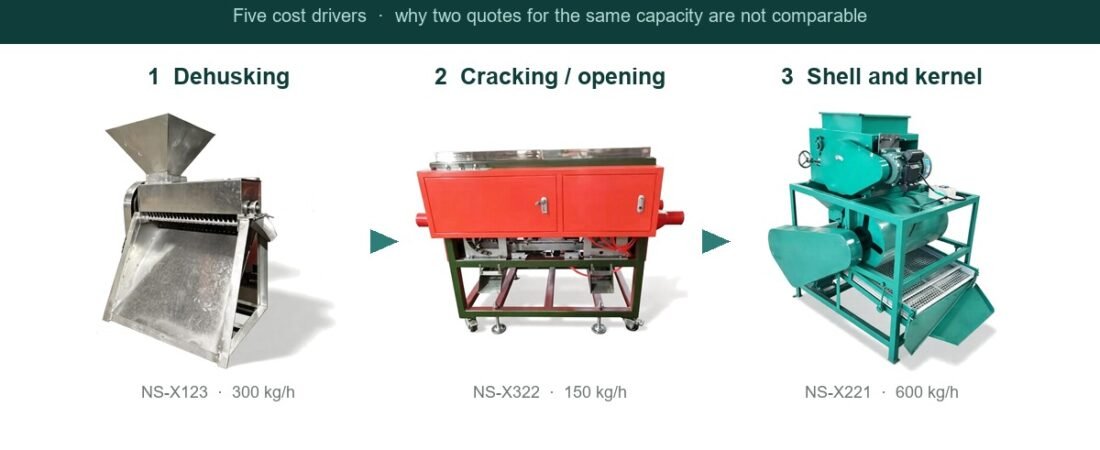
A macadamia processing line has no single price, and a supplier who quotes one before asking about your throughput, voltage and stage list is quoting a machine rather than a line. Five things drive the cost: the throughput of the slowest stage, how many stages you buy, the materials of construction, the level of automation, and the scope around the machine — freight, voltage customisation, spares and testing. This page works through each driver using the published capacities and shipping volumes of the machines we build, and ends with a checklist for comparing two quotes that look nothing alike.
Last updated: 24 September 2026
The short answer
- Five cost drivers: throughput, number of stages, materials, automation, and scope (freight, voltage, spares, testing).
- Line throughput is set by the slowest stage. One oversized machine does not raise the output of the line around it.
- Stainless steel costs more than carbon steel in both material and fabrication time, and it earns that difference on surfaces that touch kernel.
- Packing volume drives ocean freight. Two machines with the same capacity ship at different cost: from 0.80 CBM for the NS-X121 to 3.00 CBM for the NS-Y121.
- A quote is comparable only when it names the model, the capacity on your nut size, power supply, voltage, dimensions, weight, packing volume, body material, included spares and Incoterms.
- We do not publish a price list. The configuration changes with your throughput, voltage and stage list, so every quotation is built to the line you are buying.
Two terms are used throughout this page and are worth fixing at the start. Line throughput is the mass of nut in shell the whole line can pass in one hour, which equals the throughput of its slowest stage. Cost per tonne is the total cost of ownership — machines, freight, spares and labour — divided by the tonnes the line actually processes in a season. Cost per tonne, not the price on the quotation, is the number that decides whether a line pays.
The five cost drivers at a glance
| Driver | What moves the number | How to control it |
|---|---|---|
| Throughput of the slowest stage | A line is limited by its slowest stage; oversizing one machine leaves the rest of the line unchanged | Size every stage from the same peak-day figure |
| Number of stages | Each stage added removes manual labour and adds capital cost | Buy the stage that stops your largest loss first |
| Materials of construction | Stainless steel costs more in material and in fabrication time than carbon steel | Specify stainless where the surface touches kernel |
| Automation | Automatic feeding and continuous discharge raise the machine price and cut labour per tonne | Compare on cost per tonne, not on sticker price |
| Scope around the machine | Freight, voltage customisation, spare parts, sample testing, Incoterms | Put the same scope into both quotes before comparing |
Driver 1 — the slowest stage sets the price of the line
The largest single driver of what you spend is the throughput you decide to build for, and throughput is a property of the whole line rather than of any one machine. A dehusker rated at 1,000 kg/h feeding a cracking stage rated at 150 kg/h produces 150 kg/h of cracked product, and the money spent on the extra dehusking capacity sits idle for most of the season. This is why we ask for your peak-day volume before naming a model: the answer to a line question is a set of machines that match each other, not one impressive machine.
| Stage | Models we build | Published capacity | Power supply |
|---|---|---|---|
| Green husk peeling (dehusking) | NS-X121 Small | ~150 kg/h | 2.2 kW, 220 V or 380 V |
| Green husk peeling (dehusking) | NS-X123 Medium | 300 kg/h | 3 kW, 220 V or 380 V |
| Green husk peeling (dehusking) | NS-X122 Large | ~500 kg/h | 4 kW, 380 V |
| Green husk peeling (dehusking) | NS-X124 Industrial | 1,000 kg/h | 3 kW, 380 V |
| Shell and kernel separation | NS-X221 Standard | ~600 kg/h | 3 kW + 1 kW, 220 V |
| Shell and kernel separation | NS-X222 Heavy Duty | ~200 kg/h | Stainless steel, automatic continuous feed |
| Cracking / opening | NS-X321 Compact | ~50 kg/h | Electric single unit |
| Cracking / opening | NS-X322 Industrial | ~150 kg/h | 6 kW, 380 V |
A worked example shows how the arithmetic behaves. Take a peak harvest day of 5,000 kg of nut in shell arriving inside eight hours: that is 625 kg/h entering the line. Dehusking with the NS-X123 at 300 kg/h needs the machine running for more than 16 hours, so the practical choice is the NS-X124 at 1,000 kg/h in a single pass, or two NS-X123 units side by side. The cracking stage is the tighter constraint: the NS-X322 opens about 150 kg/h, so matching 625 kg/h takes four units, and most buyers instead crack across several days and keep the dehusking line at full speed. The shell and kernel stage at 600 kg/h on the NS-X221 matches the incoming flow, which is what a balanced line looks like.
Two rules follow from that example. First, dehusking has its own deadline regardless of throughput: the green husk is biologically active and pushes moisture back through the shell into the kernel, so the working rule is to dehusk within 24 hours of harvest and never beyond 48 — read green husk peeling: timing, loss rates and settings. Second, the stage you crack on is the one that sets the pace of the whole line, so it is the stage where matched capacity earns the most money.
Driver 2 — how many stages you buy
A line is a sequence: dehusking, drying, cracking or opening, shell and kernel separation, then grading. You do not have to buy the sequence at once, and the cheapest way into a line is almost never the most profitable one. Where kernel is being lost, the loss happens in a fixed order: harvest and husk handling first, moisture second, cracking force third, separation last. Money spent on the stage that stands furthest up that order reduces loss fastest, which is why dehusking and drying come before cracking in every line we quote, even when the buyer’s first question is about a cracking machine.
The cost side of the same decision is simple to state. Each stage you add has its own capital cost, its own footprint and its own power supply, and it removes a specific manual task. A buyer who adds a dehusking stage removes manual husking labour across the whole harvest. A buyer who adds a cracking stage removes the manual hammer or hand cracker and, with it, a large share of broken kernel. The stages that stop the biggest losses, measured in whole kernel, are the ones that repay their cost first — the arithmetic behind that statement is in how to improve macadamia kernel recovery and how to measure whole kernel rate.
Driver 3 — materials of construction
Carbon steel and stainless steel do the same job at different cost, and the difference shows up twice: in the price of the material and in the time it takes to fabricate, weld and finish. Stainless steel earns its cost on surfaces that touch kernel, in humid climates where a carbon steel frame corrodes, and in plants that wash down between batches. Carbon steel remains the lower-cost choice for frames and covers that carry load rather than product, and it is the material used across the green husk peeler range and the NS-X221 shelling machine.
The two shell and kernel machines in our range illustrate the trade-off directly. The NS-X221 Standard is built in carbon steel and weighs about 250 kg. The NS-X222 Heavy Duty is stainless steel with automatic continuous feeding and discharging, and weighs about 390 kg — the extra mass is material and structure, and it is what the additional cost buys. Buyers moving into food-contact work, or working in a humid coastal climate, specify stainless; buyers running dry product on a carbon steel frame in a dry climate do not need to pay for it. Both options are available, and the material is confirmed in writing with the rest of the specification.
Driver 4 — automation and labour
Automation is the driver that is easiest to misjudge, because it raises the machine price and lowers the cost per tonne at the same time. The NS-X222 is the clearest example in our range: automatic continuous feeding and discharging means a plant can run it through a shift without an operator standing at the hopper, which is worth real money where labour is expensive or where the line runs continuously. On a small farm processing a few hundred kilograms a day, the same automation is idle most of the year, and the lower-cost single-unit machine is the better financial decision even though its hourly output is lower.
The comparison to make is labour cost per tonne, not labour cost per hour. Divide the wage bill for a season by the tonnes processed in that season, and compare that figure between a manual configuration and an automated one. Automation tends to win as volume climbs and as labour rates rise; manual loading wins at low volume, where the machine sits idle longer than it runs. Run that calculation with your own numbers before deciding, because it is the one part of a line’s cost that changes with your location rather than with the machine.
Driver 5 — what sits outside the machine price
Two quotations for the same machine can differ by a wide margin once the scope around the machine is included, and ocean freight is the largest of those items. Freight is charged on volume and weight, so the packing volume of each model matters as much as its capacity. The table below lists the published packing volume and packed weight of every model in the range; the figures come from the same specification sheets we send with each quotation.
| Model | Machine | Packing volume | Packed weight |
|---|---|---|---|
| NS-X121 | Green husk peeler, small | 0.80 CBM | ~176 kg |
| NS-X123 | Green husk peeler, medium | 1.00 CBM | ~220 kg |
| NS-X122 | Green husk peeler, large | 0.80 CBM | ~180 kg |
| NS-X124 | Green husk peeler, industrial | 2.10 CBM | ~360 kg |
| NS-X221 | Shelling machine, standard | 2.00 CBM | ~330 kg |
| NS-X222 | Shelling machine, heavy duty | 2.40 CBM | ~475 kg |
| NS-X321 | Opening machine, compact | 1.00 CBM | ~330 kg |
| NS-X322 | Opening machine, industrial | 2.70 CBM | ~570 kg |
| NS-Y121 | Cashew shelling machine | 3.00 CBM | ~280 kg |
| NS-S121 | Pine nut threshing machine, standard | 1.00 CBM | ~200 kg |
| NS-S122 | Pine nut threshing machine, high capacity | 2.10 CBM | ~200 kg |
Beyond freight, confirm four more items before you compare two prices. Voltage customisation: a 220 V single-phase site and a 380 V three-phase site take different drives, and the machine is built and tested for the supply you name. Spare parts: ask which wear parts ship with the machine and what a replacement set costs. Sample testing: we set the machine on your sample and report the expected result in writing, which turns a specification into a number you can check on arrival. Incoterms and lead time: FOB, CIF and DAP put different costs on different sides of the quotation, and a lead time without an Incoterm tells you nothing about when the machine reaches you.
Why we do not publish a price list
A published number would have to assume a throughput you have not chosen, a voltage your site may not have, a body material you may not need and a destination port you have not named. Buyers then compare that number against a quotation built for a different scope and reach a conclusion that has nothing to do with either machine. We quote per configuration instead: send the five items listed below and you receive a written quotation with the model, specification, packing size, freight basis and lead time. We reply within one business day, and specifications are confirmed in writing before production starts.
How to compare two quotes fairly
- Model number and the capacity quoted on your nut size, not a generic figure.
- Power supply in kW and the voltage it is built for — 220 V single phase or 380 V three phase.
- Overall dimensions and machine weight, so you can check doorways and floor loading before it lands.
- Packing volume and packed weight, because these set the freight line on both quotes.
- Body material — carbon steel or stainless steel — and which surfaces are stainless.
- Wear parts included, and the price of a replacement set.
- Test result on your sample, in writing, with the settings used.
- Incoterms, destination port, lead time and warranty terms.
- Whether the quotation covers one stage or the whole line, and which stages are left out.
Five questions to ask before you compare prices
- Which stage in your line is the slowest one, and what is its published capacity?
- Is the quoted capacity measured on macadamia in shell at your moisture, or on a different crop?
- Which parts of the machine are stainless steel, and which are carbon steel?
- What is the packing volume and packed weight of the unit being quoted?
- What exactly is excluded from this price — freight, duty, installation, spares, training?
Frequently asked questions
How much does a macadamia processing line cost?
A line is priced stage by stage, so the answer is a configured quotation rather than a list price. The number is driven by five things: the throughput you build for, how many stages you buy, whether surfaces are carbon or stainless steel, how much automation you need, and the scope around the machine such as freight, voltage customisation and spares. Send your peak-day volume, supply voltage, nut size range and destination port, and we return a written quotation with the model, specification, packing size and lead time.
Why are two quotes for the same capacity so different?
The differences sit in four places. The material: a stainless steel machine such as the NS-X222 costs more than a carbon steel machine of similar output. The scope: one quote includes freight, voltage customisation and spare parts, the other does not. The number of stages: one supplier quotes a single machine, the other quotes a line. And the basis of the capacity figure: a rating measured on one crop at one moisture is not the same as a rating on your nut in shell. Put the same nine items into both quotations and the gap narrows to things that genuinely differ.
Is a bigger machine always cheaper per tonne?
No. A larger machine lowers cost per tonne only while it is fed at a rate that keeps it near its rated capacity. A 1,000 kg/h dehusker that receives 300 kg/h of harvest spends most of its life underloaded, and its cost per tonne ends up higher than a 300 kg/h machine running at its rated load. The correct comparison is between machines operating near capacity for your real harvest curve, which is why we ask for the peak day rather than the season average.
Does stainless steel matter if I am not exporting?
It matters wherever the surface touches kernel and wherever the air is humid. Stainless steel is specified for food-contact surfaces, for wash-down between batches and for humid or coastal climates where a carbon steel frame corrodes. Carbon steel is the lower-cost choice for load-bearing frames and covers in dry conditions, and it is the material used across our green husk peeler range and the NS-X221 shelling machine. Both materials are available, and the choice is recorded in writing with the rest of the specification.
What information do I need to give to get an accurate quote?
Five items are enough: the material you process, your target output per hour or per day, your supply voltage (220 V single phase or 380 V three phase), your nut size range, and your destination port or country. Adding the stages you want now and the stages you plan to add later lets us size the first machines so they still fit the line you are building. Specifications are confirmed in writing before production.
Request a quote for your line
Send us your peak-day volume, supply voltage, nut size range and destination port, and we will come back with the model, the specification, the packing size, the freight basis and the lead time.
- Email: nanshengtechnology@gmail.com
- Phone / WhatsApp: +86 133 7302 3075
To get an accurate quotation, please tell us:
- The material you process (macadamia, cashew, pine nut, coffee cherry, other nuts)
- Your target output per hour or per day
- Your power supply: 220 V single phase or 380 V three phase
- Your destination port or country
Minimum order quantity is one unit. OEM branding and customisation are available on request, and specifications are confirmed in writing before production. Dongguan Nansheng Technology Co., Ltd., Dongguan, Guangdong, China.
Related reading and machines
- Macadamia processing line layout: harvest to packed kernel
- Macadamia shelling vs opening machines: which one do you need?
- Nut in shell moisture content: the 1.5% target
- Macadamia green husk peeler – medium (NS-X123, 300 kg/h)
- Macadamia nut shelling machine – standard (NS-X221, 600 kg/h)
- Macadamia nut opening machine – industrial (NS-X322, 150 kg/h)
- All nut and coffee processing machines
- Cashew shelling machine: reading the numbers before you buy
- Nut processing machine quotation: what to include in your enquiry
Related reading: How to improve macadamia kernel recovery. Also see whole kernel rate: how to measure it and what improves it.