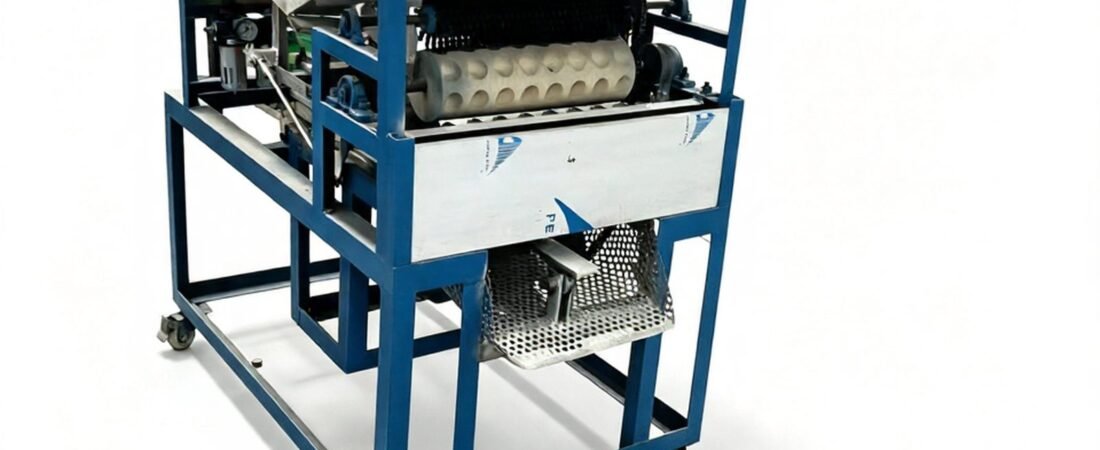
Most macadamia cracking machines are shortlisted on one number — throughput in kilograms per hour — and that is the number least likely to decide whether your line makes money. The specifications that actually protect your margin are the crack-out method, whether the opening can be re-set to your nut size, and how the machine separates kernel from shell. This guide sets out the seven specs worth comparing, with the target values and the questions to put to any supplier.
Last updated: 13 September 2026
The short answer
Seven specifications decide whether a macadamia cracking machine fits your operation: the crack-out method, rated throughput against your peak harvest day, adjustable opening angle and opening diameter, kernel and shell separation in the same pass, drive power and supply voltage, body material, and packed volume. The first three decide your whole-kernel rate, which is where your income is; the last four decide installation, running cost and freight. If you compare only one thing, compare how the machine opens a shell and whether that method can be re-set for a different nut size. A machine that is cheap to buy but fixed to a single size grade usually costs more in its second season than it saved in its first.
Why the wrong machine costs more than it saves
Whole-kernel rate is the percentage, by weight, of kernel that comes out of cracking completely intact. It is the number that decides your price per kilogram, because whole macadamia kernels sell for a wide multiple of broken pieces — and unlike throughput, it cannot be recovered later in the line. Run the arithmetic on a modest operation and the stakes become obvious. Take five tonnes of nut-in-shell per day at 28% kernel recovery: that is about 1,400 kg of kernel per day. Move the whole-kernel rate down by five percentage points and you lose roughly 70 kg per day, or 4.2 tonnes across a 60-day season. That loss is fixed at the moment the shell opens, and no downstream sorter puts a broken kernel back together.
Spec 1 — Crack-out method: saw-slot opening or impact crushing
There are two ways to get into a macadamia shell, and they are not interchangeable. Controlled saw-slot opening cuts a slot through the shell with an arc-shaped saw, leaving the kernel loose inside a shell that is still in one piece; impact crushing breaks the shell mechanically and extracts the kernel. Saw-slot opening is the method you want when the kernel has to stay intact for retail sale, chocolate or confectionery — the NS-X321 compact opening machine works this way at around 50 kg/h. Crushing suits volume, where the kernel goes on to further processing rather than a shelf. Ask every supplier which method their machine uses, and what whole-kernel rate they will stand behind on your variety rather than on a demonstration sample.
Spec 2 — Throughput sized to your peak day, not your annual average
Size the machine to your peak harvest day divided by the hours you are willing to run, then add a margin of about 20%. Macadamia does not arrive evenly: harvest is compressed into a few intense weeks and nut-in-shell cannot sit in a pile, so a machine sized to the annual average will be the bottleneck exactly when it matters. The formula is straightforward. If your peak day is six tonnes of nut-in-shell and you will run one eight-hour shift, you need roughly 750 kg/h — either a 600 kg/h machine such as the NS-X221 sheller running with a buffer, or a second shift. Be careful with headline figures, because capacity is quoted per material and per method. A 200 kg/h stainless-steel continuous line and a 600 kg/h benchtop cracker are not the same product at different sizes, and the lower-rated machine can legitimately cost more.
Spec 3 — Adjustable opening angle and opening diameter
If a machine has no adjustment for opening angle and opening diameter, it can only run the nut size it was set to at the factory. Macadamia size varies by variety, orchard, season and even within a single tree’s drop, and every change in size changes where the tool should meet the shell. Opening angle controls how the nut is held while force is applied; opening diameter controls how deep the tool goes. The NS-X322 industrial cracking machine adjusts both, so one unit can be re-set between batches instead of being dedicated to a single grade. Our commissioning engineers set the opening angle first and then the diameter — the angle decides how the nut is held, the diameter decides how deep the tool goes — and they log the setting per orchard, so the next season starts from a known point rather than from scratch.
Spec 4 — Kernel and shell separation in the same pass
A cracking machine that does not separate kernel from shell in the same pass leaves you with a mixed stream, and every time that stream is moved the kernels chip. The NS-X221 cracks hard shells and extracts kernels in a single pass; the NS-X222 heavy-duty line goes further with continuous automatic feeding and discharging, so the hopper keeps the machine working without an operator standing over it. Where a machine does not separate internally you need a downstream step, and there are two standard routes: a colour sorter, which has high capital cost and almost no labour, or a trommel plus hand sorting on a belt, which is the low-capital, labour-intensive option. Neither is wrong, but size the separation step to keep pace with the cracker, or the kernels waiting in the pile become the breakage.
Spec 5 — Drive power and supply voltage
Match the machine’s voltage to the supply you actually have, and confirm it in writing before the order is placed. A three-phase 380 V machine delivered to a site with only a single-phase 220 V supply is not a machine with a problem — it is an unusable machine, and rewiring is rarely as simple as fitting a new plug. Our drive ratings run from 0.8 kW on the entry cashew sheller to 6 kW on the NS-X322 macadamia cracker, which runs on 380 V three-phase, while the NS-X221 cracker uses a 3 kW plus 1 kW combination on 220 V. Some models are configurable: the NS-X121 peeler uses a 2.2 kW motor available in either 220 V or 380 V. Tell your supplier your supply at the quotation stage, and ask for the machine to be configured and test-run for that voltage before it ships.
Spec 6 — Body material and food-grade construction
Carbon steel is the right choice for dry nut cracking; stainless steel is worth the premium only when the machine runs in wet or oily conditions or inside a food-grade audited environment. This is the spec where buyers most often overpay. Macadamia cracking is a dry process, and a carbon-steel body such as the NS-X221’s is entirely adequate and easier to repair and repaint in a rural workshop. Stainless steel earns its cost on wet processing, on oily products, and where a buyer audit requires washable surfaces — the NS-X222 heavy-duty line is stainless for exactly those reasons. Ask what the frame is made of, but also ask why you need that material, and treat “food grade” as a question about your process rather than a slogan.
Spec 7 — Footprint, weight and packed volume
Packed volume is a freight cost, and on an export order it can move your delivered price more than any discount negotiated on the machine itself. Three figures belong in every comparison: the operating footprint, the machine weight for installation, and the packed volume in cubic metres for shipping. Our cracking and opening machines span 1.00 CBM for the compact NS-X321, which weighs about 250 kg and occupies 1,200 x 700 x 1,100 mm, up to 2.70 CBM for the industrial NS-X322 at about 470 kg. Multiply each shortlisted model’s packed volume by your forwarder’s rate before you decide, and check that the door width on site clears the crate — a machine that cannot be wheeled into the shed is not an installed machine.
The seven specs at a glance
| Specification | NS-X321 (opening) | NS-X322 (cracking) | NS-X221 (shelling) | NS-X222 (heavy-duty) |
|---|---|---|---|---|
| Crack-out method | Arc-shaped saw-slot opening | Automatic opening, angle and diameter adjustable | Cracks hard shell and extracts kernel in one pass | Automatic continuous cracking and separation |
| Rated throughput | ~50 kg/h | ~150 kg/h | ~600 kg/h | ~200 kg/h |
| Adjustability | Saw grouting | Opening angle and opening diameter | Set per batch | Automatic, continuous feed and discharge |
| Separation in same pass | No — kernel stays in the shell | No — opening only | Yes | Yes |
| Power supply | Electric single unit | 6 kW, 380 V | 3 kW + 1 kW, 220 V | Automatic line |
| Body material | Carbon steel | Carbon steel | Carbon steel | Stainless steel |
| Dimensions / weight / packing | 1,200 x 700 x 1,100 mm / ~250 kg / 1.00 CBM | 1,850 x 1,200 x 1,180 mm / ~470 kg / 2.70 CBM | 1,350 x 1,000 x 1,300 mm / ~250 kg / 2.00 CBM | 1,150 x 990 x 1,370 mm / ~390 kg / 2.40 CBM |
Matching a machine to your operation
- Selling opened macadamia in shell for retail or confectionery: controlled saw-slot opening, around 50 kg/h, keeps the kernel whole — see the NS-X321 compact opening machine.
- Opening volume for further kernel processing: adjustable opening angle and diameter, around 150 kg/h on a 6 kW three-phase drive — see the NS-X322 industrial cracking machine.
- One machine for several hard-shell crops: cracks and separates in a single pass at around 600 kg/h — see the NS-X221 macadamia nut shelling machine.
- Continuous line for macadamia or pecan in wet or oily conditions: stainless steel with automatic feed and discharge — see the NS-X222 heavy-duty shelling line.
- Start from the harvest end: if your breakage begins before cracking, read how to improve macadamia kernel recovery.
Five mistakes buyers make
- Buying on throughput alone, then finding the machine cannot be re-set when the next delivery is a different size grade.
- Comparing a saw-slot opening machine with a crushing machine as if they were the same product at different prices.
- Ordering before the site’s supply voltage has been confirmed in writing.
- Paying for stainless steel on a dry process, or specifying carbon steel for a wet one.
- Ignoring packed volume until the freight quote arrives.
Frequently asked questions
What is the difference between a macadamia cracking machine and a shelling machine?
A cracking or opening machine gets into the shell, either by cutting a controlled slot with a saw or by applying force. A shelling machine breaks the shell and extracts the kernel, and usually separates kernel from shell in the same pass. If the kernel has to stay whole for retail sale, you want controlled opening; if you are processing volume for further use, crushing and shelling is the faster route. For the full comparison, including which one each product actually needs and how to size either machine to your peak day, see shelling vs opening machines.
How do I work out what throughput I need?
Divide your peak harvest day in kilograms by the number of hours you are prepared to run, then add about 20% as margin. If your peak day is 6,000 kg and you will run one eight-hour shift, that is 750 kg/h before margin. Size to the peak, not the annual average, because the macadamia harvest is compressed into a few intense weeks and nut-in-shell cannot be stockpiled for long.
Can one machine handle several macadamia sizes?
Yes, if it has adjustable opening angle and opening diameter. The NS-X322 industrial cracking machine adjusts both, so one unit can be re-set between batches for different size grades. A machine with no adjustment can only run the size it was set to at the factory, which becomes a problem as soon as your supply changes variety or orchard.
Should I choose carbon steel or stainless steel?
Carbon steel suits dry cracking and is cheaper, lighter and easier to repair. Stainless steel is worth the premium when the process is wet or oily, or when a customer audit requires washable food-grade surfaces. For a dry macadamia cracking line, stainless is usually money spent for no process benefit.
Do I need a 220 V or a 380 V machine?
It depends entirely on the supply at your site, and it should be decided before the order rather than after delivery. Macadamia cracking machines commonly draw 6 kW on 380 V three-phase or 3 kW plus 1 kW on 220 V, and some models such as the NS-X121 peeler can be configured for either. Send us your supply details with your enquiry and the machine will be configured and tested for that voltage before shipping.
Not sure which of these seven specs your operation actually needs? Send us your harvest volume, nut size grade and site supply voltage, and we will come back with a model recommendation — or get a quote for a macadamia cracking line sized to your throughput.
Related machines
- Macadamia opening machines (cracking)
- Macadamia shelling machines
- All macadamia processing equipment
- Small-scale nut processing: choosing a farm-scale line