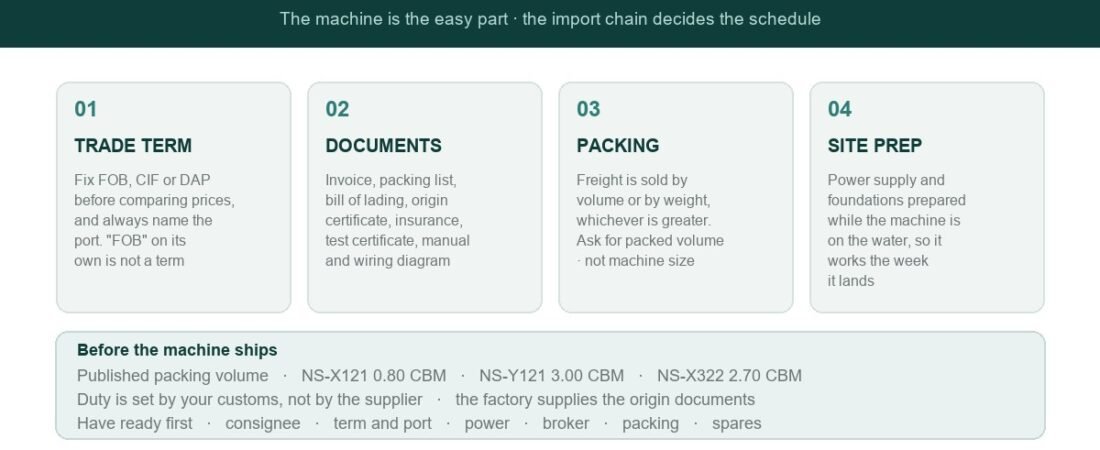
Buying a processing machine from a Chinese manufacturer is usually the cheapest way to add capacity, and the part buyers underestimate is not the machine — it is everything around it. The order itself takes a conversation; the import takes a chain of decisions about terms, packing, documents, clearance and site preparation, and each link has to be settled in the right order.
This page walks that chain from the buyer’s side: which trade term to agree before comparing prices, which documents a customs broker will ask for, why packing volume changes your freight as much as machine size, where the weeks in the timeline actually go, and what to have ready before the machine leaves the factory. It is written from the manufacturer’s side of the transaction, which is the side that has to produce the paperwork.
Last updated: October 2026
The short answer
- Agree the trade term before you compare prices. A FOB figure and a delivered figure are not comparable, and a quotation without the term attached cannot be checked.
- Your customs broker decides the duty, not the supplier. The supplier provides the invoice, packing list, bill of lading and certificate of origin; classification and duty belong to your country’s rules.
- Packing volume drives freight as much as weight does. A machine that is light but bulky still pays for the space it occupies, which is why packed volume is published alongside machine dimensions.
- Sea freight is the default for machines; air freight is for spare parts and urgency. The break-even is usually about schedule, not about the freight invoice alone.
- Preparation on site takes longer than buyers expect. Power supply, foundations, storage and unloading equipment all have to exist before the machine is useful — and they can be prepared while the machine is on the water.
- The documents are the part you can control. Getting the invoice, packing list and origin documents right before shipment prevents almost every clearance delay.
What “importing” actually involves
Dongguan Nansheng Technology Co., Ltd. is a manufacturer of nut and coffee processing machinery based in Dongguan, Guangdong Province, China, building macadamia dehusking, cracking and shelling machines, cashew shelling machines, pine nut threshing machines and coffee pulpers. When one of those machines is exported, the chain below runs from the factory to your site — and every step has an owner.
| Step | What happens | Who drives it |
|---|---|---|
| Order and specification | Capacity, power supply, materials and packing are fixed in writing | Buyer and manufacturer together |
| Production and testing | The machine is built and run before packing | Manufacturer |
| Export packing | The machine is crated, and packing volume and packed weight are confirmed | Manufacturer |
| Booking and export clearance | Space is booked, the container is loaded, export documents are filed | Manufacturer, with the forwarder |
| Sea or air leg | The machine moves to the destination port or airport | Forwarder or carrier |
| Import clearance | Documents are presented, duty and taxes are assessed and paid | Your customs broker, on your behalf |
| Inland delivery | The container or crate moves to your site | Your forwarder |
| Unloading and installation | The machine is moved into position and connected | Buyer, with manufacturer guidance |
| Commissioning | Settings and checks are completed before regular production | Both sides |
Only four of those nine steps belong to the manufacturer. The rest are decided by the buyer’s own country, port and site — which is exactly why the preparation on the buyer’s side is where schedules are won or lost.
Step 1 — Decide the trade term before you compare prices
The trade term (the Incoterm) says where the supplier’s responsibility ends. Get it wrong and every quotation you collect is measuring a different thing.
| Term | Supplier is responsible for | Buyer is responsible for | When it makes sense |
|---|---|---|---|
| EXW (Ex Works) | Making the machine available at the factory | Everything: inland haulage in China, export clearance, freight, import | Rarely — the buyer needs their own forwarder in China |
| FOB (Free On Board) | Delivering the machine to the named Chinese port and clearing it for export | Ocean freight, insurance, import clearance, inland delivery | The most common choice for buyers with an established forwarder |
| CIF (Cost, Insurance, Freight) | FOB plus ocean freight and insurance to the destination port | Import clearance, duty, inland delivery | Buyers who want the freight handled but keep control of clearance |
| DAP (Delivered At Place) | Delivering to the named destination, with import duty still unpaid | Import clearance and duty | Buyers who want one delivered figure and can clear the goods themselves |
| DDP (Delivered Duty Paid) | Delivering with duty paid | Very little, but the supplier must understand your country’s rules | Only where the supplier genuinely handles destination clearance |
Two rules make this practical. First, always name the port along with the term — “FOB” alone is not a term. Second, ask what the figure does not include: a delivered price that excludes unloading, duty or a lift-gate service is not a problem in itself, as long as it is written down. The line-by-line structure of a comparable quotation, including how terms change the total, is set out in what a nut processing machine quotation should contain.
Step 2 — The documents your customs broker will ask for
The document set for a machine is small and predictable. Producing it correctly before shipment is the single most effective way to avoid a clearance delay.
| Document | Issued by | What it must get right |
|---|---|---|
| Commercial invoice | Manufacturer | Description of goods, unit, quantity, unit price, currency, trade term and named port |
| Packing list | Manufacturer | Number of packages, packed volume, packed weight, dimensions per package |
| Bill of lading (or air waybill) | Carrier, via the forwarder | Consignee details, notify party, port pair, freight terms |
| Certificate of origin | Issuing authority in China, arranged by the manufacturer | Origin declaration, used to claim preferential treatment where your country allows it |
| Insurance certificate | Insurer | Who is insured, the covered value, the route, and whether it matches the trade term |
| Test or inspection certificate | Manufacturer | Machine model, serial number, and the checks that were run before packing |
| Machine documentation | Manufacturer | Manual, wiring diagram and the wear-part list — needed by your electrician, not your broker |
Two practical notes. The invoice description and the origin documents must describe the same machine — a difference in wording between the invoice and the certificate of origin is a common cause of a hold. And the machine documentation should travel as a physical set inside the crate as well as by email, because the people installing the machine are not usually the people who received the email.
Step 3 — Packing volume matters as much as machine size
Ocean freight is sold by volume and weight, whichever is greater. A machine can be light and still expensive to ship because it takes up space, and two machines with the same capacity do not necessarily pack to the same volume — which is why packed volume is published for each model rather than machine dimensions alone.
The published packing figures for our range show how wide that spread is:
| Machine | Model | Packing volume | Packed weight |
|---|---|---|---|
| Macadamia green husk peeler, small | NS-X121 | 0.80 CBM | ~176 kg |
| Macadamia green husk peeler, large | NS-X122 | 0.80 CBM | ~180 kg |
| Macadamia green husk peeler, medium | NS-X123 | 1.00 CBM | ~220 kg |
| Macadamia green husk peeler, industrial | NS-X124 | 2.10 CBM | ~360 kg |
| Pine nut threshing machine, standard | NS-S121 | 1.00 CBM | ~200 kg |
| Pine nut threshing machine, high capacity | NS-S122 | 2.10 CBM | ~200 kg |
| Macadamia nut shelling machine, standard | NS-X221 | 2.00 CBM | ~330 kg |
| Macadamia nut shelling machine, heavy duty | NS-X222 | 2.40 CBM | ~475 kg |
| Macadamia nut opening machine, compact | NS-X321 | 1.00 CBM | ~330 kg |
| Macadamia nut opening machine, industrial | NS-X322 | 2.70 CBM | ~570 kg |
| Cashew shelling machine | NS-Y121 | 3.00 CBM | ~280 kg |
| Coffee fruit peeling machine | — | Confirmed in writing per configuration | Confirmed in writing per configuration |
Two things follow from that table. First, several machines can share a container — the volumes above are small enough that a single machine rarely fills a 20-foot container, so buyers adding a second machine later often pay less than they expect to ship it. Second, ask for the packed volume, not the machine size, when you request a freight quote.
Step 4 — Sea freight or air freight
For machines, sea freight is the default and air freight is the exception. The comparison is not only about the freight invoice; it is about what the extra money buys you.
| Sea freight | Air freight | |
|---|---|---|
| Cost profile | Lower per unit of volume; better for heavy or bulky machines | Higher per kilogram, and volumetric weight counts against bulky crates |
| Transit time | Measured in weeks, plus port and clearance time | Measured in days, plus clearance time |
| Suited to | Complete machines, multiple machines, non-urgent additions | Spare parts, replacement wear parts, samples, urgent single components |
| Packing | Export crating for container handling | Lighter crating, but still adequate for handling |
| Risk to plan for | Port congestion and clearance time at the destination | The volumetric weight of anything bulky |
The practical rule: ship the machine by sea and the first-season spare kit with the machine, because the parts travel in the same shipment, clear the same entry and arrive before they are needed. What that kit should contain is covered in warranty and spare parts for a nut processing machine.
Step 5 — Duties and taxes: who calculates what
This is the step where buyers most often ask the manufacturer a question the manufacturer cannot answer, so it is worth being clear about the division.
- Classification of the goods under your country’s tariff schedule is a decision for your customs authority or broker. The manufacturer’s contribution is an accurate description and, where you ask for it, the technical information needed to classify the machine correctly.
- The rate of duty and any taxes depend on the classification, the origin of the goods and any trade agreement your country applies. No manufacturer can state your duty rate accurately, and a supplier who quotes one confidently on a delivered basis is usually absorbing an unknown.
- Preferential treatment, where it exists, depends on your country’s rules and its own documentation requirements. That is why the certificate of origin is prepared before shipment rather than after arrival.
- Clearance costs — broker fees, port charges, terminal handling and inland haulage — follow your forwarder’s quotation, not the machine’s price.
The honest summary: the manufacturer controls the machine, the packing and the origin documents. Your broker controls the duty. Asking for both in one number is how buyers end up comparing impossible quotations.
Step 6 — Prepare the site while the machine is on the water
Transit time is free preparation time, and it is usually the difference between a machine that starts working the week it lands and one that sits in its crate for a month.
- Power supply. Confirm the voltage, phase and available capacity match the machine before it ships — not after it arrives. The checks worth doing at your site are set out in voltage and power customization for export orders.
- Foundations and floor. Check the loading, the level and the drainage where the machine will stand. A machine that needs a flat, firm floor is often moved to a floor that was never checked.
- Unloading equipment. A crate of several hundred kilograms needs a forklift, a crane or a team that has been organised in advance. Confirm what your port or site can actually provide.
- Storage for incoming material and finished product. The machine sets a throughput; the storage around it decides whether that throughput can be used.
- The electrician and the operator. Both should be available in the days after delivery, because the wiring diagram and the manual are written for them.
Step 7 — The timeline: where the weeks actually go
Buyers usually ask for a single lead-time number and then discover that the total is made of several parts. It is more useful to think in stages.
| Stage | What determines its length |
|---|---|
| Specification and quotation | How completely your enquiry describes feed material, throughput, power supply and destination |
| Production | The model, whether a voltage or material customisation is needed, and the factory’s current schedule |
| Testing and packing | The checks run before packing, and how the machine is crated for the route |
| Booking and export clearance | Vessel or flight availability from the chosen port |
| Ocean or air transit | The route, and whether the container is consolidated with other cargo |
| Import clearance | Document accuracy and the destination’s own processes |
| Inland delivery and installation | Distance from the port, site access, and when power is available |
A lead time quoted without those stages attached is a marketing number. A quotation that separates production from transit, and transit from clearance, is one you can actually plan around — which is the point of the comparison method in how to compare two quotations line by line.
The eight things to have ready before the machine ships
Give the manufacturer these eight items and the shipment, the documents and the arrival all become predictable.
1. Consignee details exactly as they should appear on the bill of lading, including the notify party your broker wants.
2. The trade term and the named port, confirmed in writing.
3. The destination country and nearest port, so packing and documentation follow the actual route.
4. The power supply on site — voltage, phase and available capacity.
5. Your broker’s contact, so document questions are answered before the vessel sails rather than after it arrives.
6. Packing preferences, including whether you want the crate marked for a particular warehouse or site.
7. The documentation language your operators and electrician can read.
8. The spare parts kit you want shipped with the machine, with part numbers.
Common delays and how to avoid them
| Delay | Usual cause | Prevention |
|---|---|---|
| Clearance hold at arrival | Invoice description and origin documents describe the machine differently | Have the manufacturer confirm the description once, and use it on every document |
| Container unloaded late | Consignee or notify party details were wrong or incomplete | Confirm both in writing before booking |
| Machine arrives before the site is ready | Power supply or foundations were not prepared during transit | Treat the transit time as the preparation window |
| Installation stops on a wiring question | Wiring diagram and manual were in a language the electrician cannot read | Specify the documentation language in the order |
| Production stops in week one | No wear parts on site | Ship the first-season kit with the machine |
| The quotation cannot be compared | Trade terms were never fixed | Name the term and the port in the enquiry, first line |
Frequently asked questions
Which Incoterm is best for buying a machine from China?
It depends on how much of the journey you want to control. FOB is the most common starting point for buyers who work with a forwarder, because it puts the ocean leg, insurance and clearance in your own hands and keeps the quotation clean. CIF suits buyers who want the freight arranged but keep control of clearance. DAP gives a single delivered figure with duty still payable by you. The wrong answer is to compare quotations that use different terms.
What documents do I need to import a machine from China?
Expect a commercial invoice, a packing list, a bill of lading or air waybill, a certificate of origin, an insurance certificate where the term requires it, and any test or inspection certificate the machine carries. Separately, ask for the machine documentation — manual, wiring diagram and wear-part list — because your electrician and operators need it and it is not part of the customs set.
Who pays the duty and taxes on an imported machine?
You do, under the rules of your own country, unless you have agreed a term where the supplier takes that responsibility. The rate depends on how the machine is classified, its origin, and any trade agreement your country applies. Your customs broker or customs authority is the only reliable source for that figure; the manufacturer’s job is to provide accurate descriptions and origin documents so the classification can be made correctly.
Is it cheaper to ship a machine by sea or by air?
By sea, for anything machine-sized. Air freight is priced against weight or volumetric weight, whichever is greater, so a bulky crate can cost far more than its actual weight suggests. Air makes sense for spare parts, single components and genuine urgency. Machines normally ship by sea, with the first-season spare kit travelling in the same shipment so it arrives before it is needed.
How long does it take to import a nut processing machine from China?
The total is a sum of stages, not one number: specification and quotation, production, testing and packing, booking, the transit leg, import clearance, and inland delivery. Production and transit are the two largest parts, and clearance depends mainly on document accuracy. Ask for the stages separately when you request a lead time, then plan site preparation against the transit window rather than after arrival.
Can the manufacturer declare a lower value on the invoice?
No. A manufacturer who understates the invoice value is asking you to accept a serious legal risk in your own country, and the discrepancy between the declared value, the insurance cover and the origin documents is exactly what customs procedures are designed to detect. The correct way to reduce the landed cost is to get the classification right, use preferential origin where your country allows it, and choose the trade term deliberately.
Tell us your destination and we will quote the right terms
Send us the machine or the stage you are considering, the power supply on site, the destination country and nearest port, and the trade term you prefer. We will reply with the model specifications, the packing volume and packed weight you need for a freight quote, the document set we will issue, and what we need from you before the machine ships. If the model is not yet decided, the sizing questions in what to send us with an enquiry usually settle it in one exchange.
Reach us through the enquiry form, or email nanshengtechnology@gmail.com. If you are still choosing between machines, warranty and spare parts covers what to agree at the same time as the order, and voltage and power for export orders covers the supply side before the machine is built.
Related reading and machines
- Nut processing machine quotation: what to send us
- Warranty and spare parts for a nut processing machine
- Voltage and power customization for export orders
- How to inspect and commission a nut processing line
- Macadamia processing line cost: the five drivers
- Pine nut processing plant cost: where the money goes
- Small-scale nut processing equipment
- Macadamia green husk peeler, small NS-X121
- Cashew shelling machine NS-Y121
- Nut processing machines: the full product range
- Knowledge forum: processing guides
- site preparation before the machine arrives