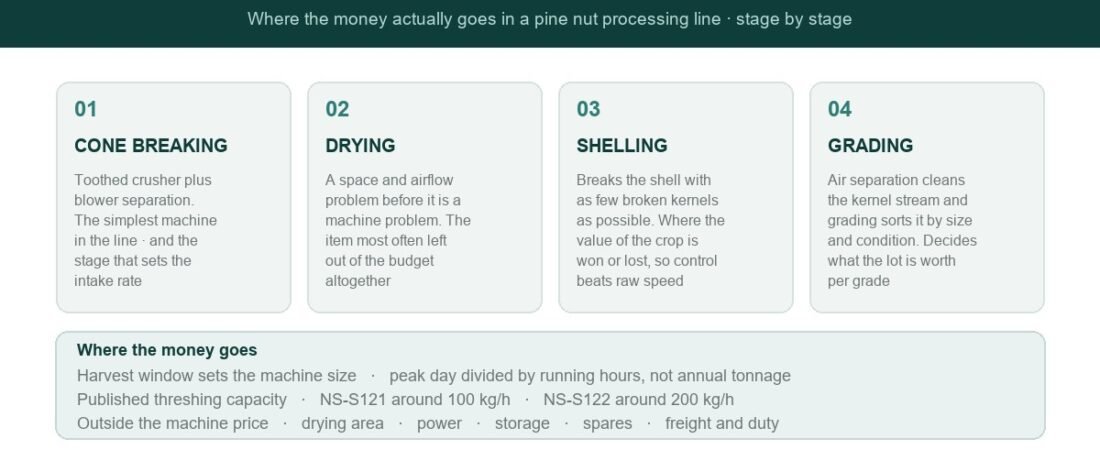
A pine nut processing plant is not a single machine, so it does not have a single price. What a buyer is really paying for is the set of stages they choose to mechanise, plus the drying area, power supply, storage and packing that have to exist around those stages. Two companies can both ask for “a pine nut processing plant” and be buying two different projects.
This page is written for buyers planning that spend: which stage carries most of the budget, which levers genuinely move the number, how to phase the investment across two seasons, and what to put in an enquiry so the quotations you receive can actually be compared. It does not offer a price list, because a price list is the fastest way to make an accurate answer wrong.
Last updated: October 2026
The short answer
- The cost is the sum of stages, not the price of a machine. Cone breaking, drying, shelling, air separation and grading are separate purchases, and you can stop at any of them.
- The harvest window drives more of the price than annual tonnage does. Pine nut harvest is short and compressed, so capacity is bought for a few busy weeks rather than for twelve months.
- Cost concentrates where the machine is hardest to build. Cone breaking is the simplest machine in the line; drying, shelling and grading carry more of the budget.
- The lowest quote is rarely the lowest cost. Freight, duty, spares, power compatibility and technical support sit outside the machine price and arrive after it.
- Kernel yield is the lever that pays for everything else. A line that breaks fewer kernels can cost more and still be the better purchase — and the arithmetic uses your own kernel price, not ours.
- We publish no price list. Cost depends on configuration; we quote from your numbers instead.
What you are buying when you buy a pine nut “plant”
Dongguan Nansheng Technology Co., Ltd. is a manufacturer of nut and coffee processing machinery based in Dongguan, Guangdong Province, China, building macadamia dehusking, cracking and shelling machines, cashew shelling machines, pine nut threshing machines and coffee pulpers. A pine nut plant is assembled from the stages below, and each stage is a separate line in a quotation.
| Stage | What it does | Why it is a budget item |
|---|---|---|
| 1. Cone breaking (threshing) | Opens the cone and separates seed from cone material. The machines in our range use a toothed crusher plus blower separation | Usually the simplest machine in the line, and the stage that fixes the intake rate for everything downstream |
| 2. Drying | Brings the in-shell seed down to a moisture level at which the shell releases the kernel without crushing it | Frequently a building and airflow project rather than a machine purchase — and the most underestimated item on the list |
| 3. Shelling (cracking) | Breaks the shell and releases the kernel with as few broken pieces as possible | Where the value of the crop is won or lost, and where control matters more than raw speed |
| 4. Air separation | Separates shell fragments from kernels after cracking | A small machine with a large effect on how clean the kernel stream is and what grading can achieve |
| 5. Grading and packing | Sorts kernels by size and condition and prepares the lot for storage or sale | Decides what the crop is worth per grade instead of as one mixed batch |
Around those five stages sit costs that never appear on a machine specification sheet: the concrete and roof over the drying area, the incoming power supply and any transformer or generator, storage for in-shell seed and for kernels, the first set of wear parts, freight and import duty, and the labour the line still needs while it is running.
Why pine nut is costed differently from other nuts
The same five stages exist on a macadamia or cashew line, but pine nut changes the weighting of the budget for four structural reasons.
- A high value per kilogram of kernel. The cost of a broken kernel is high, so protection of the kernel is worth paying for. Throughput that damages kernels is a false economy.
- A bulky, low-density raw material. Cones and in-shell seed occupy a great deal of volume for the kernel they contain, so transport, drying space and storage cost more per kilogram of finished product than they do for a denser crop.
- A short, compressed harvest. Cones arrive in a window of weeks. Sizing is therefore driven by the peak day, not by an annual total.
- A delicate kernel. Since the kernel is the product, settings and separation quality matter more than the consumption of power per hour.
The last point is where a pine nut enquiry most often goes wrong. Buyers size the line on annual volume, then discover in the first season that the plant cannot keep up with a peak week, and that the money saved on the machine is paid back in seed that was not dried in time.
Where the budget goes, stage by stage
Buyers usually ask for the percentage split before they ask for a total, because the split shows which decisions actually move the number. The ranges below are a planning guide for a small-to-mid line. They are shares of project spend, not prices, and they overlap: an operation that already owns a drying floor spends nothing on a dryer, while one that has to build that floor moves a large part of the budget into civil works.
| Stage | Typical share of project spend | What moves it |
|---|---|---|
| Cone breaking and threshing | 15-25% | Harvest window, cone size, throughput on peak days |
| Drying | 15-25% | Rack, shed or mechanical drying; airflow and fuel |
| Shelling and cracking | 20-30% | Kernel size, whole-kernel target, drive rating |
| Air separation and grading | 12-20% | Number of grades, aspiration, hand-picking backup |
| Storage, packing and food-safety fit-out | 8-15% | Cold storage, vacuum packing, pest control |
| Freight, duty, installation and commissioning | 8-15% | Packing volume, destination, technician travel |
Read the table as a way to interrogate a quotation, not as a price list. If one stage takes more than half the total, either the scope stops there or the other lines are missing. If a stage you know you need is absent, that cost has not disappeared – it has moved to a line you will pay for separately.
Lever 1 — the harvest window decides how much machine you need
Sizing a line is peak-day arithmetic, not annual arithmetic: take the volume of cones arriving on your busiest day, divide it by the hours you can realistically run the plant, and size each stage against that figure. The method, step by step, is set out in how to size a pine nut processing line.
For scale, the published capacity of the two threshing machines in our range is around 100 kg/h (NS-S121) and around 200 kg/h (NS-S122). Those are published figures for the threshing stage alone, and they are hourly figures — they say nothing about the drying, shelling and grading capacity behind them. A plant is only as fast as its slowest stage, so a decision to buy the larger thresher should only be made after checking that the stages behind it can absorb the output. That check is covered in sizing a pine nut threshing machine.
Lever 2 — how many stages you mechanise now
The largest single decision in the budget is not which model to buy, but how many stages to mechanise in the first purchase. Each stage added to the project adds its own machine, its own space and its own power draw.
| Scale of project | Stages usually mechanised | What it buys | What usually stays manual |
|---|---|---|---|
| Entry / farm scale | Cone breaking, plus sun or low-cost drying | The bottleneck lifted: cones processed the day they arrive | Grading, packing, and much of the transfer between stages |
| Small commercial | Cone breaking, controlled drying, shelling, air separation | Consistent kernel quality and a lot that can be sold as graded product | Final packing, and the least frequent grades |
| Full plant | All five stages, sized so the bottleneck sits where you want it | Predictable output through the peak week without seasonal labour spikes | Supervision, maintenance and quality checks |
The order of mechanisation matters more than the total spend. Mechanise the bottleneck first, not the first stage in the sequence. If cones can be broken quickly but the seed then sits waiting for drying, the money spent on a faster thresher is money spent on a longer queue. The stages that follow threshing are discussed in pine nut drying and shelling settings, and the whole route from cone to packed kernel is mapped in the pine nut processing guide.
Lever 3 — build standard, materials and wear parts
Two machines with the same capacity and the same motor rating can differ substantially in price because of what they are made from and how they are finished.
- Material of construction. Carbon steel with a painted finish is normal for the parts of the line that never touch the product; stainless is used where the product stream, water or cleaning demands it. Buying stainless where it is not needed moves money out of the stages that earn it.
- Contact surfaces and wear parts. The parts that touch cones and seed — crusher elements, screens, blower liners and seals — are consumed by normal operation. A line built with thicker or better-specified contact surfaces costs more up front and less per season.
- Drive and control. A three-phase drive built for continuous duty costs more than a light-duty equivalent, and it is the difference between running through a harvest day and stopping to let the motor cool. Our high-capacity thresher, the NS-S122, is built with a three-phase drive for exactly that reason.
- Finish and protection. Painting specification and surface treatment decide how the machine looks and how it survives in year five, not how it performs in week one. Corrosion protection matters most where the plant is coastal or humid.
Lever 4 — what sits outside the machine price
For most pine nut projects the gap between the cheapest quote and the most expensive one is not in the machines at all. It is in the scope around them.
| Item outside the machine price | Why it appears in the budget | Who normally pays |
|---|---|---|
| Power supply and site wiring | The supply on site has to match the machine’s voltage and phase before it can run | The buyer, unless agreed otherwise; the checks are covered in voltage and power requirements for export |
| Drying area and airflow | Drying is a space and air problem before it is a machine problem | The buyer — and it is the item most often left out of the plan |
| Storage for in-shell seed and kernels | Seed that waits must be stored without spoiling or re-absorbing moisture | The buyer |
| First season of spare parts | Screens, seals and crusher elements are consumed in normal operation | Normally bought with the machine, because a separate shipment costs more |
| Freight, insurance and import duty | These follow the destination and the packing volume, not the machine price | The buyer, or included if the quotation says so |
| Installation, training and commissioning | A line that is assembled correctly performs differently from one that is not | Depends entirely on what the quotation states |
A quotation that names only machines is not a cheaper quotation. It is a shorter one, and the missing items will be paid for later at the buyer’s own risk.
Lever 5 — kernel yield: the number that pays for the plant
Because pine nut kernels are valuable and fragile, the return on a processing plant is driven by recovery, not by hourly throughput. The arithmetic is straightforward and uses your own prices:
1. Take the weight of in-shell seed you expect to process in a season.
2. Apply your realistic kernel recovery rate to get the kilograms of kernel the plant should deliver.
3. Compare that with what your current method recovers. The difference is the extra kernel the new line makes available each season.
4. Multiply that difference by your own kernel price to see the extra revenue per season.
5. Compare that figure against the cost of the stages you are considering — not against the cost of the whole plant at once.
Step 5 is the important one, because it turns an unaffordable project into a sequence. If one stage pays for itself in a season, that stage is the one to buy first, and the next stage can be funded out of the improvement it produced. The same reasoning, applied to a different crop, is set out in what drives the cost of a macadamia processing line.
Why we do not publish a price list
A published price is only useful if the thing it describes is identical for every buyer, and on a processing line it never is. Capacity, material of construction, drive type, the stages included, the destination port and the scope agreed with the buyer all change the number. A figure published for one configuration becomes misleading the moment it is applied to another — and it usually ends up being compared against a quotation that included less work.
What we can do is make the quotation itself comparable: itemised by machine and by scope, with the assumptions written down and the exclusions named. What a quotation should contain, line by line, is set out in what a nut processing machine quotation should contain.
How to compare two quotes for the same capacity fairly
Two quotations that both say “pine nut line, 200 kg/h” can differ by a large margin without either being dishonest. Before comparing totals, check that they are quoting the same thing.
| What to check | Why it changes the price | Question to ask |
|---|---|---|
| Stage list | A quote may cover threshing only, or threshing through grading | Which stages are included, and which are excluded? |
| Material of construction | Stainless contact surfaces cost more and last differently | Which parts are stainless, and which are painted carbon steel? |
| Drive and motor rating | Light-duty and continuous-duty drives are priced differently | Is the drive rated for continuous duty through the harvest? |
| Packing and shipping terms | Packing volume decides freight, and terms decide who pays it | What are the packing volumes, and what are the delivery terms? |
| Spare parts included | A first-season kit can be inside or outside the total | Which wear parts are included, and at what quantity? |
| Installation and training | Support may be by phone, by video or on site | What is included in commissioning and who is trained? |
| Warranty terms and exclusions | Cover differs in start point and exclusions, not only in duration | When does the warranty start, and what is excluded? |
Compare the quotes line by line against that list, and the cheapest total will usually stop looking like the cheapest project.
What to send us for a quotation
Seven numbers and facts are enough for a supplier to answer specifically rather than generally.
| What to send | Why it decides the answer |
|---|---|
| Peak-day volume of cones or in-shell seed | Sizing is done on the busiest day, not the annual total |
| Running hours available per day | Two shifts and one shift need different machines for the same daily volume |
| Condition of the incoming seed (moisture, cleanliness) | It decides how much drying capacity has to sit behind the thresher |
| Stages you want to mechanise now, and which you may add later | Lets a supplier quote a sequence instead of one indivisible project |
| Power supply available on site (voltage, phase, kVA) | A machine that does not match the supply cannot be commissioned |
| Target product and grade | Kernel grading and separation are specified around the final product |
| Destination country and nearest port | Packing volume, freight and duty all follow from it |
Send those, plus a photograph of the seed and any existing equipment in the shed, and the reply can address your line instead of describing a catalogue. The same information is what makes a small-scale project affordable to specify, as set out in small-scale nut processing equipment.
Frequently asked questions
How much does a pine nut processing plant cost?
There is no single figure, because a plant is a sequence of separately priced stages and the scope around them changes the total. The number is built from the stages you mechanise, the materials, the drive ratings, the drying and storage space, the power supply and the freight and duty to your destination. The practical approach is to price one stage at a time, starting with the bottleneck, and to compare quotations line by line.
Which stage of a pine nut line is the most expensive?
It depends on configuration, but the money generally concentrates in the stages that are hardest to build and most critical to quality: drying, shelling and grading, rather than the threshing stage at the front. Cone breaking is mechanically the simplest machine in the line. Drying is frequently a building and airflow problem, and shelling is where kernel breakage is decided, so both tend to attract more of the budget than buyers expect.
Which stage should I mechanise first?
Mechanise the bottleneck, not the first stage in the sequence. If cones can be broken faster than the seed can be dried, a larger thresher simply builds a longer queue, and the money spent on it earns nothing. Work out your peak-day volume, convert it into an hourly requirement for each stage, and then find the stage that is furthest behind. That is the stage whose mechanisation changes the output of the whole line.
Why are two quotations for the same capacity so different?
Usually because the two quotations are not for the same thing. “200 kg/h” may describe one stage or the whole line; it says nothing about material of construction, drive duty rating, whether a first-season spare kit is included, what packing volume and delivery terms apply, or what support is offered. Before comparing totals, compare the stage lists, the materials, the inclusions and the exclusions side by side.
Do I need stainless steel for a pine nut line?
Only where the product stream, water or cleaning routine requires it. Stainless is used for contact surfaces that must resist corrosion or be cleaned to a food-standard routine, while frames, guards and other non-contact parts are often painted carbon steel. Buying stainless on parts that never touch the product moves budget away from the stages that determine output and recovery.
What information should I send to get an accurate quotation?
Send the peak-day volume of cones or in-shell seed, the running hours available per day, the condition of the incoming seed, the stages you want to mechanise now and later, the voltage and phase available on site, the target product and grade, and the destination country with its nearest port. Those seven items let a supplier size the stages against your harvest instead of describing a machine that happens to be in the catalogue.
Request a quote for your pine nut line
Tell us the volume of cones or in-shell seed you handle on your busiest day, the hours you can run the plant, the stages you want to mechanise now and the stages you may add later, the power supply on site, and the destination port. We will tell you which machines in our range fit the first stage, what the stages behind it have to be able to absorb, and how the quotation is built — including what sits outside the machine price so nothing appears later.
Send it through the enquiry form, or email nanshengtechnology@gmail.com. If you are still working out what the line should consist of, start with the pine nut processing guide and how to size a pine nut processing line.
Related reading and machines
- Pine nut processing: the complete guide from cone to packed kernel
- How to size a pine nut processing line
- Pine nut drying and shelling settings
- Sizing a pine nut threshing machine
- Pine nut threshing: cone breakage and cleaning
- Macadamia processing line cost: the five drivers
- What a nut processing machine quotation should contain
- Small-scale nut processing equipment
- Pine nut threshing machine NS-S121, standard
- Pine nut threshing machine NS-S122, high capacity
- Nut processing machines: the full product range
- Knowledge forum: processing guides
- importing a nut processing machine from China: terms, documents and packing
- what drives the cost of a cashew processing line
- calculating the payback period on a nut processing machine
- choosing which nut crop to process
- the seven cost drivers of a nut processing plant