Most people who ask which nut to process are really asking two different questions: which crop makes a machine pay for itself fastest, and which crop can I actually get raw material for. The first question has a structural answer. The second one only you can answer, and it matters more.
This page compares macadamia, cashew, pine nut and coffee as processing businesses on the things that actually differ between them — the stage that eats labour, how long the season runs, where the money leaks, what the byproduct is worth, and which machine you would buy first. It is written by a manufacturer of the machines, so it is deliberately structural: no promises, no price figures, and no claim that one crop is universally better than another.
Last updated: October 2026
The short answer
- Raw material supply decides the crop, not the other way round. A crop you cannot buy consistently is not a business, however good its margins look.
- Season length decides how fast a machine pays back. A machine earns only while there is crop to run through it.
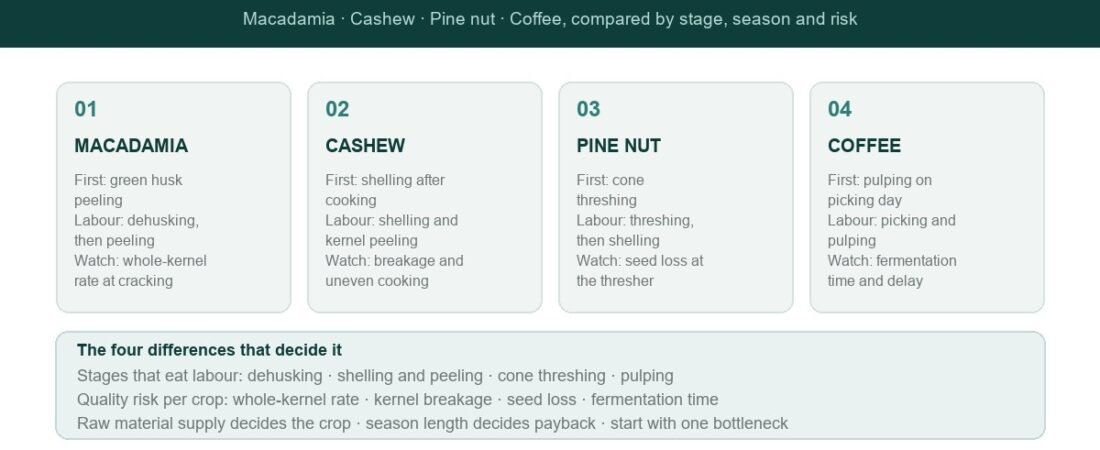
- Each crop has one stage that eats labour. Macadamia is dehusking at the front of the season, cashew is shelling and peeling, pine nut is cone threshing, coffee is pulping on picking day.
- Byproduct value is where the crops differ most. Cashew shell, macadamia husk and shell, and coffee pulp are all potential revenue or a disposal cost, depending on how you set up.
- Quality risk is concentrated in one number per crop. Whole-kernel rate for macadamia, kernel breakage for cashew, seed loss for pine nut, and fermentation time for coffee.
- Start with one crop and one bottleneck. A line built for four crops at once is usually a line that does none of them well.
The five questions that actually decide it
| Question | Why it decides the answer |
|---|---|
| Can you buy the raw material at a workable price, every season? | Volume you cannot source is not capacity; it is an idle machine |
| How many working days is the harvest? | Everything is divided by season length, so a short season lengthens every payback |
| Which stage consumes the most labour today? | That is the stage a machine can pay for; the others cannot |
| What happens to the husk, shell, pulp or parchment now? | A byproduct that costs money to dump is a hidden cost line in every crop |
| Which stage is currently the bottleneck? | Mechanising a stage that is not the constraint moves the queue, not the output |
Notice that four of the five are about your situation rather than about the crop. That is the honest shape of the decision. The crop comparison below only becomes useful once those five are answered.
The four crops side by side
| Macadamia | Cashew | Pine nut | Coffee | |
|---|---|---|---|---|
| What arrives | Nut in green husk | Raw nut in shell | Cones | Cherry |
| First machine stage | Green husk peeling | Shelling (after cooking) | Cone threshing | Pulping |
| Stage that eats labour | Dehusking, then peeling | Shelling and kernel peeling | Threshing and shelling | Picking and pulping |
| Season pattern | Short, a few months | Short, often overlapping heat | Short and geographically narrow | Varies widely by origin |
| Main quality risk | Kernel breakage at cracking | Kernel breakage, uneven cooking | Seed loss and over-drying | Delayed pulping and uneven fermentation |
| Byproduct | Husk, shell | Shell, shell liquid | Cone residue, shell | Pulp, parchment, mucilage |
| Where the price is set | Whole-kernel share | Grade mix | Seed size and count | Green bean quality |
Macadamia: the crop where recovery rate is the whole margin
Macadamia’s distinguishing feature is that the shell is hard and the kernel is valuable, so almost all of the risk sits in one measurement: the share of kernels that come out whole. A line that runs fast and breaks kernels is worth less than a slower line that does not.
Three consequences follow for a new processor.
- Dehusking sits at the very front of the season and sets up everything after. Husk left on the nut transfers moisture back into the shell, so timing matters more than throughput here.
- Drying is a decision, not a delay. Cracking at the wrong moisture is the most common cause of breakage, and it is invisible until the kernels come out.
- The husk and shell are usable. They are not simply a disposal problem, which changes how a site’s layout and handling should be planned.
The machine you buy first is usually a green husk peeler, because it is the stage that must happen within a day of harvest and it is also where a manual crew is most stretched. Cracking comes next, and it is the stage where the whole-kernel rate is won or lost.
Cashew: the crop where labour, not capacity, sets the price
Cashew is different in kind. The shell contains a caustic oil, so raw shelling by hand is unpleasant and slow, and most origins have long traditions of manual shelling and peeling. A cashew machine is therefore rarely bought to do something impossible — it is bought to do the same job with fewer people and with less breakage.
The cashew line also has two stages that other crops do not have at all:
- Cooking, by steam or roasting, before shelling. This conditions the shell so it can be opened without crushing the kernel. It needs fuel, a steam supply and, critically, resting space after cooking.
- Kernel peeling, where the inner skin is removed. This is the most labour-hungry stage in the whole line and the one most often left manual.
The byproduct matters here too: cashew shell liquid is an industrial material, and whether you recover it or pay to have it handled changes the cost per kilogram. None of that is visible on a machine specification sheet, which is why a cashew budget that stops at the sheller usually disappoints.
Pine nut: the crop with a stage nothing else has
Pine nut processing begins with cones, not with nuts, and that single fact creates a stage unique to this crop: threshing, in which the cones are broken apart and the seeds extracted. Cone breakage and cleaning sit here, and losses at this stage cannot be recovered later in the line.
After threshing, pine nut follows a familiar path — drying, then shelling — but with different economics. The seeds are small and high value per kilogram, the crop is geographically concentrated, and the harvest window is narrow. That combination makes the threshing stage the natural first purchase: it is the bottleneck, it is unique to the crop, and it is where the season’s volume is either captured or lost.
Coffee: the crop where the clock starts on picking day
Coffee is not a nut crop, but it behaves like one at the front of the process, and it shares the same buyers of machinery. What makes it distinctive is time pressure: cherries left in a heap ferment unevenly, and uneven fermentation produces off-flavours before the beans ever reach a drying bed.
The stages are pulping (removing skin and pulp), fermentation, drying, and hulling to green bean. Pulping has to happen the same day as picking, which is why the pulper — not the dryer — is normally the first machine a smallholder buys, and why pulping settings matter so much for what the coffee is worth later.
The byproducts are real but demanding: pulp and mucilage are wet, heavy and need somewhere to go. Planning that alongside the machine, rather than afterwards, is the difference between a working wet mill and a muddy problem.
Where the money leaks in each crop
| Crop | The leak | What it looks like in practice |
|---|---|---|
| Macadamia | Kernel breakage | A fast cracker with the wrong setting, or nuts cracked at the wrong moisture |
| Cashew | Breakage plus labour | Uneven cooking, then hand peeling that splits whole kernels into splits |
| Pine nut | Seed loss at threshing | Cones broken too hard, seeds crushed or left behind in the residue |
| Coffee | Fermentation time | Pulping delayed past picking day, or fermentation left to chance |
All four leaks share the same shape: they are process decisions rather than equipment decisions, and each one costs more than the difference between two machines of the same class. That is why the sensible order is to fix the process first and buy the machine second.
A decision sequence you can run in one afternoon
1. List the crops you can actually buy, with the volumes each supplier could realistically deliver at peak.
2. Measure the harvest window in working days for each of those crops, in your area rather than in a textbook.
3. Walk your current process and write down how many people each stage employs on a real day.
4. Find the stage where the people are — that is your first machine, not the stage that looks most modern.
5. Price the whole installation, not the machine: freight, import charges, site work, power and the first wear parts.
6. Run the payback calculation for that one stage before considering a second purchase.
If two crops both survive those six steps, the tie-breaker is season length. The crop with the longer window gives the same machine more earning days, and that usually decides it.
Frequently asked questions
Which nut processing business is the most profitable?
There is no universal answer, because profitability in every one of these crops is set by your raw material cost and your recovery rate rather than by the crop itself. What differs between them is where the risk sits: macadamia and cashew live or die on how many kernels survive intact, pine nut on how many seeds survive threshing, and coffee on how quickly cherries are pulped. Compare crops on those leaks, not on headline prices.
Which nut is the easiest to process?
Judged purely by process length, macadamia is the most compact: dehusk, dry, crack, separate. Cashew adds cooking and resting before shelling and usually a peeling stage after it, and coffee adds fermentation and hulling. “Easiest” is not the same as “best” though, because a shorter process is also a more competitive one, and the crops with more stages often support higher labour arbitrage.
How much money do I need to start a nut processing business?
We deliberately do not publish figures, because the honest number depends on the crop, the configuration, the voltage you need, freight and import charges into your country, and whether you build or rent the space. What we can give you is the specification and packed volume of every machine, so you can build the in-place cost for each option yourself and compare configurations on the same basis.
Can one machine process more than one nut crop?
Sometimes, and usually not in the way buyers hope. A threshing or dehusking machine is generally built for one crop and one seed size, because the gap, the drum and the throughput are all set to that material. Some machines are genuinely multi-material — our pine nut thresher is also used on rice and rapeseed — but nothing in this range is a general-purpose nut machine, and buying on that assumption is a common and expensive mistake.
Which crop has the longest processing season?
It varies far more by origin than by crop, which is why the practical answer is to measure your own window rather than to compare crops in the abstract. As a rule, longer seasons favour expensive machines, because the same capital cost is spread over more earning days. If your chosen crop has a short window, consider whether a second crop or contract work for neighbours can extend the machine’s useful year.
Do I need a different machine for each crop?
For a mixed operation, often yes, and that is not a flaw in the machines — it is what correct sizing looks like. A dehusker set for macadamia will not thresh pine cones, and a coffee pulper has no equivalent job in a nut line. The sensible approach is to mechanise the bottleneck crop first, then add a second machine only when the second crop’s volume can justify its own capital cost.
Next step
Dongguan Nansheng Technology Co., Ltd. builds macadamia dehusking, cracking and shelling machines, cashew shelling machines, pine nut threshing machines and coffee pulpers in Dongguan, Guangdong Province. Because the machine we would recommend depends entirely on the crop and the stage, the useful first message is a short one: which crop, what you currently do by hand, your peak daily volume and your site’s power supply.
Send that through the contact form and we will reply with the configuration that fits the bottleneck, its published figures, and what else the line would need. The full range is listed under nut and coffee processing machines.
Related reading and machines
- Macadamia kernel recovery: how to improve your whole-kernel rate
- Whole kernel rate in macadamia: how to measure and improve it
- Cashew processing: complete guide from raw nut to kernel
- Cashew shelling explained: kernel breakage, steam and resting
- Pine nut processing: complete guide
- Pine nut threshing: cones to seeds efficiently
- Coffee processing: complete guide from cherry to green bean
- Coffee fruit peeling: wet processing basics
- What drives the price of a macadamia processing line
- What drives the cost of a cashew processing line
- What drives the cost of a pine nut processing plant
- Nut processing machine payback period: how to calculate ROI
- Small-scale nut processing equipment: what to buy first
- Macadamia green husk peelers, all models