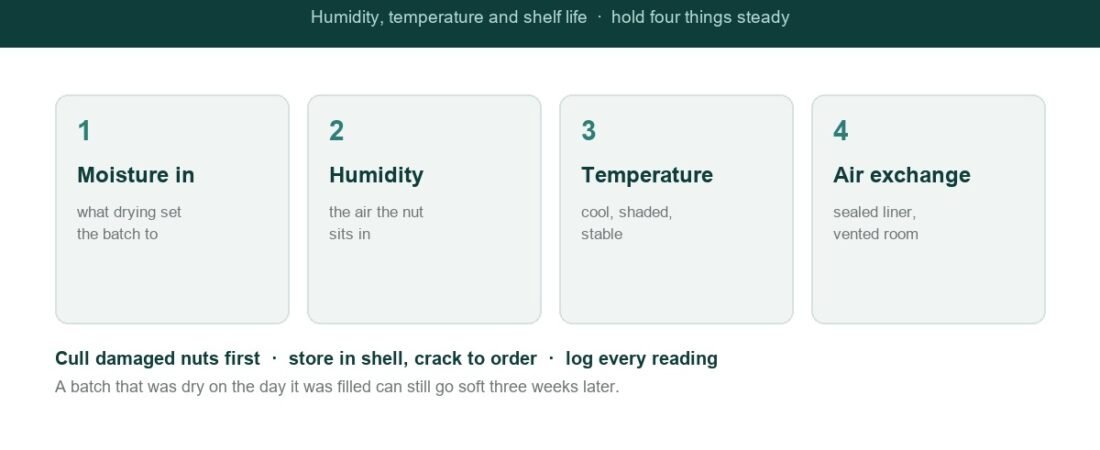
A dried batch of macadamia does not stay dry by itself. Kernel and shell keep exchanging moisture with the air around them, so a store that was correct on the day it was filled can be a store that is slowly ruining the batch three weeks later. Storage is therefore not a room you fill and forget, it is a set of four things held steady: the moisture the nut arrived at, the relative humidity of the air it sits in, the temperature, and how much air and pest pressure it is exposed to. This page covers what to hold steady, how to monitor it, and what to cull before it goes in.
Last updated: 24 September 2026
The short answer
- The moisture you dried to is a starting point, not a guarantee. Kernel and shell re-equilibrate with the air around them. If the store is humid, a correctly dried batch will pick moisture back up.
- Sealed and dry beats cold and open. For most small and mid-size processors, an airtight liner inside a clean, shaded, well-ventilated room holds quality better than a cold room with open pallets.
- Cull before you store. Cracked, chipped and mould-affected nuts are the ones that go off first and take the batch with them, so remove them on the way in, not on the way out.
- Store nut in shell, crack to order. Nut in shell buffers better than kernel against short-term humidity swings, and cracking late keeps the kernel’s storage clock shorter.
- Keep kernel and nut in shell separate. They have different target moistures and different airflow needs. Mixing them in one store means one of them is being stored wrongly.
- Log it or you cannot fix it. Record store temperature, relative humidity and a moisture reading on a fixed schedule, plus every re-drying event. Without a log, a soft batch becomes a guess.
Why a dried batch goes soft again
Drying is not a one-way door. Water moves between any two materials that can hold it, in the direction of the drier one, until both are at the same moisture. A macadamia kernel at 1.5% moisture sitting in air at 75% relative humidity is drier than that air, so it takes moisture in. The shell does the same, and once the shell picks up water, the kernel beside it follows over time.
This is why two processors can dry to the same number and get different shelf lives. The one who packs into an airtight liner the same day holds the number. The one who leaves the batch in an open bin in a humid shed loses it, and finds out in a later quality check that looks unrelated to drying.
The practical consequence is simple: treat drying and storage as one continuous job. Drying sets the number, storage defends it. Buying a dryer and skipping the store is paying for half a solution.
The four numbers to hold steady
| Factor | What it does | What commercial practice works to | How it fails |
|---|---|---|---|
| Kernel moisture on the way in | Sets the starting point for everything after | The same target your buyer’s specification names; our drying guidance uses 1.5% for kernel | Dried unevenly, so the average looks right while part of the batch is wet |
| Relative humidity of the storage air | Decides which way moisture moves | Dry, stable air; avoid a store that swings with the weather | A shed that is humid at night and hot at midday pumps moisture in and out daily |
| Temperature | Faster chemistry at higher temperature; faster quality loss with it | Cool, shaded, stable; keep the daily swing small | Metal-roofed store in full sun, which bakes the top of the stack every afternoon |
| Air exchange and headspace | Oxygen drives oxidation, and free air carries moisture and insects | Airtight liner where the batch is held, plus ventilation for the room itself | Sealed bags that were filled while the batch was still warm, so condensation forms inside |
Read that table as a set of targets to confirm against your own buyer’s specification rather than as fixed numbers that suit every market. What matters more than the exact figure is that each one is measured, written down and stable. A store that holds a slightly higher target steadily outperforms one that swings across a wide range around a better target.
Nut in shell or kernel: store which
This is the first decision, and it changes everything downstream.
- Nut in shell is the better thing to hold if your store is not perfect. The shell is a buffer, moisture moves slowly through it, and the kernel inside is protected from physical damage and from air. It also means you crack against demand, so kernel is only exposed to storage conditions for a short time.
- Kernel is the better thing to hold if you have genuinely controlled conditions and quality is already guaranteed, because you have already paid the labour to crack it and you can deliver straight from stock.
Most processors we quote do both, and get it wrong by putting the two in the same room. Separate them. Kernel wants very dry, very stable, ideally airtight storage. Nut in shell tolerates more airflow and more room to breathe.
Where storage sits in the line
Storage is not an afterthought bolted onto the end of a processing line, it is the buffer that decides how hard every other machine has to work. A store that can hold a month of dried nut in shell lets you run one shift at a steady rate instead of chasing harvest peaks, which is a large part of why processors who add storage first report lower cost per tonne than processors who add capacity first.
The sequence is the same one described in our macadamia processing line layout guide: harvest, dehusk, dry, store in shell, crack, separate, grade, pack. Storage sits between drying and cracking, and it is the stage most often left out when a line is built in stages.
What to cull before the store goes in
This step takes minutes and saves batches:
- Cracked and chipped nuts. A damaged shell lets air and moisture straight to the kernel, so these nuts age faster than the rest and act as a starting point for mould.
- Green or immature nuts. They carry more water than the rest of the batch and will pull the store’s humidity up around them.
- Foreign matter. Stones damage cracking equipment later; plant material carries moisture and insects.
- Anything already showing mould. Do not store a problem hoping it stays contained. Remove it, and find out why it happened.
If you are seeing a high proportion of cracked or damaged nuts at this stage, the cause is usually upstream. Our guide to green husk peeling covers the husking settings that damage shell, and kernel recovery covers the moisture window where most loss is created.
Setting up the store itself
- Line the container, not just the bag. Airtight liners inside bulk bags or drums do more for shelf life than any change in the room.
- Keep stacks off the floor and away from walls. Air has to move around the stack, and a stack against a cold wall condenses moisture on that side.
- Shade and insulate the roof. The largest temperature swing in most stores is the roof in the afternoon. That is fixable with insulation and ventilation, without buying refrigeration.
- One batch, one label. Date, moisture reading, source block, quantity. First in, first out, physically, by stacking the oldest in front.
- Separate the kernel store from the nut in shell store, and separate both from workshop dust and from any chemical storage.
- Keep pests out with building discipline, not with treatment inside the batch. Sealed liners, clean floors, no standing water, nothing edible stored nearby.
How to monitor it
- Sample the same way every time. A reading taken from the top of the stack is not the same as one taken from the centre. Decide on a method, then never change it, so readings stay comparable.
- Read at a fixed hour. Humidity rises at night in most stores. A morning and an afternoon reading tells you the daily swing, which is the number that damages quality.
- Log: date, batch, store temperature, relative humidity, moisture reading, action taken. This is the record that turns a quality complaint into something you can answer with evidence.
- Decide the re-dry trigger in advance. Write down the moisture at which a batch leaves the store and goes back through the dryer. Deciding during a panic is how batches get ruined.
Five mistakes that show up again and again
- Drying to target and then storing in an open bin in a shed with a metal roof.
- Sealing bags while the batch is still warm, so the water that evaporates inside has nowhere to go.
- Mixing kernel and nut in shell in one store because there was only one room.
- Using the shell moisture reading as if it were the kernel reading. They equilibrate, but they are not the same number on the same day.
- Storing a batch that was never uniform, then sampling only the good part of it.
Frequently asked questions
How long can dried macadamia be stored?
There is no single answer, because storage life is a function of moisture, temperature, oxygen exposure and how much physical damage the batch already has. What commercial practice shows is the shape of the answer: a correctly dried, well-sealed batch in a cool stable store holds quality far longer than the same batch in an open humid shed, and kernel has a shorter useful window than nut in shell. Set your own verification protocol with the quality team or buyer you supply, and test before you commit a whole season to one assumption.
Should I store macadamia in shell or as kernel?
Store nut in shell when your store is not tightly controlled, when you want to crack against orders, or when the batch will be held for more than a short time. Store kernel when you have genuinely stable, sealed conditions and can move stock quickly. Many processors hold most volume in shell and a smaller working stock as kernel.
What moisture should dried macadamia be stored at?
Use the target named in your buyer’s specification as the authority. Our own drying guidance works to 1.5% for kernel. The more important discipline is evenness: a batch whose centre and edges read differently is a batch that will behave unpredictably, even when the average reads correctly.
Can soft kernel be re-dried?
Yes, and the earlier the better. Re-drying brings moisture back down, but it will not undo oxidation or mould that has already started. Treat soft kernel as a signal that the store is failing, and fix the store before re-drying, otherwise the batch returns to the same conditions.
Why does kernel go rancid inside a sealed bag?
Sealing removes air exchange, which is good, but it does not remove the oxygen already trapped with the kernel, nor the moisture inside a batch that was sealed while warm. Rancidity follows from temperature, oxygen and time, so a sealed bag stored hot still ages, just more quietly.
Tell us your storage setup and we will tell you what to change
If you already process macadamia and want a second opinion on where quality is being lost, describe the four things this page is about, and we will answer with specifics rather than a brochure. Tell us what you process (macadamia, cashew, pine nut, coffee cherry, other nuts), your target output per hour or per day, your power supply (220 V single phase or 380 V three phase), and your destination port or country.
Minimum order quantity is one unit. OEM branding and customisation are available on request, and specifications are confirmed in writing before production. Dongguan Nansheng Technology Co., Ltd., Dongguan, Guangdong, China. Request a quotation or browse the full machine range.
Related reading and machines
- Nut in shell moisture content: the drying target before cracking
- Macadamia processing line layout: harvest to packed kernel
- Green husk peeling: timing, loss rates and settings
- Macadamia nut shelling machine – standard (NS-X221, 600 kg/h)
- Macadamia nut shelling machine – heavy duty (NS-X222, 200 kg/h, stainless)
- Macadamia green husk peeler – medium (NS-X123, 300 kg/h)
- All macadamia green husk peelers
- Nut processing knowledge base
Related reading: what drives the price of a macadamia processing line and whole kernel rate: how to measure and improve it.