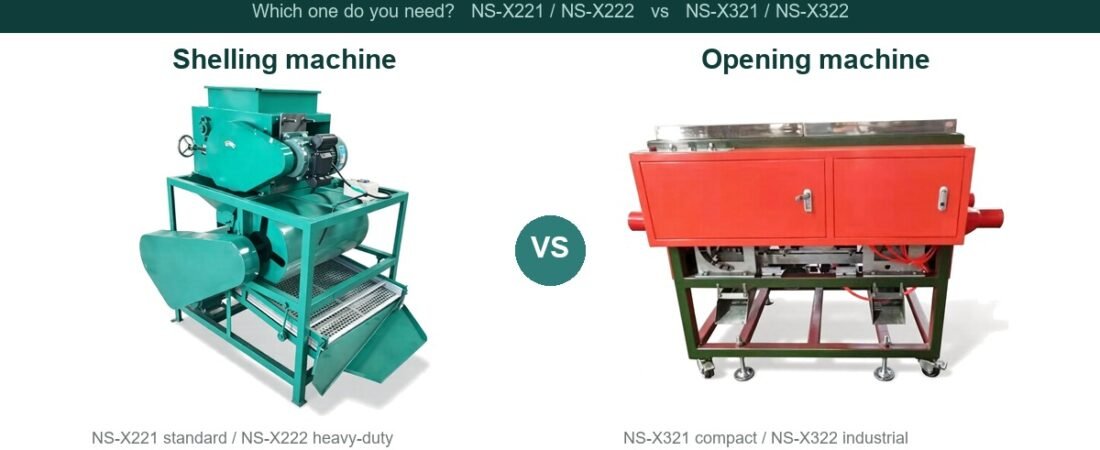
Both machines separate kernel from shell, but they are built for different products. A shelling machine cracks the shell and separates kernel from shell in a single pass at high capacity — that is how bulk kernel is produced. An opening machine cuts a controlled slot into the shell with a saw so the kernel comes out whole — that is how macadamia is prepared when it is sold opened, or in the shell, as a premium product. If your business sells kernel in bulk, you want shelling. If your business sells opened macadamia to retail or to food manufacturers, you want opening. Many processors run both.
Last updated: 21 September 2026
- Shelling — impact cracking plus kernel/shell separation in one pass. NS-X221 is rated ~600 kg/h in a carbon-steel benchtop unit; NS-X222 is a ~200 kg/h fully automatic stainless-steel line.
- Opening — a saw cuts a slot instead of crushing, so the kernel stays whole. NS-X321 opens ~50 kg/h as a compact single unit; NS-X322 opens ~150 kg/h with adjustable opening angle and diameter.
- Choose by what you sell first, then by throughput, then by who will feed the machine.
- Not sure which fits your crop and volume? Send the crop, target throughput, supply voltage and destination port and we will recommend a model rather than a range.
The short answer
| Shelling machine | Opening machine | |
|---|---|---|
| What it does to the shell | Cracks it by impact | Cuts a slot with a saw |
| Kernel outcome | Some breakage is normal; whole-kernel share depends on crop, moisture and gap setting | Kernel stays whole by design |
| Typical capacity in our range | ~200–600 kg/h | ~50–150 kg/h |
| What the customer sells | Bulk kernel, kernel for further processing | Opened macadamia for retail, chocolate, bakery |
| Automation | Benchtop single unit, or fully automatic stainless line | Compact single unit, or automated production machine |
| Main cost drivers | Capacity, drive size, steel grade | Saw assembly, adjustable opening geometry, drive size |
| Models in our range | NS-X221, NS-X222 | NS-X321, NS-X322 |
“Shelling”, “cracking” and “opening” — the words buyers use loosely
In the trade, shelling, cracking, de-shelling and kernel extraction are usually the same operation: the shell is hit hard enough to break and the kernel is separated from the pieces. Opening is a different operation. It is a sawing step that produces a whole kernel inside a slotted shell, which is what a buyer of opened macadamia is paying for. So when a supplier quotes a “macadamia shelling machine” they normally mean the impact cracker, and when they quote an “opening machine” they mean the saw-slot machine. We use those two names for the rest of this page.
What a shelling machine does
A shelling machine breaks the shell and drops the kernel through a separation stage in the same pass. Capacity is high because the action is a crack, not a cut. The trade-off is breakage: cracking machines always produce some broken kernel, and the exact share depends on the crop, its moisture content and the gap setting. We tune the machine on your sample and tell you the expected whole-kernel recovery before you order.
| Model | Capacity | Power supply | Dimensions (L × W × H) | Net weight | Body |
|---|---|---|---|---|---|
| NS-X221 | ~600 kg/h | 3 kW + 1 kW, 220 V | 1,350 × 1,000 × 1,300 mm | ~250 kg | Carbon steel |
| NS-X222 | ~200 kg/h | Confirmed on your quotation | 1,150 × 990 × 1,370 mm | ~390 kg | Stainless steel |
The NS-X221 is a general-purpose hard-shell cracker: it also handles jujube kernels, apricot kernels, cherry kernels, peach kernels and hazelnut, which makes it a sensible choice for a workshop that runs more than one crop. The NS-X222 is the opposite trade: lower throughput, stainless steel, and continuous automatic feeding and discharging, so one operator can supervise it and do something else at the same time. Both are listed on our macadamia shelling machines page.
What an opening machine does
An opening machine does not crush the shell. It cuts a controlled slot with an arc-shaped saw so the kernel inside stays intact. That is the standard method when the nut is sold opened, or when the kernel is destined for chocolate, confectionery or bakery use where a broken kernel is not acceptable.
| Model | Capacity | Power supply | Dimensions (L × W × H) | Net weight | Adjustable |
|---|---|---|---|---|---|
| NS-X321 | ~50 kg/h | Confirmed on your quotation | 1,200 × 700 × 1,100 mm | ~250 kg | Fixed saw geometry, single unit |
| NS-X322 | ~150 kg/h | 6 kW, 380 V | 1,850 × 1,200 × 1,180 mm | ~470 kg | Opening angle and opening diameter |
The NS-X322 is the one to look at if your nut sizes change through the season: both the opening angle and the opening diameter are adjustable, so one machine can be set for different sizes and different slot depths. Both models are on our macadamia opening machines page.
Decide in three questions
1. What do you actually sell?
This decides the answer on its own in most enquiries. Bulk kernel, or kernel that goes straight into further processing, is a shelling job. Opened macadamia sold to retail, gift packs, chocolate or bakery customers is an opening job. If you do both, you run both.
2. How many kg/h do you need on your biggest day?
Not your annual average — your peak intake day, divided by the hours you are willing to run. A machine rated above your peak day gives you margin for a wetter crop or a harder variety; a machine rated at your average will not.
3. Who feeds the machine?
The NS-X321 is an electric single unit: the operator feeds nuts and the machine slots each one, which is normal for a sample room or a shop. If one operator has to run the line and do other work as well, the automatic options change the labour equation far more than the hourly capacity figure does.
You need a shelling machine if…
- You sell kernel in bulk, or kernel that is graded and packed for further processing.
- Your intake is measured in tonnes per day rather than kilograms.
- You process more than one crop — the NS-X221 also cracks jujube, apricot, cherry and peach kernels.
- You need the machine to keep running with minimal attention — the NS-X222 is fully automatic and stainless.
You need an opening machine if…
- Your product is opened macadamia: the nut is sold with the kernel whole inside a slotted shell.
- Your customer is a chocolate, confectionery or bakery manufacturer who will not accept broken kernel.
- Your nut sizes change and you need the slot depth and diameter adjusted rather than fixed.
- Your volumes are modest and precise — 50 kg/h in a small unit, or 150 kg/h on the production machine.
Running both: the two-stage layout
Shelling and opening are not competitors in a full line; they sit at different points. Green husk peeling happens at intake, the nut is then dried, and only after drying does cracking or opening make sense. A processor who sells both bulk kernel and opened retail packs will typically run an opening machine for the retail-grade sizes and a shelling machine for everything else. The sequence and the sizing of each stage is covered in macadamia processing line layout: harvest to packed kernel, and the drying step that has to happen first is in nut in shell moisture content.
Sizing the machine to your peak day
Three worked examples, using the published capacity figures above.
- 3 t of nut in shell on your biggest day, one 8-hour shift: you need about 375 kg/h. That is inside the NS-X221’s ~600 kg/h rating, but above the NS-X222’s ~200 kg/h. Treat the rated figure as a design number and keep margin for a harder variety.
- 1 t on your biggest day, one 8-hour shift: you need about 125 kg/h, so the NS-X222 at ~200 kg/h covers it with margin and runs without an operator feeding it.
- Opened macadamia: the NS-X322 at ~150 kg/h covers about 1.2 t in an 8-hour shift. If your opened volume is below that, the NS-X321 at ~50 kg/h is the small-batch answer.
Common mistakes when choosing between the two
- Buying an opening machine for bulk kernel production. The kernel quality is excellent, but ~50–150 kg/h is not a tonne-per-shift operation.
- Buying a shelling machine for premium opened macadamia. Cracking always breaks some kernel; if the product is a whole kernel in the shell, that is the wrong process.
- Sizing on the annual average instead of the peak day, then running out of capacity every harvest.
- Confirming the voltage after ordering. Supply voltage decides how the machine is built and tested, so confirm it before production starts.
- Ignoring freight volume. Packed volumes differ a lot between models — 1.00 CBM for the NS-X321 against 2.70 CBM for the NS-X322 — and that shows up in the shipping cost.
Frequently asked questions
Is a shelling machine the same as a cracking machine?
In practice, yes. Shelling, cracking and de-shelling all describe the same impact-cracking step that breaks the shell and separates the kernel. Opening is the different operation, because it saws a slot and keeps the kernel whole.
Will an opening machine break fewer kernels?
Yes, by design. An opening machine cuts the shell instead of crushing it, so the kernel comes out intact. Some loss is still unavoidable, which is why we set the machine on your sample and tell you the expected whole-kernel rate before you order.
Can one machine both shell and open macadamia?
No. They are different mechanisms: one cracks by impact, the other cuts with a saw. If you sell both bulk kernel and opened product, the usual answer is one machine of each.
Which machine do I need for macadamia sold in the shell?
Neither. If the nut is sold in the shell, the shell has to stay intact, so the work is green husk peeling and drying, not cracking or opening. See green husk peeling: timing, loss rates and settings for that stage.
What information do you need to recommend a model?
Four things: the crop, the throughput you need in kg/h, the supply voltage at your site, and the country or port the machine will ship to. With those we can name one model instead of a range. Every specification is confirmed in writing before production.
Tell us the crop, the throughput you need in kg/h, the supply voltage at your site and the port you will ship to, and we will recommend one model instead of a range — or request a quote. Minimum order is one unit, OEM builds are available, and we reply within one business day.
Related machines
- Macadamia shelling machines — NS-X221 and NS-X222
- Macadamia opening machines — NS-X321 and NS-X322
- All nut and coffee processing machines — with the model, capacity and power table
Related reading and machines
- How to choose a macadamia cracking machine: 7 specs that matter
- Whole kernel rate: how to measure it and what actually improves it
- How to improve macadamia kernel recovery
- Macadamia processing line layout: harvest to packed kernel
- All nut processing guides
- What drives the price of a macadamia processing line, and why two quotes differ