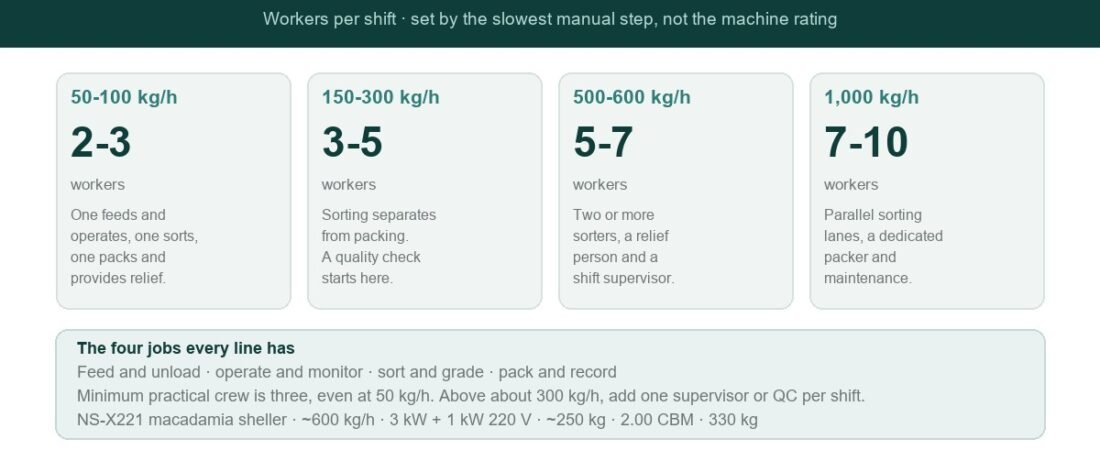
The number of nut processing line workers a plant needs is usually decided by the sorting table, not by the machine nameplate. A 600 kg/h sheller can be fed and watched by two people, but the kernels coming out of it may need three or four pairs of hands before they are packed. That is why two lines with the same rated capacity can run with five people or with ten.
This guide gives planning ranges by capacity band, a worked example for a 600 kg/h macadamia line, the four jobs every line has, and a six-step method for calculating your own crew. The ranges assume a single shift, semi-automatic equipment, manual sorting and bagging on site. They are planning figures, not a quotation.
Last updated: October 2026
The short answer
For a single-shift, semi-automatic nut processing line that includes manual sorting and bagging, plan for:
- 50 to 100 kg/h: 2 to 3 workers per shift.
- 150 to 300 kg/h: 3 to 5 workers per shift.
- 500 to 600 kg/h: 5 to 7 workers per shift.
- 1,000 kg/h: 7 to 10 workers per shift.
Add one supervisor or quality controller per shift once the line is above roughly 300 kg/h, and plan for maintenance cover separately. A practical minimum crew for any line is three: one person feeding, one operating and checking the machine, and one sorting or packing. A single operator is possible at the smallest capacity, but only by accepting slower sorting and no cover for breaks.
The rest of this page explains where those numbers come from, because the right answer for your plant depends on what your customers expect the kernels to look like.
Headcount follows the slowest manual step
Machine capacity is measured in kilograms per hour. People are measured in decisions per minute. Those two units do not scale together.
A sheller rated at 1,000 kg/h does not need twenty workers. It needs enough people to keep the hopper full, watch the machine for jams and voltage faults, take the output away before it backs up, sort it to the grade the buyer asked for, and pack it with a traceable lot number. The machine sets the pace; the manual steps set the headcount.
This is why a plant that buys a larger machine and keeps the same sorting crew often sees its bottleneck move rather than disappear. The sheller runs faster for part of the day, then sits idle while the sorting table catches up. If the goal is throughput, the sorting and packing side has to be sized at the same time as the machine.
The four jobs on every nut processing line
Almost every line, whether it is macadamia, cashew, pine nut or coffee, contains the same four kinds of work. The names change; the staffing logic does not.
1. Feed and unload. Someone has to bring nuts to the hopper, keep the feed steady, remove foreign matter, and take finished bags away. This job scales with tonnes moved, not with the number of machines.
2. Operate and monitor. Someone has to start and stop the machine, watch for jams, check the crack or shelling result, and record settings. This job scales with the number of machines and how often they need intervention.
3. Sort and grade. Someone has to separate whole kernels from broken, shell from kernel, and grade from grade. This is usually the largest manual job on the line, and the one most often underestimated.
4. Pack and record. Someone has to weigh, bag, label, seal and record the lot. This job scales with bags per hour and with the traceability your buyer requires.
| Job | What it scales with | Typical share of the crew | Can it be automated? |
|---|---|---|---|
| Feed and unload | Tonnes per hour and distance moved | 1 person on most lines | Partly, with a hopper, conveyor or loader |
| Operate and monitor | Number of machines and intervention frequency | 1 person per one to three machines | Partly, with sensors and PLC control |
| Sort and grade | Kernel kg/h and the defect standard | The largest share above 300 kg/h | Yes, with optical sorting, at a significant cost |
| Pack and record | Bags per hour and traceability requirements | 1 person on most lines | Partly, with weighing and bagging equipment |
Staffing by capacity band
The capacity bands below use the rated feed of the main machine as a reference. They assume one shift, manual sorting, and bagging on site. They do not include management, security, maintenance or laboratory staff.
| Line capacity | Example equipment from the catalogue | Crew per shift | What changes at this level |
|---|---|---|---|
| 50 to 100 kg/h | NS-Y121 cashew sheller at about 50 kg/h; NS-X321 macadamia opener at about 50 kg/h; NS-S121 pine nut thresher at about 100 kg/h | 2 to 3 | One person feeds and operates, one sorts, one packs and provides relief |
| 150 to 300 kg/h | NS-X121 husker at about 150 kg/h; NS-X322 opener at about 150 kg/h; NS-S122 thresher at about 200 kg/h; NS-X222 sheller at about 200 kg/h; NS-X123 husker at 300 kg/h | 3 to 5 | Sorting separates from packing, and a quality check starts |
| 500 to 600 kg/h | NS-X122 husker at about 500 kg/h; NS-X221 sheller at about 600 kg/h | 5 to 7 | Two or more sorters, a relief person, and a shift supervisor |
| 1,000 kg/h | NS-X124 husker at 1,000 kg/h | 7 to 10 | Parallel sorting lanes, a dedicated packer, and maintenance on site |
Two cautions before you use this table. First, the rated capacity of a husker, sheller or thresher refers to what goes into the machine, not what comes out as saleable kernel. Second, the crew size assumes the product is sorted by hand. If you add an optical sorter, the sorting number falls; if your buyer wants a tighter defect standard, it rises.
A worked example: a 600 kg/h macadamia shelling line
Take a line built around the NS-X221 macadamia sheller. The catalogue rating is about 600 kg/h, with 3 kW + 1 kW and 220 V, a machine weight of about 250 kg, and a packing volume of 2.00 CBM at about 330 kg. Those are machine facts. The crew is a separate calculation.
Assume the in-shell feed runs at the rated 600 kg/h and the kernel recovery is around 30%. That produces roughly 180 kg/h of kernel. Now measure the sorting step: if one sorter can inspect about 60 kg/h of kernel to your standard, you need about three sorters. Add one feeder, one sheller operator, one packer and one relief person, and the shift crew is about seven.
| Task | People | Basis |
|---|---|---|
| Feed the sheller | 1 | Keep the hopper full and remove foreign matter |
| Operate and monitor | 1 | Watch the crack, clear jams, record settings |
| Sort and grade | 3 | About 180 kg/h of kernel at about 60 kg/h per sorter |
| Pack and record | 1 | Weigh, bag, label and record the lot |
| Relief and breaks | 1 | Cover for breaks, absence and startup |
| Total | 7 | Single shift, manual sorting |
If the same line runs two shifts, the operating crew roughly doubles to fourteen, with one supervisor per shift. Maintenance does not double in the same way: one mechanic or a contracted service can usually cover both shifts, provided the line has a planned maintenance window. If an optical sorter replaces manual sorting, the three sorters can fall to one operator, taking the crew to about five, but the capital cost and the maintenance skill requirement rise.
Sorting is the hidden headcount
Sorting is where most staffing estimates go wrong, because it looks like unskilled work that can be absorbed by whoever is free. In practice it is the step that decides the value of the whole lot. A broken kernel and a whole kernel can leave the same sheller at the same moment; the difference in what the buyer pays is created at the sorting table.
Three things drive sorting headcount:
- The defect standard. Removing shell and foreign matter is a different job from grading whole kernels into size bands. The second takes longer and needs more training.
- The number of passes. A single final sort is cheaper in labour than a pre-sort plus a final sort, but it puts more pressure on the final table and raises the risk of a missed defect.
- The product mix. If you sell whole kernel, broken and shell as separate streams, someone has to keep those streams separate all the way to the bag.
This is the point where manual and machine sorting should be compared on total cost, not on the price of the sorter alone. The comparison is set out in sorting kernels: manual versus machine grading. For a small line, manual sorting is usually the right answer. For a line running several hundred kilograms of kernel per hour to a premium standard, the labour saving can justify a sorting machine, but only after the rest of the line is stable.
What automation actually changes
Automation rarely removes the need for people. It moves them from handling product to watching equipment, checking quality and maintaining sensors. The net effect on headcount depends on which task is automated.
| Automation | Effect on the crew | Where it makes sense |
|---|---|---|
| Feed hopper and conveyor | Removes one feeder, steadies the feed | Almost any line above 150 kg/h |
| Optical sorter | Replaces two to three manual sorters with one operator | High-volume lines with a demanding grade standard |
| Automatic weighing and bagging | Removes one packer, raises the maintenance skill needed | Lines running many bags per shift |
| PLC monitoring and alarms | Does not cut the crew directly; reduces scrap and downtime | Lines with repeatable settings and trained operators |
The practical rule is that automation should be aimed at the bottleneck. Adding a faster sheller to a line with a manual sorting table does not raise output; it raises the size of the pile in front of the sorters. Adding a sorting machine to a line that cannot keep the sheller fed does not help either. The capacity chart in nut processing machine capacity and power is useful here, because it lets you compare rated feed across models before you decide where the extra money should go.
Shifts, supervision and relief
A staffing plan that works for one eight-hour shift does not automatically work for two. The operating crew doubles, but supervision, maintenance and quality control have to be arranged deliberately.
- Relief factor. Plan for about 15% to 25% extra operating hours to cover breaks, holidays, sickness and startup. On a seven-person crew, that is roughly one extra person, not a full second team.
- Supervision. Below 300 kg/h, the owner or line leader can usually supervise and operate. Above that, a dedicated supervisor or quality controller per shift is worth the cost, because the decisions at the sorting table need a consistent standard.
- Maintenance. One mechanic or a contracted service is usually enough for a single line, provided spares are held on site. The maintenance checklist in nut processing machine maintenance checklist is a starting point for the schedule.
- Cross-training. At least two people should be able to run each critical machine. If only one person can start the sheller, every absence becomes a stopped line.
How to calculate your own crew in six steps
The ranges on this page are a starting point. To get a number you can defend to a bank or an investor, work through the line in the order the product moves.
1. Draw the process map. List every step from receiving to pallet: husking, drying, shelling or threshing, sorting, packing. Mark which steps are machines and which are manual.
2. Write down the rated feed and the unit. A 600 kg/h sheller is rated in in-shell kilograms. A 200 kg/h thresher may be rated in cones or in nut. Mixing units is the most common source of a bad staffing estimate.
3. Convert to the unit your people handle. If the bottleneck is sorting, convert the machine output to kernel kg/h using your own recovery figure. If the bottleneck is packing, convert to bags per hour.
4. Time each manual task. Run a ten-minute timed sample three times on a normal day, and average the result. Do not use a vendor’s best-case figure or a number from another plant.
5. Add relief and supervision. Add 15% to 25% for relief, then add one supervisor or quality controller per shift if the line is above about 300 kg/h.
6. Test before you hire permanently. Run the line for a week with a temporary crew and record where the queue forms. Adjust the crew to the queue, not to the org chart.
Staffing mistakes that cost more than wages
- One person watching two machines that both need intervention. The saving is visible in the payroll; the loss is invisible in downtime and lost recovery.
- No relief. A line that stops for every break loses more output than the relief person costs.
- No quality check. A rejected container costs more than a season of quality control wages.
- Hiring before commissioning. The crew learns bad settings from a line that is not yet stable. Commission first, then standardise the jobs.
- Staffing the machine instead of the bottleneck. The machine is the easy number to count; the sorting table is the number that decides output.
What to put in your staffing plan before you order
A useful staffing plan is short, but it should cover:
- An organisation chart for one shift and for the shift pattern you intend to run.
- Job descriptions for feeding, operating, sorting, packing and quality control.
- A training matrix showing who can run which machine and who can cover whom.
- Labour cost per tonne of finished product, calculated with your own wage rates and relief factor.
- A contingency plan for illness, harvest peaks and machine breakdowns.
The labour line belongs in the same model as the machine and the building. Nut processing machine payback period shows how to combine capital, labour and throughput into a payback calculation, and nut processing plant cost sets out the other cost lines that are easy to miss. If you are still choosing the scale of the line, small-scale nut processing equipment starts from the farm-scale end, while macadamia processing line layout shows how the physical flow affects how many people can work without interfering with each other.
Frequently asked questions
How many workers does a nut processing line need per shift?
A single-shift, semi-automatic line with manual sorting usually needs 2 to 3 workers at 50 to 100 kg/h, 3 to 5 at 150 to 300 kg/h, 5 to 7 at 500 to 600 kg/h, and 7 to 10 at 1,000 kg/h. Add one supervisor or quality controller per shift above about 300 kg/h, and plan maintenance separately.
Can one person run a nut processing line?
Only at the smallest capacity, and only with trade-offs. One person can feed, start and stop a 50 kg/h machine, but sorting and packing will be slower, and there is no cover for breaks or absence. For anything above about 100 kg/h, a crew of at least three is the practical minimum.
Does automation reduce the number of workers?
It changes what they do more than how many there are. A feed conveyor can remove one feeder and an optical sorter can replace two or three manual sorters, but both add maintenance and operator skill requirements. Automation works best when it is aimed at the bottleneck, not added to the whole line at once.
How many workers does a 500 kg/h macadamia line need?
Plan for about 5 to 7 per shift. The exact number depends on kernel recovery, the sorting standard and how many passes the product makes. At around 30% recovery, a 500 kg/h in-shell feed produces about 150 kg/h of kernel, which is enough to keep two or three sorters busy.
Do I need a supervisor or quality controller?
Above roughly 300 kg/h, yes. The sorting table needs a consistent standard, and the person running the machine cannot also judge every grade decision. On smaller lines, the owner or line leader can cover the role, provided the standard is written down and checked.
What is the biggest staffing mistake?
Staffing the machine instead of the sorting table. A line can have a perfectly sized sheller and still lose money because the kernels are not sorted fast enough or consistently enough. Measure the manual steps first, then size the crew around the slowest one.
Next step
If you are planning a line, send us the nut, the capacity you need and the grade standard you sell to. We will help you map the process and check which machine combination fits the crew you can realistically run. Start with the product range or send the details through the contact form. The NS-X221 macadamia sheller used in the worked example is listed at macadamia nut shelling machine – standard.