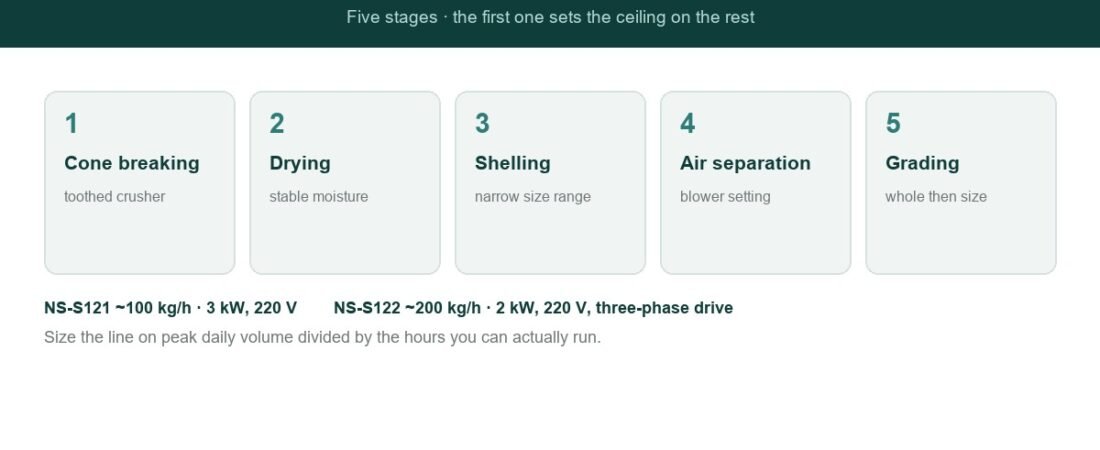
A pine nut processing line is shorter than most people expect and more sensitive than most people plan for. Cones are broken to release seed, seed is dried to a stable moisture, the shell is cracked and separated from the kernel by air, and the kernel is graded and packed. Every stage is a preparation for the next one, and the machine that does the first job – threshing cones into seed – sets the ceiling on what the rest of the line can achieve. This guide walks the whole flow, gives the published figures for the two threshing machines we build, and shows the arithmetic that tells you which one fits.
Last updated: 26 September 2026
The short answer
- The line is five jobs, not one. Cone breaking, drying, shelling, separation and grading. Each one has its own failure mode.
- Threshing comes first and it is where the design choice is made. A toothed crusher plus blower separation is the arrangement our machines use, and it decides how much seed you recover and how much kernel you break.
- Moisture is the variable that links the stages. Seed that goes to the sheller outside its working moisture behaves badly, exactly as it does in macadamia.
- Capacity is not the same as recovery. A published figure like 100 kg/h or 200 kg/h describes throughput on a suitable feed, not the share of kernel that arrives whole.
- Pine nut is a family, not one product. Kernel size and shell hardness vary by species, and a machine set for one will need re-tuning for another.
- The sizing arithmetic is two numbers. Peak daily volume in kilograms, divided by the hours you can actually run. Everything else follows.
Pine nut is a family, not a single product
The commercial term “pine nut” covers the seeds of several pine species, and the practical consequence is that the raw material arriving at your line can vary in seed size, shell thickness and shell hardness. That variation is the single most useful thing to know before you buy equipment, because it determines how much adjustment range the machines need.
The same principle that applies to macadamia applies here: machinery is matched to a material, and when the material changes, the settings have to change with it. A machine that performs well on one species and one size band will not simply be “the same machine” on a different one. If your supply is a blend, plan for grading before shelling rather than after.
The five stages of a pine nut line
| Stage | Job | What it depends on |
|---|---|---|
| 1. Cone breaking | Release seed from cone | Cone condition and moisture; crusher setting |
| 2. Drying | Bring seed to a stable moisture | Airflow, layer depth and time |
| 3. Shelling | Crack shell without destroying kernel | Seed size range, shell hardness, moisture |
| 4. Separation | Air-separate kernel from shell | Blower setting; differences in density and drag |
| 5. Grading and packing | Split whole from broken; pack | Screen sizes matched to your market |
Stages 1 and 2 are preparation. Stages 3 to 5 are where value is either preserved or lost. And the whole sequence depends on the assumption that the seed reaching stage 3 is graded and at moisture – if it is not, the sheller is being asked to solve a problem created two stages earlier.
Stage 1: breaking cones into seed
This is the stage our threshing machines are built for, and it is the one that carries the most risk of hidden loss. The mechanism is a rotating toothed crusher that breaks the cone structure, followed by a blower that separates the released seed from the lighter cone fragments.
Two settings do most of the work: how aggressively the cone is broken, and how hard the blower pulls. Set the crusher too hard and you break seed as well as cone. Set the blower too strong and you carry seed out with the waste. Both errors are quiet – they show up as a yield figure at the end of the season rather than as an obvious fault on the day.
Because both errors are quiet, the useful discipline is small-batch checking. Run a known weight of cones through, weigh the seed that comes out, and look at what is in the waste stream. That single habit will tell you more about your settings than any published capacity figure.
Stage 2: drying before shelling
Drying is the stage most often skipped under time pressure, and it is the stage that makes the sheller’s job possible.
The mechanism is the same as in every nut: shell and kernel respond differently to a load, and that difference is set by moisture. Seed that is too dry has brittle shell that fractures and takes kernel with it. Seed that is too wet has a kernel that deforms instead of releasing cleanly. Drying is not about making the product dry for storage – it is about putting shell and kernel into a relationship where the sheller can work.
Practical points that hold regardless of your dryer:
- Even drying beats fast drying. Moving air through a shallow layer produces a more uniform batch than a deep layer with a strong fan.
- Measure at the kernel, not the shell. The shell can read drier than what it contains.
- Let the batch equalise before shelling. Moisture continues to redistribute for some hours after the dryer stops, which is exactly the window that turns an uneven batch into an even one.
- Write the number down. A drying record is what lets you repeat a good batch instead of remembering it.
For the arithmetic of how the drying and threshing stages size against each other, see pine nut threshing machine sizing.
Stages 3 and 4: shelling and air separation
Shelling is where the money is made or lost, and air separation is what turns a mixed output back into two sellable streams.
The two jobs are coupled. The sheller produces a mixture of kernel, shell and partially opened seed, and the blower separates them by how they behave in an airstream – kernel and shell differ in density and in drag, so a correctly set blower carries the lighter fraction away and lets the denser one fall. When the blower is wrong, the failure is either shell in the kernel stream or kernel in the shell stream, and both are revenue.
Three things make this stage work:
- A narrow size range entering the sheller. One setting cannot suit several seed sizes at once.
- A stable moisture. The shell has to fail predictably for the separation to be predictable.
- A blower setting that is re-checked per batch, not per season. Small changes in seed condition change the correct setting.
If you are also running macadamia, the same logic is set out at length in five cracking mistakes, and the underlying measurement discipline is in whole kernel rate.
Stage 5: grading and packing
The last stage decides what you can actually sell, because buyers specify kernel by size grade and by broken-kernel tolerance rather than by species alone.
- Split whole from broken first. This is the grade that carries the largest price difference.
- Then split by size. Screen sizes should match the grades your buyer asks for, not a generic set.
- Then remove the last foreign material. A final inspection door is cheap and it is the step that protects the whole consignment.
- Pack for moisture, not only for handling. Barrier packaging protects the work the dryer did.
Manual sorting has a real place here at small volumes, and the trade-offs are set out in sorting kernels: manual vs machine grading.
The two threshing machines in published numbers
| Specification | NS-S121 (Standard) | NS-S122 (High capacity) |
|---|---|---|
| Capacity | ~100 kg/h | ~200 kg/h |
| Dimensions (L x W x H) | 1,200 x 700 x 1,000 mm | 1,350 x 1,100 x 1,400 mm |
| Weight | ~120 kg | ~120 kg |
| Power supply | 3 kW, 220 V | 2 kW, 220 V |
| Separation | Toothed crusher plus blower separation | Toothed crusher plus blower separation |
| Drive | – | Three-phase drive for continuous duty |
| Packing volume | 1.00 CBM | 2.10 CBM |
| Packed weight | ~200 kg | ~200 kg |
Those are the figures we publish, and they are the ones to plan against. The pine nut threshing machine product page and the high-capacity thresher page carry the same tables, and both sit inside the pine nut threshing machines range.
Sizing the line: the arithmetic that decides the model
Two numbers decide it, and both come from you rather than from a brochure.
1. Peak daily seed volume in kilograms. Not the season total divided by 365 – the volume on your busiest day, because that is the day the machine has to keep up.
2. The hours per day you can actually run. Subtract loading, clearing, batch changes and operator breaks. Machines do not run flat out.
Divide the first by the second and you have a required kilograms per hour. Compare that with the published capacities and pick the model that covers it with margin, then check the two physical constraints that are easy to forget: the three-phase supply, and the floor space and headroom the machine needs.
There is always a temptation to buy capacity for the harvest you hope to have. The more useful habit is to size for the harvest you can prove you have, and to accept that the machine will run two shifts on the peak days rather than stand idle for eleven months.
What to tell a supplier
If you send these five things, any supplier can give you a straight answer instead of a range:
- Species or species mix, and the seed size range you see.
- Peak daily seed volume in kilograms, and the hours you can run.
- What you currently do after threshing, and what you plan to change.
- Your available power supply and the space the machine can occupy.
- Your target market, because the grade you sell to decides how much grading you need.
Frequently asked questions
Does a pine nut threshing machine also shell the seed?
No, and this is the most common misunderstanding. Threshing breaks the cone and releases the seed; shelling cracks the seed coat to release the kernel. The machines in this range use a toothed crusher plus blower separation, which is a cone-breaking and seed-recovering arrangement. Shelling and kernel separation are separate stages with separate equipment.
What capacity do I need for a small operation?
Work from your peak daily volume rather than from the season total. At a published 100 kg/h, the standard NS-S121 handles a tonne across a ten-hour day before derating; the high-capacity NS-S122 is published at around 200 kg/h on a 2 kW motor with a three-phase drive for continuous duty. Send us your two numbers and we will confirm which one covers your peak.
Why is the high-capacity model lower powered than the standard one?
Because the two machines reach their capacity in different ways, and the published figures reflect that: the standard unit is quoted at 3 kW on 220 V, while the high-capacity unit is quoted at 2 kW on 220 V and specifies a three-phase drive for continuous duty. The number to plan around is throughput and duty cycle, not motor size on its own – which is why we publish both.
Can one machine handle different pine species?
The machines are adjustable, and the settings will need to change when the seed size and shell hardness change. What we would not claim is that a single setting covers a mixed supply. If your intake is a blend of species, grade before shelling and treat the grades as separate batches.
Do you supply the drying and grading stages too?
We build the peeling, threshing and cracking machines in this range, and we will tell you plainly when a requirement sits outside what we make rather than sell you something adjacent. Send us the stages you still need and we will say which ones we can cover.
What is the minimum order, and how quickly do you reply?
Minimum order is one unit. OEM branding and customisation are available on request, specifications are confirmed in writing before production, and we normally reply within one business day.
Start with your two numbers
Give us your peak daily seed volume and the hours you can realistically run, and we will tell you which threshing model fits your line – including whether the honest answer is the smaller machine. Reach us through the contact page.
Related reading and machines
- Pine nut threshing machine sizing: cones to seeds
- 5 cracking mistakes that break kernels
- Sorting kernels: manual vs machine grading
- Whole kernel rate: how to measure it and improve it
- Standard pine nut threshing machine, NS-S121, around 100 kg/h
- High-capacity pine nut threshing machine, NS-S122, around 200 kg/h
- All nut processing machines
- Nut processing knowledge base
- Pine nut drying and shelling settings
- How to size a pine nut processing line
- Nut processing machine maintenance checklist
- Pine nut threshing: cone breakage, cleaning and output