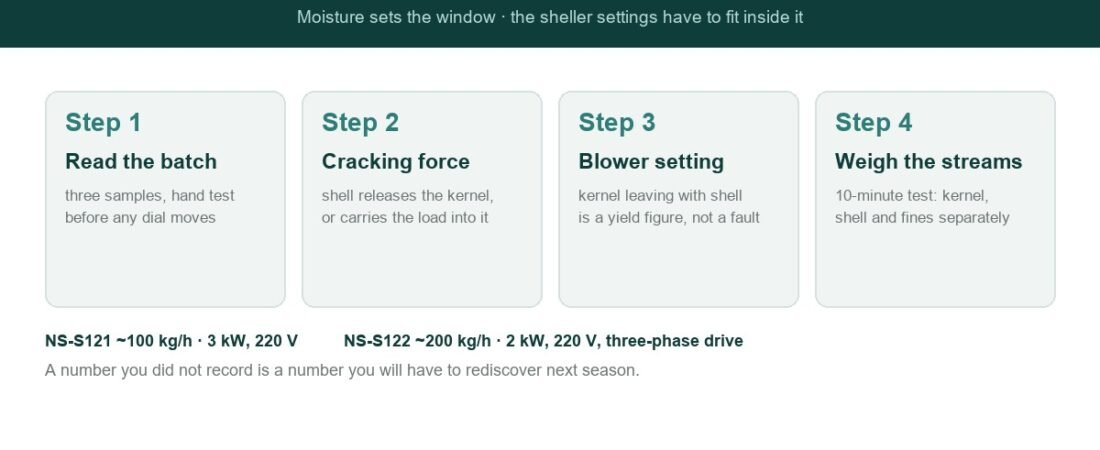
Drying and shelling are one decision, not two. The moisture you take the seed to is what sets the range of sheller settings that will work, and if the seed arrives at the sheller outside its working window, no amount of adjusting will recover the kernels you lose. This page covers what drying has to achieve in a pine nut line, how to read a batch before you set the machine, which sheller settings are worth writing down, and how the blower setting quietly decides your yield.
Last updated: 27 September 2026
The short answer
- Drying exists to create a difference, not to make the product dry. You are putting shell and kernel into a relationship where a load releases the kernel instead of shattering both.
- The sheller cannot fix a batch the dryer got wrong. Settings compensate for small variation; they do not compensate for a batch that is far outside its window.
- Two settings do most of the work: how hard the seed is cracked, and how hard the blower pulls.
- The blower is the quiet yield leak. Set too strong and kernel leaves with the shell; too weak and shell stays in the kernel. Neither shows up as a machine fault, only as a yield figure.
- Sample before you run the batch. A handful of seed, checked by hand, tells you more than any instrument reading taken at the wrong point.
- Write the settings down against the batch. A number you did not record is a number you will have to rediscover next season.
Why drying and shelling are one decision
The mechanism is the same in every nut crop, and it is worth stating plainly because it is the reason this page exists. Shell and kernel respond differently to a mechanical load, and how differently they respond is set by moisture. Get the relationship right and the shell fails along its own lines while the kernel stays intact. Get it wrong and one of two things happens:
- Too dry. The shell becomes brittle and fractures rather than separating. The fracture runs into whatever it is touching, which is the kernel.
- Too wet. The kernel becomes plastic. Instead of releasing cleanly at the shell interface it deforms under the load, and it comes out bruised, split or crushed.
Neither failure is visible on the machine. Both are visible in the output tray, which is why drying belongs in the same conversation as the sheller settings rather than in a separate one.
What drying actually has to achieve
Three things, in this order of importance:
1. A uniform batch. An average moisture figure hides a batch where half the seed is dry and half is wet. A sheller set for the average is wrong for both halves.
2. A moisture in the working window. Whatever that window turns out to be for your species and grade, it is a range rather than a number, and the machine has to be set inside it.
3. A settled batch. Moisture keeps redistributing for some hours after the dryer stops. Shelling straight out of the dryer means shelling a batch that is still changing.
The practical consequence of the third point is that “dry it, then let it stand, then shell it” is a schedule, not a delay. If your drying capacity and your shelling capacity are being sized against each other, that standing time is part of the calculation – see how to size a pine nut processing line.
Reading a batch before you set the machine
The purpose of reading a batch is not to obtain a number. It is to decide whether the batch is worth running at all, and if it is, which direction to move the settings.
Work in this order:
1. Sample from at least three places. Top, middle and discharge end, and never from the surface of the pile only. A batch that reads evenly at three points is a batch you can set the machine for.
2. Do the hand test on each sample. Press a seed between thumb and forefinger, then crack one against a hard surface. You are looking for a shell that fails cleanly along its own seam, and a kernel that comes away without a mark. A shell that shatters into small flakes is a dry signal. A kernel that dents instead of releasing is a wet signal.
3. Then take the instrument reading, on the same samples. A handheld meter measures the point where its pins are, nothing more. It is a useful record and a poor decision-maker on its own.
4. Compare the three samples against each other, not against a target. A spread between samples means the drying job is not finished, however good the average looks.
5. Give the batch its standing time. Moisture equalises across the seed for hours after the dryer stops. The length of that rest is a property of your batch and your climate; what matters is that it happens before the sheller sees the seed.
If the spread between samples is wide, stop and reconsider the drying step. Running a mixed batch through a correctly set machine still produces a mixed result, and the loss will be attributed to the sheller when it belongs to the dryer.
The two settings that do most of the work
A toothed-crusher and blower arrangement – the separation principle used on the NS-S121 and NS-S122 – gives you two adjustments that matter more than all the others combined.
Cracking force. How hard the seed is loaded as it passes the crusher. This decides whether the shell releases the kernel or carries the load into it.
Blower setting. How hard the air stream pulls across the discharge. This decides which stream – shell or kernel – leaves with the wrong material.
Read the symptom before you touch a dial:
| What you see in the output | What it usually means | What to change first |
|---|---|---|
| Kernel arrives shattered, shell in fine flakes | Force too high for the moisture | Re-check moisture, then reduce force |
| Kernels dented, split or bruised; much shell still holding | Kernel plastic: too wet | Check moisture and standing time before touching the machine |
| Good kernels, but kernel found in the shell outlet | Blower too strong | Reduce air |
| Whole shell in the kernel stream | Blower too weak | Increase air |
| Half the sample perfect, half badly damaged | Not a setting problem – a uniformity problem | Back to drying and equalising |
| Kernel quality good but fines rising over the run | Wear or clearance drift | Inspect the crusher, then reset |
A batch record that survives the season
Every one of these columns earns its place, because each is a number you will otherwise have to rediscover next season. Keep it on paper beside the machine if that is what actually gets filled in.
| Column | Why it is there |
|---|---|
| Date, lot and supplier | Ties a yield figure to the material that produced it |
| Species and seed size range | Settings do not transfer between species |
| Moisture in, moisture out, and how it was measured | The single most useful record you will keep |
| Standing time before shelling | Explains results that the moisture figure alone cannot |
| Cracking force setting | Your starting point next season |
| Blower setting | Where most yield is quietly lost or recovered |
| Throughput actually achieved | Separates machine capability from material behaviour |
| Whole kernel percentage, from a weighed sample | The only honest measure of the run |
| Notes on weather and intake condition | The pattern you will spot after two seasons |
Where the line, not the machine, sets the limit
A sheller”s published capacity is a throughput figure, not a promise about your material, and the number that matters on any given day is the capacity of the slowest stage. Two imbalances are common:
- The dryer is the bottleneck. Seed passes the sheller inside its window and yield is good, but only part of the crop gets that treatment. The loss shows up as volume left on the floor, not as a machine problem.
- The sheller is the bottleneck. Seed is dried faster than it can be shelled, so it either waits – and drifts dry – or it is run wet. Both outcomes reduce whole kernel recovery, and both look like a sheller fault.
The fix in either case is arithmetic rather than equipment. Work out the tonnes per peak day, divide by realistic running hours, apply the standing time, and see which stage falls short. That calculation is set out in how to size a pine nut processing line, and the upstream stages are covered in pine nut threshing: cones to seeds and the complete pine nut processing guide.
What to tell a supplier
If you send these five things, any supplier can give you a straight answer instead of a range:
- Species or species mix, and the seed size range you see.
- Peak daily seed volume in kilograms, and the hours you can realistically run.
- Your current drying method, and what moisture you typically finish at.
- The power supply available, and the space the machine can occupy.
- The kernels you are selling, because the grade you sell to decides how much damage is acceptable.
Frequently asked questions
What moisture should pine nut seed be at before shelling?
We do not publish a single target figure, and we would be cautious about anyone who does: the working window depends on species, seed size and shell thickness, and a number that is right for one supply is wrong for the next. The practical method is to establish your own window with a run test – take three sub-samples at different moisture levels, shell each one, and weigh the whole kernel out of each. The window is where the shell releases cleanly and the kernel comes out unmarked. Once you have found it for a species, the batch record is what makes it reusable.
Can I shell the seed without drying it first?
Only if the intake moisture already sits inside the working window, which for freshly harvested seed is unusual. Shelling wet seed damages the kernel by deformation rather than by fracture, so the loss is more subtle and usually larger: the kernels look whole on the tray and bruise later in handling. If your intake is wet, the dryer is what protects the sheller”s yield.
Why does the same setting stop working partway through the season?
Because the material changed, not the machine. Seed size, shell thickness and intake moisture all move through a harvest, and late-season seed is typically drier and more brittle than early seed. This is the reason the settings are recorded per batch rather than set once: the record tells you which way to move, and how far, the next time the material shifts.
How do I know if the blower setting is wrong?
Weigh the three streams. Run for a measured ten minutes, then weigh the kernel outlet, the shell outlet and the fines separately, and look through the shell stream for kernel and the kernel stream for shell. That inspection is the whole test, and it costs ten minutes. Most lines that believe they have a sheller problem discover a blower setting instead.
Do you supply the drying stage as well?
We build the peeling, threshing and cracking machines in this range, and we will say plainly when a requirement sits outside what we make instead of selling you something adjacent. Tell us the stages you still need and we will tell you which ones we cover and which ones you should source elsewhere.
Which threshing model suits a small operation?
The published figures are around 100 kg/h on the NS-S121 at 3 kW on 220 V, and around 200 kg/h on the NS-S122 at 2 kW on 220 V with a three-phase drive for continuous duty. Size against your peak day, not your season total, and send us your two numbers so we can confirm which one covers it.
What is the minimum order, and how quickly do you reply?
Minimum order is one unit. OEM branding and customisation are available on request, specifications are confirmed in writing before production, and we normally reply within one business day.
Start with your moisture figures
Send us your species, your seed size range and the moisture you finish drying at, and we will tell you which sheller settings to start from – and whether the honest answer is to fix the drying step before you change the machine. Reach us through the contact page.
Related reading and machines
- Pine nut processing: the complete guide
- Pine nut threshing: cones to seeds
- How to size a pine nut processing line
- Moisture in shell: drying before cracking
- Standard pine nut threshing machine, NS-S121, around 100 kg/h
- High-capacity pine nut threshing machine, NS-S122, around 200 kg/h
- All nut processing machines
- Nut processing knowledge base
- Pine nut threshing: cone breakage, cleaning and output