Sorting kernels is the cheapest lever you have on whole-kernel rate, and the manual-versus-machine question does not have one answer. Below a few hundred kilograms of kernel a day, hand sorting on a table usually beats the machine once you count what the machine costs to buy, house and run. Above that volume the arithmetic flips, and it flips for a reason that has nothing to do with technology: a person gets tired and a screen does not. This page sets out what each method actually sorts, where each one stops working, and how to work out which side of the line you are on.
Last updated: 26 September 2026
The short answer
- Grading is a size and quality decision, and it has to happen twice. Once before cracking, to narrow the size range the machine has to handle, and once after cracking, to separate whole kernels from halves, pieces and shell.
- Manual sorting wins on flexibility, not on speed. A person can reject a discoloured kernel, a double, or a piece of shell that no simple screen would catch. That judgement is what you are paying for.
- Machine sorting wins on consistency. The throughput does not drop in hour seven, and the setting that worked on Monday works on Friday.
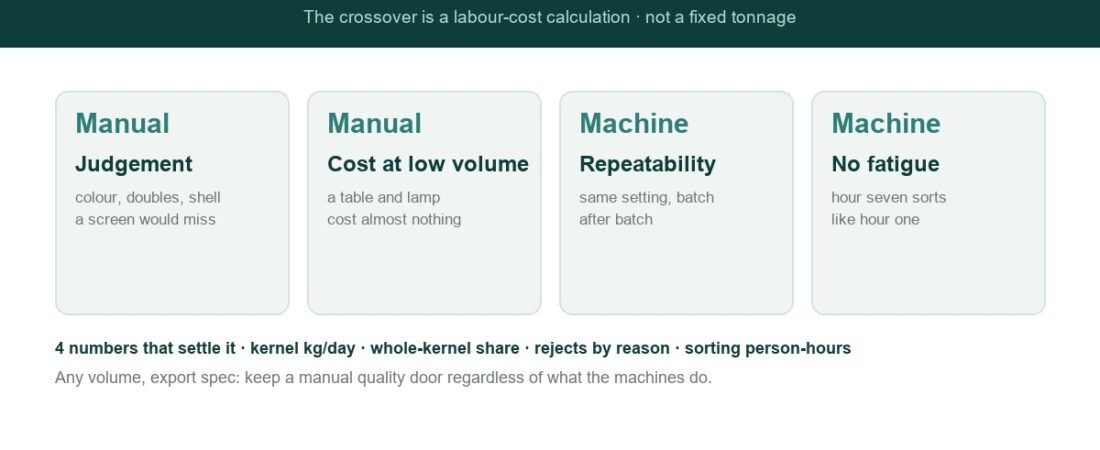
- The crossover is a labour-cost calculation, not a fixed tonnage. Work out the kilograms per hour a sorter can honestly clear, divide your daily volume by it, and multiply by what an hour of that person costs you.
- The machine cannot fix an ungraded feed. If your nuts arrive in a wide range of sizes, a sorter downstream of the cracker is sorting the consequences of a problem that starts upstream.
- Sorting does not create value by itself. It stops you destroying value you have already paid for. That is why the return is measured in whole-kernel recovery, not in throughput.
What grading actually does to your whole-kernel rate
Whole-kernel rate is a simple ratio: of the kernels released, how many came out unbroken. Every step that improves it works by removing a reason for the machine to break something.
There are only three such reasons worth engineering against:
- A size range the machine was not set for. One cracker setting cannot suit a 16 mm nut and a 22 mm nut at the same time. Whichever way you set it, one of them is wrong, and the wrong setting is what breaks kernels.
- A moisture range the shell was not prepared for. Drier shell is more brittle and shatters rather than peels. Wetter kernel is more plastic and deforms rather than splitting cleanly.
- Repeated handling of the same kernel. Every additional pass through a screw, a bucket elevator or a drop onto a hard surface is another chance to crack a kernel that survived the cracker.
Sorting addresses the first and, indirectly, the third. If you take the ungraded fraction out of the stream before it reaches the cracker, you stop one machine from doing two incompatible jobs, and you stop the operator from chasing a setting that does not exist.
If whole-kernel rate is the number you are trying to move, the measurement method matters as much as the improvement. The whole kernel rate guide covers sampling and how to compare batches honestly, and kernel recovery covers the wider moisture and dehusking picture around it.
Where manual sorting wins, and where it stops working
Manual sorting has two real advantages and neither of them is throughput.
Judgement. A person can separate on criteria that are awkward to automate cheaply: colour, shrivel, insect damage, a kernel that is the right size but the wrong shape, a nut that is clearly a double. If your buyer’s specification is written in those terms, a person is reading the actual specification.
Cost at low volume. A sorting table and good light cost a fraction of a sorter, and they cost nothing to leave idle when the season ends. For a farm cracking a few hundred kilograms of kernel a day, that is the whole calculation.
Manual sorting stops working for three predictable reasons:
- Fatigue. Attention to a slow-moving conveyor of small brown objects degrades within a couple of hours. The last hour of a shift sorts differently from the first, and that variability reaches your buyer.
- Labour availability at peak. Harvest is exactly when everyone else in the district also needs labour. A method that scales by hiring more people scales only as fast as the local labour market allows.
- The cost of an error. A single missed piece of shell in a container of kernels is a complaint. A single missed mouldy kernel is a rejected lot. The tolerance for an off day is small.
Where machine grading wins
Machine sorting earns its place when you can name the attribute you are sorting on and you can hold that attribute stable. Typical examples are size screens, density or gravity separation, and optical sorting by colour.
The advantages are the mirror image of the manual case:
- Repeatability. The same setting produces the same split, batch after batch. This is what makes a specification defensible in writing.
- Throughput that does not negotiate. A sorter sized for your line does not ask for a break, and it does not slow down because the season is busy.
- Documentation. A machine gives you a number you can put in a record – feed rate, reject rate, split point – which is the raw material of any process improvement later.
The limits are just as predictable:
- Capital, floor space and power. A sorter is a fixed cost that has to be justified over the tonnes you will actually put through it, not the tonnes you hope to.
- Setup sensitivity. A sorter set for one variety and size band will not perform on a different one without re-configuration. Somebody has to own that job.
- It sorts on what you told it to sort on. If the specification is written on attributes you did not configure, the machine will pass material that a buyer will reject.
The arithmetic: a sorter has to beat a number, not a feeling
The decision rule is worth writing down because it turns an argument into a calculation you can revisit each season.
1. Start with your kernel volume per day, in kilograms. Not nut in shell – kernel. This is usually much smaller than people expect.
2. Estimate a realistic manual rate per person per hour. Watch a real sorting table for an hour and count. Do not use a supplier’s figure.
3. Divide to get person-hours per day, then multiply by your fully loaded hourly labour cost, including the supervision and the space.
4. Compare that annual cost with the annual cost of the machine – purchase, freight, power, maintenance, and the floor space it takes.
5. Then add the cost of variability. This is the honest part of the comparison: a rejected lot, a downgraded grade, a customer who stops ordering.
If manual sorting is cheaper on steps one to four and your buyer accepts manual grading, run manual. If step five is the number that hurts, the machine has already paid for itself and the rest of the calculation is bookkeeping.
Why the machine will not rescue an ungraded feed
The most common sorting mistake we see is installing sorting capacity downstream of a crack-caused problem.
A feed with a wide size spread gives the cracker two incompatible jobs. The operator sets for the middle, the small nuts are under-cracked and the large nuts are over-cracked, and the sorter then has to separate the resulting mixture of whole kernels, halves, pieces and unshelled nuts. The sorter can do it. But you have paid to crack kernels that did not need cracking, and no downstream machine puts them back together.
Grading before the cracker narrows the range, which lets the cracker do one job properly. If you are running the standard macadamia sheller, which is published at around 600 kg/h, the machine will happily consume an ungraded feed all day – the loss shows up in the kernel tray, not in the feed hopper. The same logic applies to the purpose-built openers: the macadamia shelling machines range and the wider nut processing machines index both exist because the stage before the cracker decides what the cracker can achieve.
A practical decision rule by volume
| Daily kernel volume | Method that usually makes sense | Why |
|---|---|---|
| Up to a few hundred kg | Manual sorting table, good light, 2-3 people | Capital is close to zero and the judgement is worth more than the speed |
| A few hundred kg to roughly a tonne | Manual pre-grading door plus a size screen, then manual finish | The screen removes the bulk of the size problem cheaply; people handle the fine judgement |
| Roughly a tonne and above | Screens plus machine sorting, with a manual quality door at the end | The volume has outgrown what a local labour market can supply reliably at harvest |
| Any volume, export spec | Keep a manual quality door regardless | A machine sorts on what you configured; a buyer rejects on what they see |
Two notes on that table. First, the volumes are deliberately vague, because the crossover is set by your local labour cost and your buyer’s specification, not by a universal number. Second, the last row applies at every scale. Removing the final manual inspection is a decision to accept a specification you cannot verify.
What to measure so the decision is yours
Four numbers make the sorting decision defensible, and all four are cheap to collect:
- Kernel kilograms per day. The denominator of everything else.
- Whole-kernel share, by batch. Not an average over the season – per batch, so you can attribute a change to a cause.
- Rejects by reason. Shell, discolour, damage, undersize. The reason mix tells you whether the problem is upstream or at the table.
- Person-hours spent sorting. The number that makes the labour cost real rather than assumed.
Collect those for a fortnight and you will know more about your own line than any supplier’s brochure can tell you.
Frequently asked questions
Can one machine do both pre-cracking and post-cracking grading?
Sometimes, but the two jobs have different requirements. Pre-cracking grading is a size split and it needs to be robust and fast. Post-cracking grading is separating whole kernels from fragments and shell, and it often needs a different screen set or a different separation principle. Treating them as one purchase is how people end up with a machine that is mediocre at both.
Is manual sorting allowed for export grade?
That depends entirely on your buyer’s specification and their audit requirements, and it is a question for them rather than for us. What we would say plainly is that the specification usually describes the result, not the method. If your manual process reliably meets the result and you can document how, the method is your commercial decision.
How much does sorting actually improve whole-kernel rate?
We will not put a number on that, because it depends on your feed, your cracker setting and your moisture, and a figure quoted without those three inputs is a sales number rather than an engineering one. What we can say is the mechanism: grading before cracking removes the mismatch that forces a cracker to work outside its setting.
Do you supply sorting machines?
We build the peeling, threshing and cracking machines in this range, and we will tell you plainly when a requirement is outside what we make rather than sell you something adjacent. If sorting is your bottleneck, send us your volumes and grades and we will tell you which stages we can cover and which you should source elsewhere.
What is the minimum order, and how quickly do you reply?
Minimum order is one unit. OEM branding and customisation are available on request, specifications are confirmed in writing before production, and we normally reply within one business day.
Sizing your line around the sorting decision
If you tell us your daily kernel volume, the size spread of your feed, and what your buyer actually rejects for, we can tell you which of our machines sits either side of your sorting step – and which part of the job is better done by hand. Send those three numbers through the contact page and we will come back with a straight answer, including the parts we do not build.
Related reading and machines
- Whole kernel rate: how to measure it and the order to improve it in
- Macadamia kernel recovery: moisture, dehusking and the numbers that decide it
- Macadamia shelling machines – the range either side of the cracker
- Standard macadamia nut shelling machine, NS-X221, around 600 kg/h
- All nut processing machines
- Nut processing knowledge base
- Cashew kernel peeling without breakage
- Coffee pulping: settings and damage control