Pine nut processing is usually described as if it were one job, but the equipment does two: getting the seeds out of the cone, and getting the kernel out of the hard seed shell. The first is threshing or de-coning, the second is shelling, and a machine sold as a “pine nut threshing machine” or a “pine nut sheller” is normally doing the first while the trade names blur the two. This page separates the two jobs, puts our two threshing machines side by side on their published specifications, and then answers the question buyers actually ask: what changes when you move from about 100 kg/h to about 200 kg/h, and is the bigger one simply a scaled-up version of the smaller one. It is not, and the difference decides your freight bill.
Last updated: 24 September 2026
The short answer
- Threshing removes seed from cone; shelling removes kernel from seed shell. Different machines, different settings, and a quotation that does not distinguish them is a quotation you cannot compare.
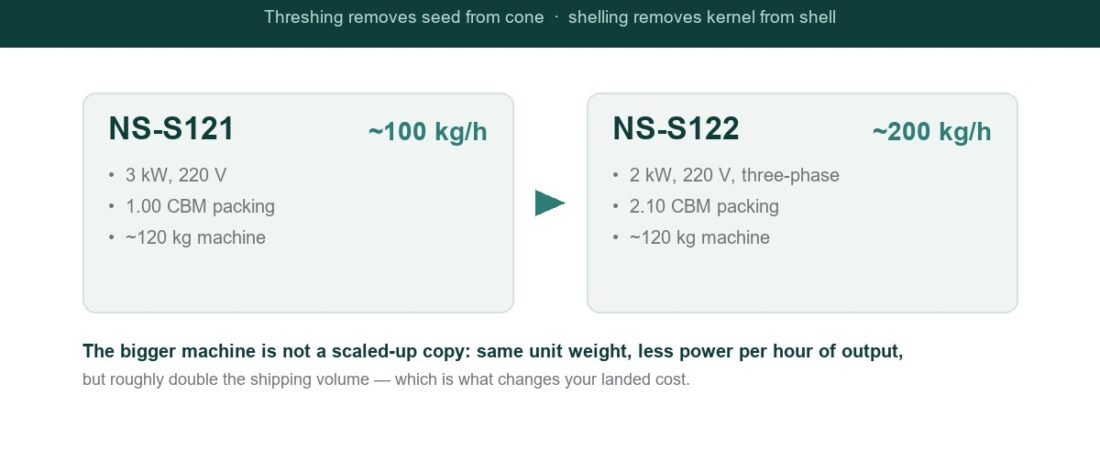
- We build two threshers: NS-S121 at about 100 kg/h on 3 kW, 220 V, and NS-S122 at about 200 kg/h on 2 kW, 220 V with a three-phase drive for continuous duty.
- Doubling capacity does not double power or weight. Both machines are about 120 kg as shipped. The high-capacity unit uses less power per hour of output, not more.
- What roughly doubles is the volume you ship. Packing volume goes from 1.00 CBM to 2.10 CBM, so on a per-unit-of-capacity basis the larger machine costs less to run and more to move.
- Size from measurement, not from a ratio. Cone-to-seed yield varies by species, origin and season, so weigh and time a representative batch of your own cones before choosing a model.
- Continuous duty is a different specification from peak capacity. If your season runs the machine all day, the three-phase, continuous-duty drive matters more than the nameplate number.
Threshing, de-coning and shelling are three different jobs
The language in this trade is loose, so fix these three terms before you compare quotations:
- Threshing or de-coning takes whole cones in and delivers seed still in its hard shell, separated from cone material and debris. The machine has to break up a fibrous, woody cone without crushing the seeds inside it. This is what our NS-S121 and NS-S122 do, using a toothed crusher followed by blower separation.
- Shelling or decortication takes seed in shell and removes the hard shell to release the kernel, usually with a cracking or splitting action followed by air separation of shell from kernel.
- Cleaning and grading then take the output and divide it by size and by shell content.
If a supplier answers “what capacity does it have” without asking which of the three jobs you are buying, the number you are given will not be the number you get on your own material.
The two machines we build, side by side
| Specification | NS-S121 (standard) | NS-S122 (high capacity) |
|---|---|---|
| Capacity | ~100 kg/h | ~200 kg/h |
| Dimensions (L x W x H) | 1,200 x 700 x 1,000 mm | 1,350 x 1,100 x 1,400 mm |
| Machine weight | ~120 kg | ~120 kg |
| Power supply | 3 kW, 220 V | 2 kW, 220 V |
| Separation | Toothed crusher plus blower separation | Toothed crusher plus blower separation |
| Drive | – | Three-phase drive for continuous duty |
| Packing volume | 1.00 CBM | 2.10 CBM |
| Packed weight | ~200 kg | ~200 kg |
Machines: NS-S121 standard pine nut thresher and NS-S122 high capacity pine nut thresher. The whole range sits under pine nut threshing machines.
What actually changes when you double capacity
Read the table twice, because it contradicts what most buyers assume.
Power goes the wrong way. The 200 kg/h machine is listed at 2 kW while the 100 kg/h machine is listed at 3 kW. That is not a typo and it is not a mistake in favour of one model. It reflects a different drive arrangement: the high-capacity unit is built for continuous duty on three-phase supply, with the throughput coming from how the crushing and separation are arranged rather than from a bigger motor. If your site has three-phase power and your season runs long shifts, that is the more efficient machine per tonne processed.
Weight does not change at all. Both units ship at about 120 kg as a machine. So the usual rule that “the bigger machine needs a stronger floor, a bigger truck and a bigger crane” does not apply here. What you need to check is the footprint, and the two differ: 1,200 x 700 mm against 1,350 x 1,100 mm. The larger machine needs meaningfully more floor space per unit, which affects how it fits into an existing shed.
Volume is where the money goes. Packing volume goes from 1.00 CBM to 2.10 CBM for an extra 100 kg/h of capacity. Ocean freight is charged on volume for light machinery like this, so on a per-unit-of-capacity basis the larger machine is the cheaper machine to run and the more expensive machine to ship. Two NS-S121 units and one NS-S122 deliver roughly the same throughput, but they do not occupy the same shipping volume, and they do not fail in the same way.
The practical question is therefore not “which is bigger” but “one machine or two”. A single larger unit has fewer parts to maintain and one drive to service. Two smaller units let you run one while the other is being maintained, and let you start production with one and add the second later. Neither answer is universally right; it depends on how your season is shaped and how far you are from a spare-parts shipment.
How to size the machine from your own harvest
Do not size from a published cone-to-seed ratio. Yield per tonne of cones varies with species, origin, cone maturity and how the cones were dried, and a ratio taken from someone else’s crop is a guess dressed as a number. Do this instead:
- Take a representative batch of cones. Not the best ones, not the worst. A batch that looks like the average of what you will actually run.
- Weigh it before and after. Run it through at your intended setting and weigh the seed that comes out. That is your own yield, for your own material, for this season.
- Time it. Record how long the batch took. Now you have both numbers you need, expressed per hour.
- Add the hours you actually run. If the line runs six hours a day, size against six hours, and check whether the machine can hold that rate for a full shift without interruption. This is where the continuous-duty drive in the NS-S122 earns its place.
- Check the bottleneck either side. A thresher that outruns your drying or your shelling stage just moves the queue.
If you are building the whole line rather than buying one machine, the same logic runs through our macadamia processing line layout guide, and the cost consequences of buying stages in the wrong order are covered in what drives the price of a macadamia processing line.
Cone preparation before threshing
- Cones need to be dry enough to open, not so dry they shatter into dust. Feed cones that still hold moisture and the crusher smears and clogs; feed cones that are brittle throughout and you create fines that the blower cannot separate cleanly.
- Sort out the obvious non-cone material before the machine. Stones and metal do more damage to a toothed crusher than any amount of cone fibre.
- Feed at a steady rate. A thresher fed in surges runs below its rated capacity on average while still absorbing the peak load, which is how drives fail early.
- Keep batches separate. Cone origin and moisture affect both throughput and the quality of separation at the outlet. Mixed batches make every later measurement meaningless.
What comes out of the machine, and what you do with it
At the outlet of a toothed-crusher thresher with blower separation you get three streams, and how clean they are decides how much labour sits downstream:
- Seed in shell, the product you want. Its cleanliness is the number to watch, because every piece of cone material that reaches the shelling stage is something you paid to move and something that can jam a cracker.
- Cone and husk fragments, lifted away by air. If this stream still carries seed, your blower setting is too aggressive.
- Fines and dust. Unavoidable in a toothed crusher, and managed by how dry the cones are and how the machine is fed.
Run the machine on a small batch and look at all three streams before you buy. A supplier who cannot show you this on your own cones is asking you to take their word for the separation quality.
Power and site requirements
- 220 V is available on both machines, which matters in sites that do not have three-phase supply. The NS-S121 runs on 3 kW, 220 V; the NS-S122 is listed at 2 kW, 220 V.
- Continuous duty is a supply question, not only a machine question. If you intend to run long shifts, confirm your supply and your distribution board can support it, and tell us the supply you have rather than the one you wish you had. Voltage customisation is available, and it is confirmed in writing before production.
- Leave service access. Both machines are compact, and both need clearance for belt checks, cleaning and clearing a jam. Design the access into the layout, not into the working day.
- Plan dust and cleaning. A thresher produces fines. Decide where they go before the first shift, not after the first complaint.
What we need from you to quote accurately
Send us these five things and you will get a specification you can compare against other suppliers rather than a generic price:
- The material you process (pine nut seed, other nuts, or a mix)
- Your target output per hour or per day, and the hours you run per day
- Whether your input is whole cones or seed in shell
- Your power supply: 220 V single phase or 380 V three phase
- Your destination port or country
Minimum order quantity is one unit. OEM branding and customisation are available on request, and specifications are confirmed in writing before production. Dongguan Nansheng Technology Co., Ltd., Dongguan, Guangdong, China. Request a quotation.
Frequently asked questions
What is the difference between a pine nut threshing machine and a pine nut shelling machine?
A threshing machine takes whole cones in and delivers seed still in its hard shell, separating the seed from cone fibre and debris. A shelling machine starts from seed in shell and removes that shell to release the kernel. Our NS-S121 and NS-S122 are threshers operating on a toothed crusher with blower separation.
How much power does a pine nut threshing machine need?
The two models we build are listed at 3 kW, 220 V for the NS-S121 at about 100 kg/h and 2 kW, 220 V for the NS-S122 at about 200 kg/h. The higher-capacity unit is arranged for continuous duty on a three-phase drive, so the drive arrangement matters as much as the nameplate rating.
Can one machine handle both threshing and shelling?
Not on the machines we build. They are separate stages with different mechanisms, and trying to combine them usually means compromising the separation at the outlet of both. Plan them as two stages in sequence.
How do I know which capacity I need?
Measure it: weigh a representative batch of your own cones, run it through at your intended setting, weigh the seed that comes out, and time the run. Size against the hours you actually operate, then check that drying and shelling either side can keep up.
What is the packing volume for shipping?
1.00 CBM for the NS-S121 and 2.10 CBM for the NS-S122, with packed weights of about 200 kg for both. Volume is usually the deciding factor for ocean freight on machinery of this size.
Related reading and machines
- Pine nut threshing machine – standard (NS-S121, ~100 kg/h, 3 kW, 220 V)
- Pine nut threshing machine – high capacity (NS-S122, ~200 kg/h, 2 kW, 220 V, three-phase)
- All pine nut threshing machines
- Macadamia processing line layout: harvest to packed kernel
- Nut in shell moisture content: the drying target before cracking
- All nut and coffee processing machines
- Nut processing knowledge base
- Pine nut processing: complete guide
- Pine nut drying and shelling settings
- Voltage and power requirements for export
- Pine nut threshing: cone breakage, cleaning and output
Related reading: what drives the price of a nut processing line and shelling vs opening machines: which one do you need.