A pine nut thresher has to do two jobs that pull against each other: open a dried cone completely, and release the seeds inside it without turning those seeds into fragments. Most of the practical difficulty in pine nut threshing sits in that tension, and most of the arguments about “the machine is not performing” turn out to be arguments about cone condition, settings and the separation stage rather than about the crusher itself.
This page covers where cone breakage comes from, how the cleaning stage decides how much of the output is actually saleable seed, and how to measure output so a setting change can be judged on numbers instead of impressions. Every machine figure quoted here is a figure we publish in our own catalogue; everything else is described as a method, because the right number depends on your cones.
Last updated: 30 September 2026
The short answer
- A thresher is a breaking stage plus a separation stage, and output is decided by both. Changing the crusher without checking the blower usually moves the loss from one place to another.
- Cone condition sets the achievable result. Cone size, dryness and storage time change what the same setting can deliver, so a setting that worked last month is not automatically right this month.
- Breakage and throughput move in opposite directions. Every change that raises throughput is checked against a seed sample before it is kept.
- Cleaning is where the recoverable fraction is decided. Seed that leaves with the debris has been processed and then thrown away.
- Measure three numbers per shift: cone weight in, seed weight out, and a breakage sample. Without those three, no setting change can be compared with any other.
- Our two published models differ in capacity, not in working principle – NS-S121 at around 100 kg/h on 3 kW, 220 V, and NS-S122 at around 200 kg/h with a three-phase drive for continuous duty.
What a pine nut thresher actually does
The machine is easiest to reason about as three stages in series, each of which can be adjusted and each of which can lose output.
- Breaking. Material enters the toothed crusher, which opens the cone. The clearance and the feed rate together decide how hard the cone is worked.
- Separation. A blower separates the lighter cone material and debris from the heavier seed. Air volume and the discharge arrangement decide how clean that split is.
- Discharge. Seed leaves one way and debris the other. How those two outlets are arranged decides whether the operator can see what is happening at all.
The consequence for troubleshooting is simple: if seed is coming out broken, the crusher is only one of the suspects, and if seed is missing from the output, the crusher is usually not the suspect at all. Both of our pine nut threshing machines use the same arrangement – a toothed crusher plus blower separation – so the operating logic below applies to either model.
Cone breakage: where it comes from
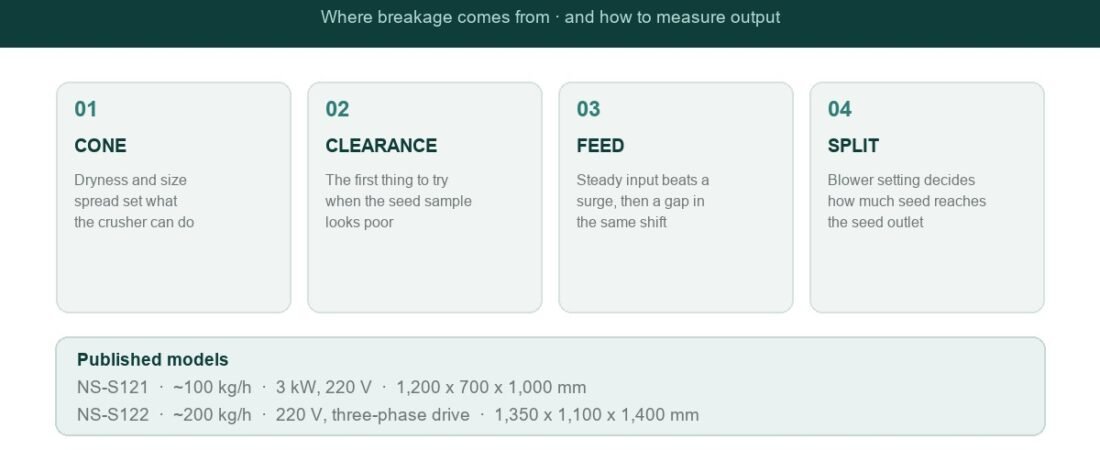
Breakage is not a single fault. In practice it arrives from four directions, and they are addressed in different places.
| Source of breakage | What it looks like | Where the correction is made |
|---|---|---|
| Crusher clearance too tight for the cone | A high proportion of split or fragmented seed in the sample | Crusher setting, checked against a sample rather than by feel |
| Feed rate too high | Breakage rises as the machine is pushed, and the sample gets worse as the shift goes on | Feed control – steady input, not a surge followed by a gap |
| Cone moisture and dryness spread | Some cones shatter and some resist in the same batch | Cone preparation and storage, before the machine |
| Re-crushing in the separation stage | Sound seed returned to the crusher or held too long in the air stream | Blower setting and the discharge arrangement |
The last row is the one most often missed. A separation stage that is set too aggressively will lift good seed into the debris stream, and a separation stage that is set too gently will leave cone material in the seed. Both look like a crusher problem from the output pile, and neither is fixed at the crusher.
Dryness and storage: the variables that arrive with the cone
A thresher meets whatever the cones are, not what the specification assumed. Three properties matter most, and all three are decided before the machine is switched on.
- Dryness. Cones that are still green resist opening and tend to tear rather than split, while very dry cones shatter. The working band is narrow, which is why pine nut processing lines usually place drying ahead of threshing.
- Cone size spread. A batch with a wide size range cannot be served well by one clearance. Where the range is wide, the practical answer is sorting the batch, not tightening the machine.
- Storage history. Cones held warm and damp behave differently from cones held cool and dry, even when a moisture reading looks similar. The reading is a single number and the cone is not.
How to handle this without guessing is covered in the drying and shelling settings page linked at the end of this article.
Settings that trade throughput against breakage
The table below describes the direction of each adjustment, not a recommended value. Recommended values follow from your cone and your seed sample, and are settled with a sample in hand.
| Adjustment | Effect on throughput | Effect on breakage | Practical note |
|---|---|---|---|
| Open the crusher clearance | Falls | Falls | The first thing to try when the sample is poor |
| Increase feed rate | Rises | Rises | Judged against a sample taken at that feed rate, not the previous one |
| Increase air volume | Rises slightly | Can rise | Lifts good seed if set past the point where the split is clean |
| Reduce air volume | Falls | Falls | Debris then carries through to the seed outlet |
| Run dry cones | Rises | Rises | Fragmentation replaces tearing; the loss changes shape, not size |
| Run green cones | Falls | Rises | Tearing rather than splitting, and the crusher works harder for less |
The rule that keeps this manageable is to change one adjustment, take a sample, weigh the output and only then decide. Two adjustments at once produce a result that cannot be attributed to either.
Measuring output and recovery
A thresher’s performance is only visible if three numbers are recorded per shift. They take a few minutes and they are the difference between operating on evidence and operating on impressions.
| Measurement | How it is taken | What it tells you |
|---|---|---|
| Cone weight in | Weigh the batch before it is fed | The denominator for everything else |
| Seed weight out | Weigh the seed outlet over the same period | The actual recovery figure for that setting |
| Breakage sample | Take a fixed-size sample from the seed outlet and separate sound from broken seed | Whether the recovery figure was earned or borrowed from the seed |
Once those three exist, comparisons become possible: the same cone, two settings, and a decision that can be defended. It also shows up losses that no single number reveals – a recovery figure that holds steady while the breakage sample worsens is a machine being pushed past its setting, and a recovery figure that falls while breakage is unchanged is a separation problem.
Published machine data
The figures below are the published values from our own catalogue for the two pine nut threshing machines we supply. Both use a toothed crusher with blower separation. Where a site’s requirement falls outside these figures – a different supply, a different duty cycle – the configuration is confirmed in writing before production rather than assumed.
| Machine | Model | Capacity | Power supply | Dimensions (L x W x H) | Packing volume |
|---|---|---|---|---|---|
| Pine nut threshing machine, standard | NS-S121 | ~100 kg/h | 3 kW, 220 V | 1,200 x 700 x 1,000 mm | 1.00 CBM |
| Pine nut threshing machine, high capacity | NS-S122 | ~200 kg/h | 2 kW, 220 V, three-phase drive for continuous duty | 1,350 x 1,100 x 1,400 mm | 2.10 CBM |
Both models are quoted as packed weights of around 200 kg and both use the same working principle, so the choice between them is a choice about throughput and duty cycle rather than about the kind of work the machine does. The sizing page linked below covers how to arrive at a capacity figure from your own cone supply.
Running a thresher as part of a line
A thresher rarely works alone, and two of its neighbours change how it behaves.
- Drying ahead of it decides whether the crusher tears or shatters, which is why the dryness band belongs to the line design rather than to the machine settings.
- Separation and sorting after it decide how much of what the thresher releases is actually recovered as saleable seed.
This is the reason a performance problem is worth checking along the whole line before the thresher is adjusted. A line that is sized to the wrong throughput will show its first symptom at the machine that is working hardest, which is often the thresher, even when the cause is upstream or downstream of it.
What to check before you buy
Four questions decide most of the specification, and answering them before the enquiry saves a round of correspondence.
- What cone supply do you have, and how is it dried? The answer sets the working band the machine has to hold.
- What throughput do you need, and for how many hours a day? Capacity and duty cycle together decide between a standard and a high-capacity model.
- What power supply is available at the installation position? Voltage, phases and frequency are part of the configuration.
- How will you measure output? If there is no weighing and sampling routine planned, the first setting change will be a guess.
With those four answered, the machine specification is a short conversation rather than a negotiation.
Frequently asked questions
How do I stop pine nut seeds breaking in the thresher?
Work from the crusher clearance outwards, and change one thing at a time. Open the clearance and re-sample; if breakage falls and throughput is still acceptable, that was the problem. If breakage stays high, check the feed rate for surges and check that the separation stage is not returning sound seed to the crusher. A fixed-size sample from the seed outlet after every change turns this into a sequence of decisions.
Does a higher-capacity thresher break more seed?
Not by design. Capacity is a figure for how much material the machine can be fed in a given time, and both of our published models use the same toothed crusher and blower arrangement. What breaks seed is feeding a machine past the setting it is running at, or feeding cones outside the dryness band the setting was chosen for. A high-capacity model fed steadily at a sensible rate behaves like a standard model fed steadily at a sensible rate.
What cone moisture should I aim for before threshing?
There is no single figure we would publish, because the right band depends on the cone, the variety and the drying method. What matters operationally is consistency: measure the batch, run it, and weigh the output and the breakage sample. Then a change in the drying routine can be judged against a result instead of an opinion. Our drying and shelling settings article covers how to build that routine.
Why is seed coming out with cone material still attached?
That points at the separation stage rather than the crusher. If air volume is set low, the split is not clean and lighter cone material carries through to the seed outlet, while if it is set high, good seed is lifted into the debris. Adjust air volume in small steps and watch the seed outlet rather than the debris outlet, because the debris outlet always looks busy. Both published models use blower separation.
Can the thresher be used for other nuts?
The machines are built as pine nut threshers, with a toothed crusher and blower separation sized for that job. Other crops differ in shell strength, seed size and how they fail under load, so the arrangement that suits a pine cone is not automatically right elsewhere. If you want to run a different crop, describe the material and the target output in the enquiry and the configuration is confirmed in writing.
What is the minimum order, and how quickly do you reply?
Minimum order is one unit. OEM branding and customisation are available on request, specifications are confirmed in writing before production, and we normally reply within one business day.
Tell us about your cones and your target output
Send us the cone supply you are working with, how it is dried, the throughput you need in kg/h and the power supply at the installation position, and we will tell you which model fits and what to check before it is installed. Reach us through the contact page.
Related reading and machines
- Pine nut threshing machine, standard model NS-S121
- Pine nut threshing machine, high capacity model NS-S122
- Pine nut threshing machines range
- How to size a pine nut threshing machine
- Pine nut drying and shelling settings
- How to size a pine nut processing line
- Pine nut processing: complete guide
- All nut processing machines